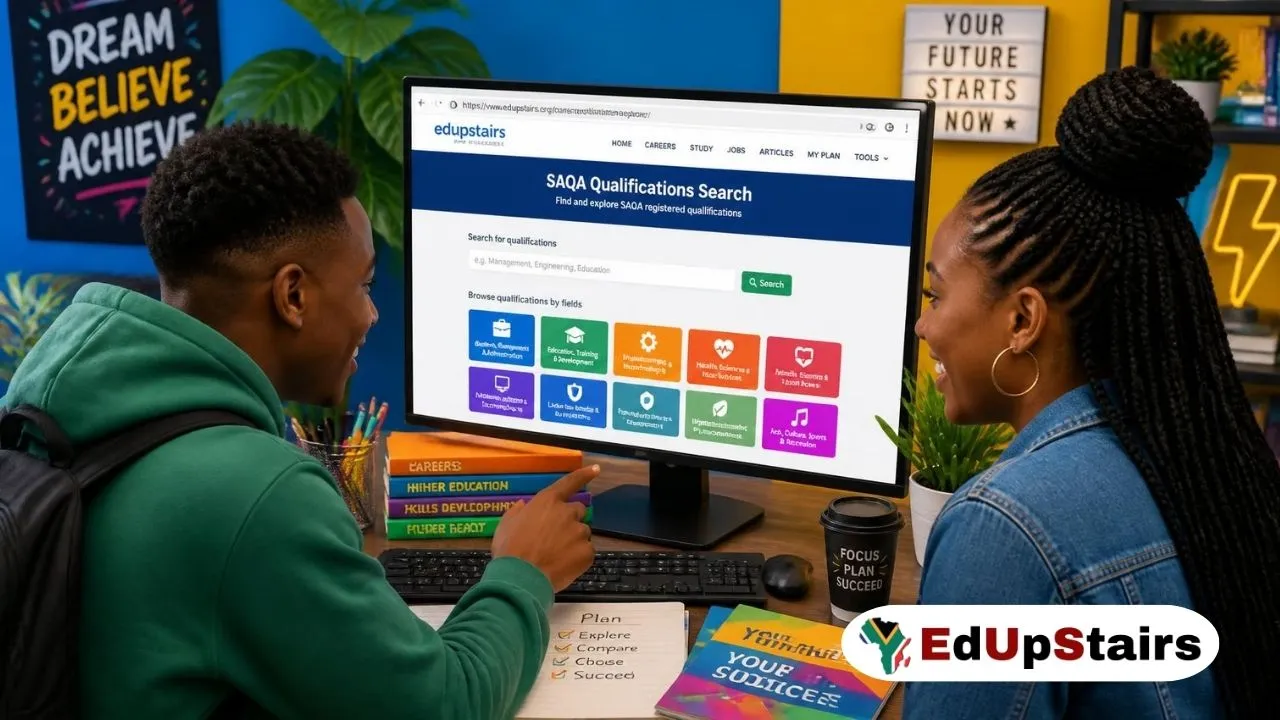

If you are planning to study in 2027, one of the most important checks you should make before applying to a university, TVET college, private college or training provider is whether the qualification you want to study is recognised within South Africa’s education and training system.
A course may sound impressive. An institution may advertise it as “accredited”. You may even be promised that the qualification will help you find employment.
But before paying an application, registration or tuition fee, you should investigate the qualification properly.
Is the qualification registered on the National Qualifications Framework (NQF)? Does it have a SAQA ID? What is its NQF level? How many credits does it carry? Is the institution or training provider actually authorised or accredited to offer the programme?
For students, parents and job seekers preparing for 2027, Edupstairs has made the first part of this research considerably easier through the Career & Qualification Explorer.
Search SAQA Qualifications on Edupstairs
The Edupstairs Career & Qualification Explorer allows users to search South African careers and SAQA qualification records from one platform.
At the time of writing, the Explorer contains:
- 22,667 SAQA qualification records
- 1,511 OFO careers
- 726 careers with qualification mappings
- 2,230 career-to-qualification links
This means you can search for a qualification you are considering and also investigate careers that may be associated with particular study pathways.
Explore here: https://www.edupstairs.org/career-qualification-explorer/
You can search by:
- Qualification name
- Career
- OFO occupation
- SAQA ID
This is particularly useful for learners completing Grade 12, TVET College students, graduates considering further study, unemployed young people researching skills programmes, and adults considering a career change.
What Does SAQA Accreditation Actually Mean?
The term “SAQA accredited” is commonly used by colleges, training providers and students, but it can be misleading.
SAQA stands for the South African Qualifications Authority.
SAQA plays a central role in overseeing the National Qualifications Framework and registering qualifications and part-qualifications on the NQF.
However, there is an important distinction between:
the registration of a qualification
and
the accreditation or authority of an institution/provider to offer that qualification.
A qualification appearing on the NQF does not automatically prove that every college or training company advertising that qualification is permitted to offer it.
Therefore, when people search online for:
- SAQA accredited qualifications
- SAQA accredited courses
- SAQA registered qualifications
- accredited qualifications South Africa
- SAQA accredited colleges
they should actually perform two checks.
Check 1: Is the qualification registered?
Check the qualification itself and establish whether it is appropriately registered on the National Qualifications Framework.
Check 2: Is the provider authorised to offer it?
Then investigate the university, TVET college, private college or training provider offering the programme.
Both checks matter.
What Is the National Qualifications Framework?
The National Qualifications Framework (NQF) is the system South Africa uses to organise recognised qualifications according to levels of learning achievement.
South Africa’s NQF has 10 levels.
In broad terms:
| NQF Level | Typical Qualification |
| NQF Level 1 | General Certificate |
| NQF Levels 2–4 | Vocational and occupational qualifications |
| NQF Level 4 | National Senior Certificate / NC(V) Level 4 |
| NQF Level 5 | Higher Certificate |
| NQF Level 6 | Diploma / Advanced Certificate |
| NQF Level 7 | Bachelor’s Degree / Advanced Diploma |
| NQF Level 8 | Honours Degree / Postgraduate Diploma |
| NQF Level 9 | Master’s Degree |
| NQF Level 10 | Doctoral Degree |
These descriptions should be treated as general guidance rather than a substitute for checking the individual qualification.
Always investigate the actual qualification record.
How to Find SAQA Qualifications for 2027
Finding a qualification through the Edupstairs Career & Qualification Explorer is straightforward.
Step 1: Open the Career & Qualification Explorer
Visit: https://www.edupstairs.org/career-qualification-explorer/
The platform combines careers and qualifications instead of requiring students to research them completely separately.
Step 2: Search for the Qualification
Enter the qualification or study field you are considering.
For example:
- Diploma in Supply Chain Management
- Bachelor of Education
- Higher Certificate
- Information Technology
- Accounting
- Electrical Engineering
- Human Resources
- Nursing
- Public Management
- Occupational Certificate
The database contains qualifications at different NQF levels and across numerous fields.
Step 3: Look for the SAQA ID
One of the most useful pieces of information when researching a qualification is its SAQA ID.
Do not rely only on the name of a qualification.
Different qualifications can have similar names, and qualifications can differ in NQF level, credit value, registration history and purpose.
The SAQA ID helps identify the specific qualification record you are investigating.
Step 4: Check the NQF Level
Next, check the qualification’s NQF level.
For example, the Edupstairs database includes records ranging from occupational certificates to Higher Certificates, Diplomas, Bachelor’s Degrees, Honours qualifications and postgraduate programmes.
Knowing the NQF level helps you understand where the qualification sits within the South African qualifications framework.
Step 5: Check the Credits
Look at the qualification’s credit value where this information is available.
For example, a qualification record may show: SAQA ID → NQF Level → Credits
Credits are important because they form part of the formal structure of the qualification.
Do not assume that two qualifications with similar names are identical simply because they are both described as Diplomas or Certificates.
Step 6: Check the Current Registration Status
This is especially important when planning to enrol in 2027.
Qualification records can have registration periods, registration end dates, last dates for enrolment and last dates for achievement.
A qualification may also have been replaced by a newer qualification.
Therefore, finding an old SAQA ID on a website or advertisement is not enough.
Check the current official registration information before enrolling.
For final confirmation, students should consult SAQA’s official qualification records.
Registered Does Not Always Mean Currently Open for New Enrolments
This is an important detail for 2027 applicants.
South Africa has thousands of qualification records, including qualifications registered during different periods.
Some qualifications may have passed their registration end date or may be in a teach-out period.
Others may have been replaced.
SAQA’s official qualification database distinguishes between qualifications that are currently registered and qualifications that have passed their registration end date.
Therefore, students should pay particular attention to:
- Registration status
- Registration start date
- Registration end date
- Last date for enrolment
- Last date for achievement
- Replacement qualifications, where applicable
This becomes especially important when an institution is advertising an older qualification.
Search by Career Instead of Qualification
One of the strongest features of the Edupstairs Career & Qualification Explorer is that you do not necessarily need to know the name of a qualification before starting.
You can start with a career.
For example, you could search for:
- Electrician
- Teacher
- Nurse
- Software Developer
- Plumber
- Welder
- Accountant
- Human Resources
- Marketing Manager
- Traffic Officer
The Explorer contains 1,511 OFO careers alongside more than 22,600 SAQA qualification records.
This creates a different approach to career planning.
Instead of starting with:
“What can I do with this qualification?”
you can start with:
“What career do I want to pursue?”
You can then investigate qualifications and study pathways that may be associated with that occupation.
Explore careers and qualifications:
https://www.edupstairs.org/career-qualification-explorer/
SAQA Qualification Does Not Automatically Guarantee a Job
Finding a qualification related to a career does not mean completing that qualification automatically guarantees employment.
It also does not necessarily mean the qualification alone allows you to practise the occupation.
Some South African careers are regulated.
Depending on the profession or trade, additional requirements may include:
- Professional registration
- Candidacy
- Workplace experience
- Internship
- Community service
- Practical training
- Trade testing
- Board examinations
- Professional examinations
- Licensing
- Statutory registration
For example, becoming qualified academically and becoming professionally registered can be separate processes.
Students should therefore research the complete career pathway, not simply the qualification.
Also Explore Universities on Edupstairs
Once you have identified the type of qualification or career you want, the next question is:
Where can I study?
Edupstairs has developed a University Explorer that helps prospective students research South African universities and their programmes.
Explore universities: https://www.edupstairs.org/universities/
Published university hubs can include information such as:
- Undergraduate programmes
- APS requirements
- Required school subjects
- Programme duration
- Programme codes
- Application information
- Application closing dates
- NBT requirements where applicable
- NSFAS and funding guidance
- Prospectuses
- Official student resources
This allows prospective 2027 students to move through a logical research process:
Choose career → identify qualification → find institution → check admission requirements → apply.
Explore Public TVET Colleges for 2027
University is not the only pathway.
Students interested in vocational, technical, occupational and artisan-related education can also use the Edupstairs TVET Colleges Explorer.
Explore TVET Colleges:
https://www.edupstairs.org/tvet-colleges/
Edupstairs TVET College pages can help prospective students research:
- NC(V) programmes
- NATED / Report 191 programmes
- Occupational programmes
- Skills programmes
- Admission requirements
- College campuses
- 2027 application information
- Fees and NSFAS resources
- Past examination papers and memoranda
This can be particularly valuable for learners interested in engineering, business studies, hospitality, tourism, agriculture, ICT, trades and other vocational pathways.
Explore SETA Qualifications, Learnerships and Apprenticeships
Another useful Edupstairs resource for anyone researching qualifications is the SETA Platform.
South Africa has 21 Sector Education and Training Authorities (SETAs) covering different economic sectors.
The Edupstairs SETA Platform brings these SETAs and their programme pathways together.
Explore the SETA Platform: https://www.edupstairs.org/seta-platform/
The platform includes more than 1,000 programmes across multiple industries and NQF levels.
Users can explore opportunities and pathways such as:
- Learnerships
- Apprenticeships
- Skills programmes
- Occupational qualifications
- Work Integrated Learning
- Internships
- Bursaries and funding
- Artisan development
- Recognition of Prior Learning
- Workplace experience
- Digital and 4IR skills
- Entrepreneurship programmes
- Graduate programmes
There is also a qualification catalogue containing hundreds of records grouped across NQF levels.
This makes the SETA Platform particularly useful for students who want a more workplace-focused route into a career.
SAQA Qualifications vs SETA Programmes
It is useful to understand the relationship between these systems.
SAQA and the NQF help provide the national framework within which qualifications are registered.
SETAs operate within specific economic sectors and support skills development initiatives.
Depending on the sector, these may include learnerships, apprenticeships, bursaries, workplace experience, skills programmes and occupational pathways.
For example, someone interested in an ICT career could investigate relevant qualifications through the Career & Qualification Explorer and then investigate sector-specific opportunities through the SETA Platform.
This provides a much broader view of the pathway into employment.
What About Higher Certificates?
Higher Certificates can be useful entry-level higher education qualifications.
They are generally associated with NQF Level 5, although students should always check the actual qualification record.
A Higher Certificate may be useful for someone who:
- Does not currently qualify for their preferred Diploma or Degree
- Wants an introductory higher education qualification
- Wants specialised knowledge in a particular field
- Intends to pursue further study later
However, articulation into another qualification is not automatic.
Always check the admission and progression requirements of the institution concerned.
What About Diplomas?
Diplomas remain an important study pathway in South Africa.
A Diploma is generally associated with NQF Level 6, while an Advanced Diploma is generally associated with NQF Level 7.
Diploma programmes exist across fields such as:
- Engineering
- Information Technology
- Accounting
- Supply Chain Management
- Logistics
- Human Resources
- Public Management
- Marketing
- Tourism
- Agriculture
- Business
- Health-related disciplines
Again, students should search for the specific qualification rather than relying solely on the word “Diploma”.
What About Degrees?
Bachelor’s Degrees generally sit at NQF Level 7, although certain professional Bachelor’s Degrees may be positioned differently depending on their structure.
Degrees are available across fields including:
- Engineering
- Education
- Law
- Commerce
- Health Sciences
- Agriculture
- Humanities
- Science
- Information Technology
- Social Sciences
If you are applying to university for 2027, identifying a qualification is only the beginning.
You must also check the university’s:
- APS requirements
- Subject requirements
- Closing date
- Additional selection requirements
- NBT requirements where applicable
- Portfolio, interview or audition requirements where applicable
Use the Edupstairs University Explorer to research available programmes.
What About NC(V) Qualifications?
The National Certificate (Vocational) is an important pathway within South Africa’s TVET system.
NC(V) programmes generally progress through:
- NC(V) Level 2
- NC(V) Level 3
- NC(V) Level 4
Students should be careful not to confuse an NC(V) programme level with an NQF level.
For example, NC(V) Level 4 is associated with NQF Level 4.
Students considering an NC(V) pathway can use the Edupstairs TVET Colleges Explorer to compare colleges and programmes.
Be Careful of Fake Colleges and Misleading Accreditation Claims
One of the biggest reasons to research a qualification before enrolling is to protect yourself from misleading education advertisements.
Be cautious if a provider:
- Refuses to provide the full qualification name
- Cannot provide a SAQA ID where one should exist
- Uses vague statements such as “internationally accredited” without explaining the accreditation
- Claims every course is “SAQA approved”
- Guarantees employment after completing the programme
- Pressures you to pay immediately
- Cannot clearly identify the awarding body
- Cannot explain which Quality Council or regulator oversees the programme
- Advertises a qualification whose registration status cannot be confirmed
- Uses the logo of a government body without clear evidence of a legitimate relationship
Do not pay simply because an advertisement looks professional.
Investigate first.
The Difference Between a Qualification and a Short Course
Not every useful course is a full qualification.
This distinction matters.
A provider may offer a short course that teaches valuable skills but does not lead to a full NQF-registered qualification.
That does not automatically make the course worthless.
The problem arises when a short course is marketed as though it were a nationally registered qualification when it is not.
Before enrolling, ask:
What exactly will I receive when I finish this programme?
Will you receive:
- A full qualification?
- A part-qualification?
- An occupational qualification?
- A skills programme?
- A statement of results?
- A certificate of completion?
- A provider certificate?
These are not necessarily the same thing.
Which Quality Councils Should Students Know?
South Africa’s NQF operates through different sub-frameworks and Quality Councils.
Important bodies include:
Council on Higher Education (CHE)
Relevant to the higher education environment.
Umalusi
Relevant to qualifications within the General and Further Education and Training Qualifications Sub-Framework.
Quality Council for Trades and Occupations (QCTO)
Relevant to occupational qualifications and the occupational training environment.
Which authority you need to consult depends on the qualification and provider you are investigating.
A 10-Point Qualification Check Before You Pay
Before paying a college or training provider for a programme in 2027, ask these questions:
- What is the full registered name of the qualification?
- What is its SAQA ID?
- What NQF level is it?
- How many credits does it carry?
- What is its current registration status?
- What is the last date for enrolment?
- Which institution or provider will deliver the programme?
- Is that provider appropriately registered or accredited to offer it?
- Does the qualification support the career I want to pursue?
- Will I need professional registration, workplace experience, a trade test or additional study afterwards?
If a provider cannot give clear answers to basic questions about the qualification it is selling, investigate further before paying.
A Better Way to Plan Your Studies for 2027
Instead of choosing a college first and then looking at whatever courses it advertises, consider reversing the process.
Step 1: Choose a career
Use the Edupstairs Career & Qualification Explorer to investigate occupations.
Step 2: Research the qualification pathway
Determine what qualifications may lead towards the career.
Step 3: Check the NQF information
Look at the SAQA ID, NQF level and credits.
Step 4: Find institutions offering the programme
Use the Edupstairs University Explorer or TVET Colleges Explorer where relevant.
Step 5: Investigate alternative pathways
Use the SETA Platform to explore learnerships, apprenticeships, occupational qualifications, bursaries and workplace programmes.
Step 6: Verify everything officially
Before paying or enrolling, confirm the current qualification and provider information with SAQA, the relevant Quality Council, professional body, DHET and/or institution where applicable.
This approach connects career planning, qualifications, education providers and workplace opportunities rather than treating them as separate decisions.
Tools you may find useful:
- SETA Platform
- RDP / BNG Housing Eligibility Checker
- SASSA Grant Eligibility Checker
- SAPS / Metro / Traffic / DCS Eligibility Checker
- Youth Employment Eligibility Checker
- SA Bursary & NSFAS Eligibility Checker
- UIF Benefits Eligibility Checker and Payment Estimator
View Other Employment Opportunities here
Need Help?
Edupstairs Advice for 2027 Applicants
Do not start your education journey by asking:
“Which course can I register for?”
Start by asking:
“What career am I trying to build?”
Then work backwards.
Find the career.
Identify possible qualification pathways.
Check the SAQA qualification information.
Understand the NQF level.
Find reputable institutions offering the programme.
Check the institution’s admission requirements.
Investigate funding.
Explore SETA opportunities where relevant.
And finally, confirm the qualification and provider with the appropriate official authorities before paying any money.
The Edupstairs platforms can help you bring much of this research together.
Career & Qualification Explorer
https://www.edupstairs.org/career-qualification-explorer/
Search thousands of SAQA qualification records and explore their relationship with South African careers.
University Explorer
https://www.edupstairs.org/universities/
Explore university courses, APS requirements, applications and student resources for 2027.
TVET Colleges Explorer
https://www.edupstairs.org/tvet-colleges/
Explore South Africa’s public TVET Colleges, programmes, campuses, admission information and application resources.
SETA Platform
https://www.edupstairs.org/seta-platform/
Explore all 21 SETAs and discover qualifications, learnerships, apprenticeships, WIL programmes, bursaries, skills programmes and other workplace development opportunities.
Frequently Asked Questions About SAQA Qualifications for 2027
-
Where can I search for SAQA qualifications?
You can start with the Edupstairs Career & Qualification Explorer: https://www.edupstairs.org/career-qualification-explorer/
For authoritative confirmation of registration status, consult SAQA’s official qualification database.
-
How many SAQA qualifications are available on Edupstairs?
At the time of writing, the Edupstairs Career & Qualification Explorer contains 22,667 SAQA qualification records.
-
What is a SAQA ID?
A SAQA ID is an identifying number associated with a qualification record. It is useful when distinguishing between qualifications that may have similar names.
-
How do I know if a qualification is accredited?
Start by checking whether the qualification is appropriately registered on the NQF. Then separately confirm whether the institution or provider is authorised or accredited to offer that particular programme.
-
Is a SAQA-registered qualification automatically accredited at every college?
No. Registration of the qualification and accreditation or authority of the provider are separate issues. Always investigate both.
-
Can I search qualifications by career?
Yes. The Edupstairs Career & Qualification Explorer combines OFO careers with qualification records and mapped career-to-qualification pathways.
-
Can I search by SAQA ID?
Yes. The Edupstairs Career & Qualification Explorer supports searches using a qualification, career, OFO occupation or SAQA ID.
-
What NQF level is a Higher Certificate?
Higher Certificates are generally positioned at NQF Level 5.
-
What NQF level is a Diploma?
Diplomas are generally positioned at NQF Level 6, while Advanced Diplomas are generally positioned at NQF Level 7.
-
What NQF level is a Bachelor’s Degree?
Bachelor’s Degrees are generally associated with NQF Level 7, although some professional Bachelor’s Degrees may be positioned at NQF Level 8.
-
Can I find TVET qualifications on Edupstairs?
Yes. Students can use the Edupstairs TVET Colleges Explorer to investigate public TVET Colleges, NC(V), NATED, occupational and other programmes.
Visit: https://www.edupstairs.org/tvet-colleges/
-
Can I find SETA qualifications on Edupstairs?
Yes. The Edupstairs SETA Platform brings together all 21 SETAs and more than 1,000 programme records and pathways across sectors and NQF levels.
Visit: https://www.edupstairs.org/seta-platform/
-
Does a registered qualification guarantee employment?
No. A qualification can improve your knowledge and eligibility for certain career pathways, but it does not guarantee employment.
-
Do I still need to check the institution?
Absolutely. Finding a registered qualification does not prove that every provider advertising it is authorised to offer it.
-
What should I check before applying for 2027?
Check the qualification, SAQA ID, NQF level, credits, current registration status, provider, accreditation or registration status, admission requirements, costs, funding options and potential career pathway.
Our Conclusion: Check Before You Register for 2027
Choosing a qualification can affect several years of your life and potentially thousands of rands in education costs.
Do not make that decision based only on an advertisement.
Before registering for 2027, investigate the qualification’s SAQA ID, NQF level, credits and registration status. Then verify the institution or training provider offering it.
Most importantly, connect the qualification to your longer-term career plan.
The Edupstairs Career & Qualification Explorer provides a practical starting point by bringing more than 22,600 SAQA qualification records and more than 1,500 South African careers into one searchable platform.
Start your research here:
https://www.edupstairs.org/career-qualification-explorer/
Use Edupstairs to explore your options, and use SAQA and the relevant official education, training and professional authorities to make the final verification before enrolling.
You can also:
- View latest Internships
- View latest Learnerships
- View Latest Bursaries
- View latest Government jobs
- View latest Company Vacancies
- View latest Municipality vacancies
- Visit the Edupstairs blog for daily updates
Application Outcome Tracker (anonymous)
No names collected. This helps future applicants understand real-world timelines.
Have you applied for this opportunity?
Disclaimer
Edupstairs provides educational and career information to help students, parents and job seekers research opportunities. Qualification registration, provider accreditation, programme availability and admission requirements may change. Users should always verify current information with SAQA, DHET, the relevant Quality Council, professional body, university, TVET College or training provider before applying, registering or making payment.
EDUPSTAIRS IS A REGISTERED NON-PROFIT ORGANISATION NPO No: 232 – 182, PUBLIC BENEFIT ORGANISATION (PBO): 930066984. EDUPSTAIRS DOES NOT, IN ANY WAY OR FORM, SOLICIT MONEY OR CV’S FROM PEOPLE FOR JOBS. PLEASE BE AWARE OF PHONY JOB POSTINGS AND RECRUITMENT FRAUD. USE THE EDUPSTAIRS SCAM DETECTOR TOOL TO SPOT A SCAM BEFORE YOU APPLY