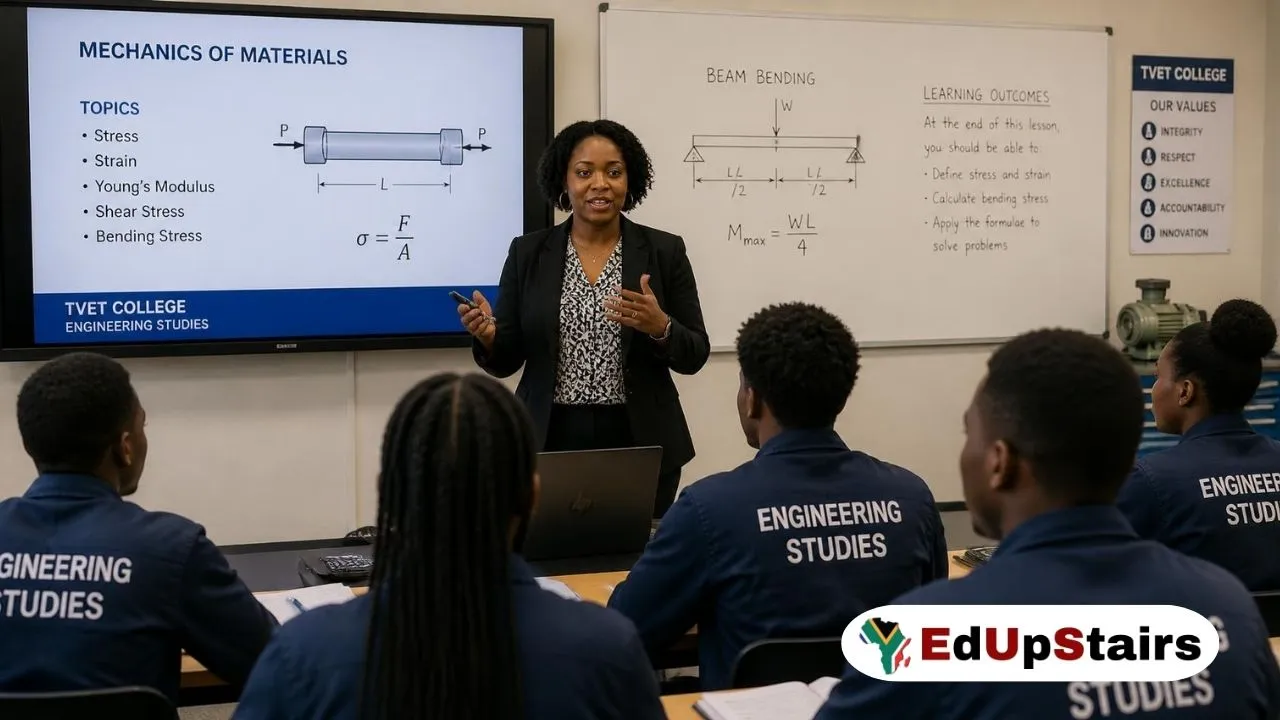

South African TVET College students who have completed N6 but still need practical workplace experience to work towards their National N Diploma should take note of the Work Integrated Learning opportunity available through Resolution Circle.
Resolution Circle has officially confirmed that applications are open for its Work Integrated Learning (WIL) programmes for TVET students. The programme is specifically aimed at TVET students with N6 who require the practical WIL component of their studies before progressing towards their National N Diploma.
For thousands of TVET students, completing N6 is only one part of the journey. The next major challenge is finding an appropriate practical or experiential learning opportunity.
That is exactly the gap the Resolution Circle WIL programme is designed to address.
Students should, however, note an important timing detail: Resolution Circle’s official programme page currently states that applications are open for its upcoming intake and that programmes commence on 7 September 2026. Information circulating about a January 2027 intake should therefore be confirmed directly with Resolution Circle before applicants make financial or study decisions.
Quick Overview: Resolution Circle TVET Work Integrated Learning
| Information | Details |
| Programme | Work Integrated Learning (WIL) |
| Organisation | Resolution Circle |
| Target group | TVET College students |
| Minimum study position | N6 requiring WIL |
| Purpose | Practical WIL towards the National N Diploma pathway |
| Training type | Work Integrated Learning |
| Duration | Approximately 6–18 months, depending on pathway |
| Intake | Flexible intake |
| Location | Resolution Circle accredited training programmes are delivered in Gauteng |
| Funding | Self-funded unless the student secures an employer, sponsor or bursary |
| Applications | Open |
| Official application | Apply through Resolution Circle |
| Edupstairs resource | TVET Colleges Explorer |
| Career planning | Career & Qualification Explorer |
| Workplace pathways | SETA Platform |
What Is the Resolution Circle Work Integrated Learning Programme?
Resolution Circle’s TVET Work Integrated Learning programme is designed for students who have completed the academic component of their TVET studies but still require practical experience.
The purpose is to help participants complete the practical WIL component associated with the National N Diploma pathway.
Unlike an ordinary classroom programme, Resolution Circle combines practical workshop-based training with experiential learning.
Depending on the programme structure and requirements, an on-the-job component with a host employer may also form part of the pathway.
This is particularly important for N6 students who find themselves in the difficult position of having completed their theoretical studies but still needing appropriate practical exposure.
Before applying, students can use the Edupstairs TVET Colleges Explorer to research their TVET College, programmes, NATED/Report 191 pathways, campuses and other available student resources.
About Resolution Circle
Resolution Circle was founded in 2012 by the University of Johannesburg and operates as UJ’s skills-training arm.
The organisation provides technical training and Work Integrated Learning programmes aimed at helping students bridge the gap between academic study and practical technical experience.
Resolution Circle states that it has provided Work Integrated Learning to thousands of engineering students and has expanded its WIL offering to TVET National N Diploma students.
Its facilities include training locations in Doornfontein, Johannesburg; Brakpan in Ekurhuleni; and Welkom in the Free State, while its programme page states that its accredited training programmes are delivered in Gauteng.
Applicants should confirm the actual training location attached to their specific intake.
Who Should Apply?
According to Resolution Circle, the programme is intended for:
TVET students with N6 who require the Work Integrated Learning component to obtain their National N Diploma.
This distinction is important.
This is not simply a general learnership being advertised to anyone with Matric.
The programme is designed around TVET students who have progressed through the relevant academic component and require WIL.
If you are still deciding which TVET programme to study, start with the Edupstairs TVET Colleges Explorer, which allows prospective students to explore South Africa’s public TVET Colleges, programmes, campuses and admission information.
Students can also read the TVET College Applications for 2027: All 50 Public TVET Colleges, Opening & Closing Dates guide if they are planning to begin or continue TVET studies in 2027.
How the Resolution Circle WIL Programme Works
Resolution Circle explains that its TVET WIL model can contain several components.
-
Workshop-Based Training
Participants can first receive practical workshop training.
Instead of only understanding concepts theoretically, students are expected to demonstrate practical skills relevant to their field.
This stage is intended to help bridge the gap between what students learned during their N-level studies and what they may be expected to perform in a practical technical environment.
-
Experiential Training
Students can then move into experiential training.
During this component, participants can become involved in the planning and implementation of engineering projects.
The idea is to integrate different technical skills into more complete practical projects rather than treating every skill as an isolated classroom exercise.
-
On-the-Job Experience
Resolution Circle also describes an on-the-job component that can be incorporated into certain programme structures.
Where applicable, students may be placed with host employers to gain relevant real-world experience.
Areas of exposure mentioned by Resolution Circle include:
- drawing and project-office activities;
- reading and interpreting basic engineering drawings;
- manufacturing and production;
- producing engineering parts using machinery;
- installation; and
- maintenance of machinery.
Applicants should confirm the exact training structure applicable to their own qualification before enrolling.
9 + 9 and 6 + 6 + 6 Programme Structures
Resolution Circle describes two potential structures for TVET Work Integrated Learning.
The standard model is referred to as the 9 + 9 programme.
This generally consists of:
9 months workshop-based training + 9 months experiential training.
Resolution Circle also describes a 6 + 6 + 6 programme, which can consist of:
6 months workshop-based training + 6 months experiential training + 6 months on-the-job experience.
The exact programme offered to an applicant may depend on the student’s qualification, WIL requirements and the arrangement being implemented.
Resolution Circle also indicates that programmes can be adapted to client requirements without compromising the core outcomes required by TVET Colleges.
Applicants should therefore not assume that every student will automatically follow exactly the same structure.
How Long Is the Resolution Circle TVET WIL Programme?
The official programme information lists the duration as approximately 6 to 18 months.
Resolution Circle also explains that it can offer an 18-month programme and, where required by particular TVET Colleges, a 24-month programme.
The appropriate duration therefore depends on the WIL requirements applicable to the student’s qualification and programme arrangement.
Students should confirm their required workplace-experience period with their TVET College before enrolling.
Why WIL Is Important After N6
One of the biggest misunderstandings among TVET students is believing that completing N6 automatically means that the entire National N Diploma process is complete.
For students following applicable NATED/Report 191 pathways, the practical workplace component can be a critical part of progressing towards the National N Diploma.
This is why Work Integrated Learning opportunities are so valuable.
Edupstairs has previously covered opportunities such as the SASSA Internships & TVET Work Integrated Learning Programmes, National Treasury TVET Work Integrated Learning Programme and Lephalale TVET College Work Integrated Learning Programme.
These opportunities demonstrate why N6 students should actively search for workplace-learning pathways instead of waiting indefinitely after completing their theoretical studies.
Connect Your N6 Qualification to a Career
Students should not view WIL simply as something they need to “finish the diploma.”
It is also an opportunity to understand the occupation they are preparing to enter.
Use the Edupstairs Career & Qualification Explorer to investigate South African careers and qualifications.
The Explorer currently brings together more than 1,500 OFO career records and over 22,000 SAQA qualification records, allowing students to research potential connections between qualifications and occupations.
For example, students from technical and engineering pathways can investigate careers and qualifications associated with areas such as:
- electrical engineering;
- mechanical engineering;
- fitting and turning;
- manufacturing;
- maintenance;
- welding;
- instrumentation;
- electronics;
- engineering technicians;
- production;
- technical trades; and
- related engineering occupations.
Explore Careers and Qualifications on Edupstairs
Understanding where your qualification could lead makes it easier to choose workplace experience that actually supports your longer-term career direction.
TVET N6 Students Should Also Explore the SETA Platform
Do not rely on one WIL application.
South Africa’s 21 Sector Education and Training Authorities (SETAs) support a wide range of skills-development and workplace-learning pathways.
Depending on the sector and programme, opportunities may include:
- Work Integrated Learning;
- workplace placements;
- apprenticeships;
- learnerships;
- internships;
- artisan development;
- skills programmes;
- bursaries; and
- occupational qualifications.
The Edupstairs SETA Platform brings all 21 SETAs together and includes more than 1,000 programme and pathway records.
Importantly for N6 students, the platform includes a dedicated WIL pathway where students can investigate workplace-learning opportunities associated with different SETAs.
For example, students can explore the Services SETA TVET Work-Integrated Learning pathway and other SETA WIL programmes relevant to their field.
Explore Work Integrated Learning, Learnerships, Apprenticeships and Skills Programmes on the Edupstairs SETA Platform
This should form part of a broader application strategy.
Apply for Resolution Circle if it suits your circumstances, but continue looking for employer-funded and SETA-supported WIL opportunities at the same time.
Important: Resolution Circle WIL Is Self-Funded
This is probably the most important part of this opportunity for applicants to understand.
Resolution Circle states that all of its programmes are self-funded.
Students are responsible for their own tuition fees unless they have secured funding through an:
- employer;
- sponsor; or
- bursary.
This means applicants should not assume that this is a paid internship or funded WIL placement.
It is also different from an employer recruiting N6 students and paying them a monthly stipend to complete workplace experience.
Before accepting a place, applicants should therefore ask Resolution Circle for the current programme fee and obtain written information explaining what is included.
Students should consider the full financial implications, including tuition or programme fees, transport, accommodation where applicable, meals and other living expenses.
Is This a Paid Internship?
Based on Resolution Circle’s published information, applicants should not describe this programme as a paid internship.
Resolution Circle explicitly states that its programmes are self-funded unless external funding has been secured.
This distinction matters because many young applicants see the words “Work Integrated Learning” and automatically assume that a monthly stipend will be provided.
Do not make that assumption.
Ask Resolution Circle directly about costs, sponsorship arrangements and whether any host-employer component applicable to your programme includes financial support.
Can a SETA Potentially Help With WIL?
Potentially, depending on the sector, funding window and specific programme.
SETAs regularly participate in skills-development initiatives that can include workplace placements and Work Integrated Learning.
However, SETA funding is not automatic simply because you have N6.
Students should use the Edupstairs SETA Platform to identify the SETA associated with their study field and investigate relevant WIL, internship, apprenticeship and skills-development pathways.
Prepare Academically Before WIL
Students who are still completing their NATED subjects can also use the Edupstairs TVET Past Exam Papers & Memoranda Library.
The library indexes national examination resources for NC(V) and NATED/Report 191 programmes, allowing students to search previous question papers and memoranda by programme, level, subject, year and examination session where resources are available.
Find TVET NATED and NC(V) Past Exam Papers and Memoranda
Completing N6 successfully should come first. WIL becomes relevant once you reach the stage at which your programme requires practical workplace or experiential learning.
How to Apply for Resolution Circle Work Integrated Learning
Applications should be made through Resolution Circle’s official TVET Work Integrated Learning page.
Apply for Resolution Circle TVET Work Integrated Learning
On the official page, applicants can access the application/enquiry process and request further information.
Before submitting anything, make sure that you enter your information correctly and identify your TVET qualification accurately.
Applicants should be prepared to provide information about their:
- TVET College;
- N6 qualification;
- engineering or technical specialisation;
- WIL requirements;
- contact details; and
- other information requested by Resolution Circle.
Completing an enquiry form does not guarantee acceptance into the programme.
Questions to Ask Resolution Circle Before Paying
Because this is a self-funded programme, applicants should get clear answers before making any payment.
Ask:
- What is the total programme fee?
- Which WIL programme applies to my exact N6 qualification?
- How many months of WIL do I need?
- Does my TVET College recognise the proposed programme structure for my National N Diploma requirements?
- Will my programme include workshop-based training?
- Will it include experiential training?
- Does it include placement with a host employer?
- Is the host-employer component guaranteed or programme-dependent?
- What documents will I receive after completing the programme?
- What records or logbooks will be provided for submission to my TVET College?
- Are there sponsorship or bursary opportunities?
- What additional costs should I budget for?
Do not pay simply because someone sends you a social-media message claiming to represent Resolution Circle.
Use the organisation’s official channels.
Official Requirements vs Edupstairs Guidance
Official Resolution Circle Information
Resolution Circle currently identifies the programme as being for:
- TVET students;
- students with N6;
- students requiring WIL to obtain their National N Diploma;
- applicants prepared to undertake the relevant practical training; and
- students who understand that the programme is self-funded unless external funding has been secured.
Edupstairs Guidance
Before applying, Edupstairs recommends that you:
- confirm your N6 results;
- obtain a letter from your TVET College explaining your WIL requirements where applicable;
- confirm the workplace-experience duration required for your qualification;
- ask your college whether the proposed WIL arrangement satisfies its requirements;
- request Resolution Circle’s complete fee structure;
- investigate bursary, employer and SETA funding;
- keep certified copies of your academic records;
- prepare an updated CV; and
- continue applying for employer-funded WIL opportunities.
You can also use the Edupstairs Internship & Learnership Readiness Quizzes to strengthen your understanding of workplace behaviour, communication and general work readiness.
Do Not Stop Applying for Other WIL Opportunities
This is particularly important.
Because Resolution Circle’s programme is self-funded, N6 students who cannot afford the fees should not conclude that their WIL journey is over.
Continue searching.
Look for:
Employer WIL placements → SETA-funded WIL → government internships/WIL → public entities → municipalities → TVET College partnerships → private-sector workplace programmes.
Monitor Edupstairs regularly because new N6 workplace opportunities are advertised throughout the year.
Use the Edupstairs SETA Platform to understand industry-specific workplace pathways and the Career & Qualification Explorer to keep your workplace experience aligned with your intended career.
Tools you may find useful:
- SETA Platform
- RDP / BNG Housing Eligibility Checker
- SASSA Grant Eligibility Checker
- SAPS / Metro / Traffic / DCS Eligibility Checker
- Youth Employment Eligibility Checker
- SA Bursary & NSFAS Eligibility Checker
- UIF Benefits Eligibility Checker and Payment Estimator
View Other Employment Opportunities here
Need Help?
Edupstairs Advice
If you have completed N6 and have been sitting at home waiting for workplace experience, start treating WIL applications like a job search.
Do not submit one application and wait.
Build a pipeline.
Apply to Resolution Circle if the programme is appropriate and financially realistic for you. At the same time, search for employer-funded WIL opportunities, identify your relevant SETA through the Edupstairs SETA Platform and monitor government departments, municipalities, state-owned entities and private companies.
Most importantly, know exactly what workplace experience your qualification requires.
Use the TVET Colleges Explorer to research your college, the Career & Qualification Explorer to understand where your qualification could lead, and the SETA Platform to identify industry-based training pathways.
Completing N6 should not be the end of your journey.
The goal is to turn the theoretical qualification into practical experience, complete the applicable National N Diploma requirements and position yourself for employment.
Important Links
- Resolution Circle: Apply for TVET Work Integrated Learning
- Edupstairs: Explore All Public TVET Colleges
- Edupstairs: Explore Careers & SAQA Qualifications
- Edupstairs: Explore All 21 SETAs and Skills Programmes
- Edupstairs: Find TVET Past Exam Papers & Memoranda
- Edupstairs: Check 2027 TVET College Application Dates
Frequently Asked Questions
-
Who can apply for the Resolution Circle WIL programme?
Resolution Circle identifies TVET students with N6 who require the WIL component to work towards their National N Diploma as the target group.
-
Are Resolution Circle WIL applications open?
Yes. Resolution Circle’s official programme page currently states that applications are open.
-
Is this definitely the January 2027 intake?
Applicants should confirm this directly with Resolution Circle. Its official TVET WIL page currently states that its upcoming programmes commence on 7 September 2026 and describes intake as flexible. Applicants should therefore verify the exact start date applicable to the intake for which they are applying.
-
How long does the programme take?
Resolution Circle lists a duration of approximately 6–18 months, while also explaining that programme structures can vary and that 24-month arrangements can be provided where required.
-
Is Resolution Circle WIL free?
No. Resolution Circle states that its programmes are self-funded unless the student has secured funding through an employer, sponsor or bursary.
-
Will I receive a monthly stipend?
Applicants should not assume that a stipend is provided. Ask Resolution Circle directly about the financial arrangements applicable to your programme.
-
Does completing N6 automatically give me a National N Diploma?
No. Students following applicable pathways may still need the required practical/workplace component and must satisfy the applicable requirements for the National N Diploma.
-
Where can I find other WIL opportunities?
Use the Edupstairs SETA Platform and regularly monitor Edupstairs for N6 internships and Work Integrated Learning opportunities.
-
Where can I research my TVET College?
Use the Edupstairs TVET Colleges Explorer to explore South Africa’s public TVET Colleges, programmes, campuses and student resources.
-
Where can I check careers related to my N6 qualification?
Use the Edupstairs Career & Qualification Explorer to search careers, OFO occupations and SAQA qualification records.
-
Where can I find NATED past papers?
Use the Edupstairs TVET Past Exam Papers & Memoranda Library to search available NATED/Report 191 and NC(V) examination resources.
-
Does submitting the Resolution Circle application guarantee acceptance?
No. Resolution Circle explicitly states that completing its enquiry form does not guarantee acceptance into a programme.
You can also:
- View latest Internships
- View latest Learnerships
- View Latest Bursaries
- View latest Government jobs
- View latest Company Vacancies
- View latest Municipality vacancies
- Visit the Edupstairs blog for daily updates
Disclaimer
This article is intended for educational and opportunity-information purposes. Programme dates, fees, intake arrangements, eligibility requirements, training locations, host-employer arrangements and funding can change.
Resolution Circle’s official TVET WIL page currently states that applications are open and lists flexible intake, while its published page also references programmes commencing on 7 September 2026. Applicants seeking a 2027 placement should therefore confirm the exact 2027 intake date directly with Resolution Circle before paying fees, arranging accommodation or making other commitments.
Edupstairs is not Resolution Circle, a TVET College, DHET, SAQA or a SETA and cannot guarantee acceptance, funding, placement or completion of a National N Diploma.
Editorial Integrity
Edupstairs reviews opportunity information against available official sources and clearly distinguishes official programme requirements from general application guidance.
Where information cannot be independently confirmed from the official provider, Edupstairs recommends that applicants verify it directly before making financial, academic or employment decisions.
EDUPSTAIRS IS A REGISTERED NON-PROFIT ORGANISATION NPO No: 232 – 182, PUBLIC BENEFIT ORGANISATION (PBO): 930066984. EDUPSTAIRS DOES NOT, IN ANY WAY OR FORM, SOLICIT MONEY OR CV’S FROM PEOPLE FOR JOBS. PLEASE BE AWARE OF PHONY JOB POSTINGS AND RECRUITMENT FRAUD. USE THE EDUPSTAIRS SCAM DETECTOR TOOL TO SPOT A SCAM BEFORE YOU APPLY