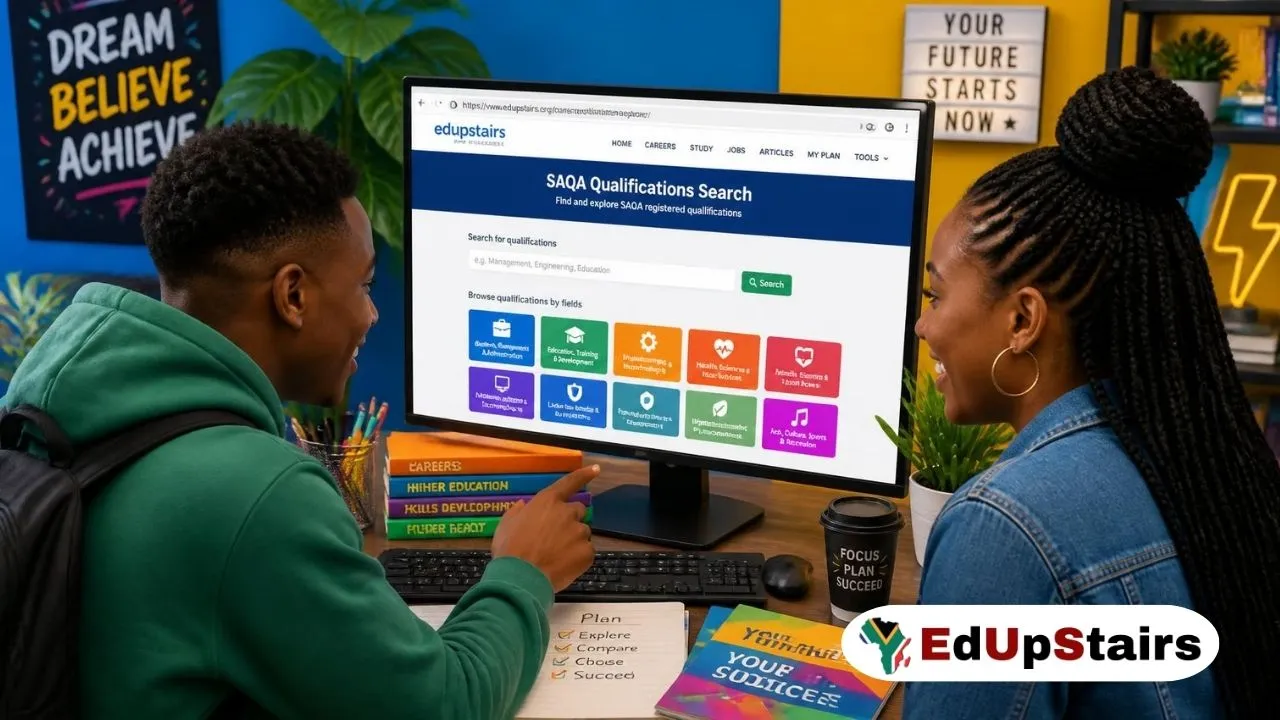

If you are planning to study in South Africa in 2027, one of the most important things you can do before applying for a course is understand the qualification you intend to pursue.
Is the qualification registered on the National Qualifications Framework (NQF)? What is its NQF level? How many credits does it carry? Is it a Higher Certificate, Diploma or Degree? And, importantly, what careers could the qualification potentially lead to?
Edupstairs has made researching these questions easier through the Career & Qualification Explorer, which brings South African careers and SAQA qualification records together in one searchable platform.
View SAQA Qualifications on the Edupstairs Career & Qualification Explorer
At the time of publication, the Edupstairs database contains more than 22,600 SAQA qualification records, alongside more than 1,500 OFO careers. This means students can move beyond simply searching for a course and start investigating the relationship between qualifications, NQF levels and possible career pathways.
What is SAQA?
The South African Qualifications Authority (SAQA) plays a central role in South Africa’s education and training system.
Among its functions is the registration of qualifications and part-qualifications on the National Qualifications Framework (NQF).
SAQA’s services also include:
- Registration of qualifications
- Verification of South African qualifications
- Evaluation of foreign qualifications
- Recognition of professional bodies
- Management of information relating to the National Qualifications Framework
- The National Learners’ Records Database (NLRD)
Understanding these different functions is important because terms such as SAQA registration, SAQA Verification, SAQA accreditation and SAQA authentication services are sometimes used online as though they mean the same thing.
They do not.
Search SAQA Qualifications for 2027
Students, parents, graduates and job seekers can use the Edupstairs Career & Qualification Explorer to browse South African qualification records.
Search SAQA Qualifications Here
You can search using information such as a qualification name, career, OFO occupation or SAQA ID.
The database includes qualifications across different levels and categories, including qualifications associated with:
- Higher Certificates
- Advanced Certificates
- Diplomas
- Advanced Diplomas
- Bachelor’s Degrees
- Honours Degrees
- Postgraduate Diplomas
- Master’s Degrees
- Doctoral Degrees
- Occupational qualifications
- Vocational qualifications
- Other qualifications registered within the NQF system
Individual qualification records can display information such as the SAQA ID, qualification title, NQF level and credits, depending on the available record.
This can be particularly useful when researching your study options for 2027.
What is the National Qualifications Framework?
The National Qualifications Framework, normally abbreviated as the NQF, is the framework through which recognised South African qualifications are organised.
Instead of treating every qualification as an unrelated certificate, diploma or degree, the framework places qualifications at different NQF levels.
This makes it easier to understand the relative complexity and learning outcomes associated with different qualifications.
South Africa’s NQF consists of 10 levels.
In broad terms:
- NQF Level 1 is associated with the General Certificate.
- NQF Levels 2–4 include qualifications within the further education and occupational/vocational environment.
- NQF Level 4 includes the National Senior Certificate and National Certificate (Vocational) Level 4.
- NQF Level 5 includes Higher Certificates.
- NQF Level 6 includes Diplomas and Advanced Certificates.
- NQF Level 7 includes Bachelor’s Degrees and Advanced Diplomas.
- NQF Level 8 includes Bachelor Honours Degrees and Postgraduate Diplomas.
- NQF Level 9 is associated with Master’s Degrees.
- NQF Level 10 is associated with Doctoral Degrees.
However, students should always check the actual registered qualification rather than assuming an NQF level based solely on the words appearing in a course title.
Higher Certificates
A Higher Certificate can provide an important entry point into higher education.
Under the Higher Education Qualifications Sub-Framework, Higher Certificates are generally positioned at NQF Level 5 and typically carry at least 120 credits.
Higher Certificates can be useful for students who want to obtain an introductory higher-education qualification in a particular field or potentially progress to further study, subject to institutional admission and articulation requirements.
Before enrolling, search for the qualification and check its details.
Search Higher Certificates on Edupstairs
Diplomas
Diplomas are another major qualification pathway available to South African students.
A Diploma is generally positioned at NQF Level 6, while an Advanced Diploma is generally at NQF Level 7 under the current higher-education qualifications framework.
Diplomas are offered across a wide range of disciplines, including areas such as:
- Engineering
- Information Technology
- Business
- Accounting
- Public Management
- Tourism
- Agriculture
- Human Resources
- Marketing
- Logistics
- Health-related disciplines
Students should not select a Diploma simply because its name sounds relevant to a career.
Investigate the registered qualification, admission requirements, institution offering it and potential progression routes.
Degrees
Bachelor’s Degrees generally sit at NQF Level 7, although some professional Bachelor’s Degrees may be positioned at NQF Level 8, depending on the qualification.
Degree options extend across virtually every major professional and academic field, including engineering, education, healthcare, law, commerce, science, agriculture, humanities and technology.
The Edupstairs Career & Qualification Explorer can help prospective students investigate qualifications while simultaneously exploring related occupations.
This is particularly useful for someone who knows the career they want but does not yet understand the qualifications associated with that career.
NCV Programmes and the NQF
The National Certificate (Vocational), or NCV, is an important part of South Africa’s vocational education system and is commonly associated with TVET Colleges.
NCV programmes progress through:
- NCV Level 2
- NCV Level 3
- NCV Level 4
Students should understand the distinction between an NCV programme level and the broader NQF level.
For example, completion of the National Certificate (Vocational) Level 4 corresponds to NQF Level 4.
NCV programmes provide vocational education across fields such as engineering, business, information technology, hospitality and other occupationally relevant areas.
What Does “SAQA Accredited” Mean?
This is one of the most important points for prospective students.
People frequently search Google for terms such as:
“SAQA accredited courses”
“SAQA accredited institutions”
“SAQA accreditation check”
However, technically, SAQA registers qualifications on the NQF; it does not simply “accredit colleges” in the way the phrase SAQA accreditation is commonly understood.
SAQA explains that education and training providers must be registered with the appropriate authorities and accredited to offer qualifications or skills programmes by the relevant Quality Council.
The three Quality Councils are:
Umalusi – responsible for quality assurance within general and further education and training.
QCTO – Quality Council for Trades and Occupations – responsible for occupational qualifications.
CHE – Council on Higher Education – responsible for higher education qualifications.
This distinction matters.
A qualification appearing on the NQF does not automatically mean that every college or organisation advertising that qualification is authorised to offer it.
Before paying registration fees, students should investigate both:
- The qualification
and
- The institution/provider offering the qualification.
How to Check Whether a Qualification is Registered
One useful identifier is the SAQA ID.
Qualifications registered on the National Qualifications Framework are assigned identifying information that enables users to distinguish between different qualification records.
When researching a programme advertised by a university, college or training provider, look for information including:
- Full qualification name
- SAQA ID
- NQF level
- Number of credits
- Qualification type
- Registration status
- Institution/provider information where applicable
You can begin your research using the Edupstairs database:
Browse SAQA Qualification Records
For formal confirmation, regulatory decisions or official verification, users should consult SAQA and the relevant Quality Council or government authority.
SAQA Verification
SAQA Verification is different from searching for a qualification.
SAQA operates a Verifications Service for qualifications obtained from South African providers and recorded on the National Learners’ Records Database (NLRD).
The NLRD is an important information system supporting the National Qualifications Framework and contains education and training records.
Employers in both the public and private sectors can use SAQA’s qualification verification services.
Individuals may also request an Individual Verification Letter confirming tertiary qualifications obtained in South Africa.
Importantly, SAQA states that its individual verification letter service is limited to registered qualifications and does not cover short courses, foreign qualifications or professional designations.
Therefore, searching the Edupstairs Career & Qualification Explorer and formally verifying that an individual actually achieved a qualification are two different processes.
SAQA Authentication Services
People also frequently search for SAQA authentication services, particularly when they need qualification documents for employment, immigration, professional registration or international purposes.
It is important to identify the service you actually require.
You may be trying to:
- Confirm that a qualification exists on the NQF
- Verify that a South African qualification was awarded to you
- Obtain an official verification letter
- Evaluate a qualification obtained outside South Africa
- Confirm the status of an institution
- Obtain documents for use outside South Africa
These are not necessarily handled through the same process.
Always use the official service appropriate to your circumstances rather than assuming that a general “SAQA authentication” application covers every situation.
Evaluation of Foreign Qualifications
If you obtained your qualification outside South Africa, simply searching for an equivalent South African qualification is not sufficient.
SAQA provides an official Evaluation of Foreign Qualifications service.
The purpose of the evaluation is to recognise foreign qualifications within the context of the South African National Qualifications Framework.
SAQA evaluates the foreign qualification and determines its location within the South African NQF framework according to the applicable policy and criteria.
SAQA currently issues certificates of evaluation electronically.
Foreign-qualified applicants may need an evaluation for purposes such as employment, further education, professional processes or other official requirements, depending on the organisation requesting it.
Do not confuse Evaluation of Foreign Qualifications with SAQA’s verification service for South African qualifications.
They are separate services.
Qualification Registration Does Not Automatically Mean Provider Accreditation
This distinction could save prospective students from making a costly mistake.
Imagine that you find a legitimate qualification carrying a valid SAQA ID.
You then find an organisation advertising a course with exactly the same name.
That does not automatically prove that the organisation is authorised to offer that qualification.
SAQA advises prospective learners to check provider registration and accreditation through the appropriate authorities.
Students should therefore ask:
Is the qualification registered?
Then:
Is this specific provider appropriately registered and accredited to offer it?
Both questions matter.
Why Check a Qualification Before Applying in 2027?
Choosing the wrong programme can have long-term consequences.
Before submitting a 2027 application or paying fees, checking the qualification can help you understand:
The NQF level – where the qualification sits within South Africa’s qualifications framework.
Credits – the credit value attached to the registered qualification.
Qualification type – whether it is a Certificate, Higher Certificate, Diploma, Advanced Diploma, Degree or another qualification type.
Career relevance – whether the qualification appears relevant to your intended occupation.
Progression opportunities – whether the qualification could potentially form part of a pathway towards further study.
Registration information – whether the qualification appears within the relevant SAQA records.
Search by Career Instead of Qualification
One of the major advantages of the Edupstairs platform is that it is not only a qualifications database.
It is also a Career & Qualification Explorer.
At the time of publication, the platform contains:
- 1,511 OFO careers
- 22,667 SAQA qualification records
- 726 careers with qualification mappings
- and more than 2,200 career-to-qualification links.
This creates another way to approach career planning.
Instead of asking:
“What can I do with this qualification?”
you can begin with:
“What career do I want?”
You can then investigate potential qualification pathways connected with that occupation.
Explore Careers and SAQA Qualifications
Popular career areas available through the Explorer include engineering, healthcare, education, ICT and digital careers, finance, human resources, trades, and sales and marketing.
SAQA Qualification vs Career Requirement
Students should also understand that finding a qualification related to an occupation does not necessarily mean completing that qualification automatically gives you the legal right to practise the occupation.
Some South African professions are regulated.
Depending on the profession, additional requirements may include:
- Registration with a professional council
- Workplace experience
- Candidacy
- Practical training
- Board examinations
- Trade tests
- Professional examinations
- Internships
- Community service
- Licensing or statutory registration
Always investigate the regulatory requirements attached to the particular career you want to enter.
How to Use the Edupstairs Career & Qualification Explorer
Using the platform is straightforward.
Go to:
Edupstairs Career & Qualification Explorer
You can then search for a career or qualification.
For example, you could search:
- Electrician
- Teacher
- Nurse
- Software Developer
- Plumber
- Welder
- Accountant
- Human Resources
- Marketing Manager
- or Traffic Officer.
Alternatively, browse the qualifications database directly.
When viewing a qualification, pay attention to information such as the qualification name, SAQA ID, NQF level and credits.
Then investigate the institution where you intend studying and confirm its current admission requirements and authority to offer the programme.
Important Advice for Students Applying for 2027
Do not choose a programme based only on an advertisement, social-media post or the promise of employment.
Research it.
Before paying an application, registration or tuition fee, establish:
- What qualification will I receive?
- What is its full registered name?
- Does it have a SAQA ID?
- What NQF level is it?
- How many credits does it carry?
- Is the provider appropriately registered?
- Is the provider accredited to offer the relevant programme?
- Does the qualification support my intended career?
- Does the career require professional registration?
- Can the qualification provide progression to further study?
These questions are particularly important when dealing with unfamiliar private colleges and training providers.
Edupstairs Advice
A qualification should not be chosen simply because it sounds impressive or because a college advertises it as “accredited.”
Start with the career you want.
Research the qualification pathway.
Check the NQF level.
Check the SAQA ID.
Investigate the institution.
Confirm accreditation and registration where applicable.
Then understand whether professional registration, workplace experience or further study will be required.
The Edupstairs Career & Qualification Explorer has been designed to make the first part of that research considerably easier.
Frequently Asked Questions About SAQA Qualifications 2027
-
Where can I view SAQA qualifications?
You can browse qualification records through the Edupstairs Career & Qualification Explorer. For authoritative regulatory confirmation, you should also consult SAQA and the appropriate Quality Council.
-
What is a SAQA ID?
A SAQA ID is an identifying number associated with a qualification record registered within the National Qualifications Framework system. It can help distinguish between qualifications with similar names.
-
What are NQF levels?
NQF levels indicate where qualifications are located within South Africa’s National Qualifications Framework. The framework has 10 levels.
-
What NQF level is a Higher Certificate?
A Higher Certificate under the current Higher Education Qualifications Sub-Framework is generally at NQF Level 5.
-
What NQF level is a Diploma?
A Diploma under the current higher-education framework is generally at NQF Level 6.
-
What NQF level is a Bachelor’s Degree?
A Bachelor’s Degree is generally at NQF Level 7, although certain professional Bachelor’s Degrees may be positioned at Level 8.
-
Are NCV programmes registered on the NQF?
The National Certificate (Vocational) forms part of South Africa’s formal qualifications framework, with NCV Level 4 corresponding to NQF Level 4.
-
Does SAQA accredit universities and colleges?
The phrase “SAQA accreditation” is commonly used, but it can be misleading. SAQA registers qualifications and part-qualifications on the NQF following the relevant processes. Provider accreditation falls under the appropriate Quality Councils, while institutional registration may involve authorities such as DHET.
-
What is SAQA Verification?
SAQA Verification is a service used to verify qualifications achieved through South African providers and recorded on the National Learners’ Records Database.
-
Can SAQA verify my foreign qualification?
Foreign qualifications are dealt with through SAQA’s Evaluation of Foreign Qualifications process rather than the ordinary verification service for South African qualifications.
-
Can I search qualifications according to a career?
Yes. The Edupstairs Career & Qualification Explorer combines career information and qualification records, allowing users to investigate career-to-qualification connections.
-
Does finding a qualification on SAQA mean a college is accredited?
No. A qualification’s registration and a provider’s authority to offer it are separate matters. Always verify the provider through the relevant regulatory and quality-assurance authorities.
Start Exploring SAQA Qualifications for 2027
Whether you are a Grade 12 learner choosing what to study, a TVET College student planning your next qualification, a graduate considering postgraduate study or a job seeker trying to understand the qualification requirements for a career, researching qualifications should form part of your decision-making process.
The Edupstairs Career & Qualification Explorer brings thousands of South African qualification records and careers into a single searchable platform.
You can explore Higher Certificates, NCV pathways, Diplomas, Degrees, Advanced Diplomas, postgraduate qualifications, occupational qualifications, NQF levels and potential career connections.
View SAQA Qualifications & Careers on Edupstairs
Use the Explorer to begin your research, then use SAQA, DHET, the relevant Quality Council, professional body and institution to confirm official information before making important education or career decisions.
You can also:
- View latest Internships
- View latest Learnerships
- View Latest Bursaries
- View latest Government jobs
- View latest Company Vacancies
- View latest Municipality vacancies
- Visit the Edupstairs blog for daily updates
Disclaimer
The Edupstairs Career & Qualification Explorer is an educational and career-research resource and should not be treated as a replacement for SAQA, DHET, CHE, Umalusi, QCTO, universities, TVET Colleges, professional councils or other statutory authorities.
Qualification records, registration status, provider accreditation, admission requirements and regulatory requirements can change. Applicants should always verify important information with the relevant official authority before applying, registering or making payments.
EDUPSTAIRS IS A REGISTERED NON-PROFIT ORGANISATION NPO No: 232 – 182, PUBLIC BENEFIT ORGANISATION (PBO): 930066984. EDUPSTAIRS DOES NOT, IN ANY WAY OR FORM, SOLICIT MONEY OR CV’S FROM PEOPLE FOR JOBS. PLEASE BE AWARE OF PHONY JOB POSTINGS AND RECRUITMENT FRAUD. USE THE EDUPSTAIRS SCAM DETECTOR TOOL TO SPOT A SCAM BEFORE YOU APPLY