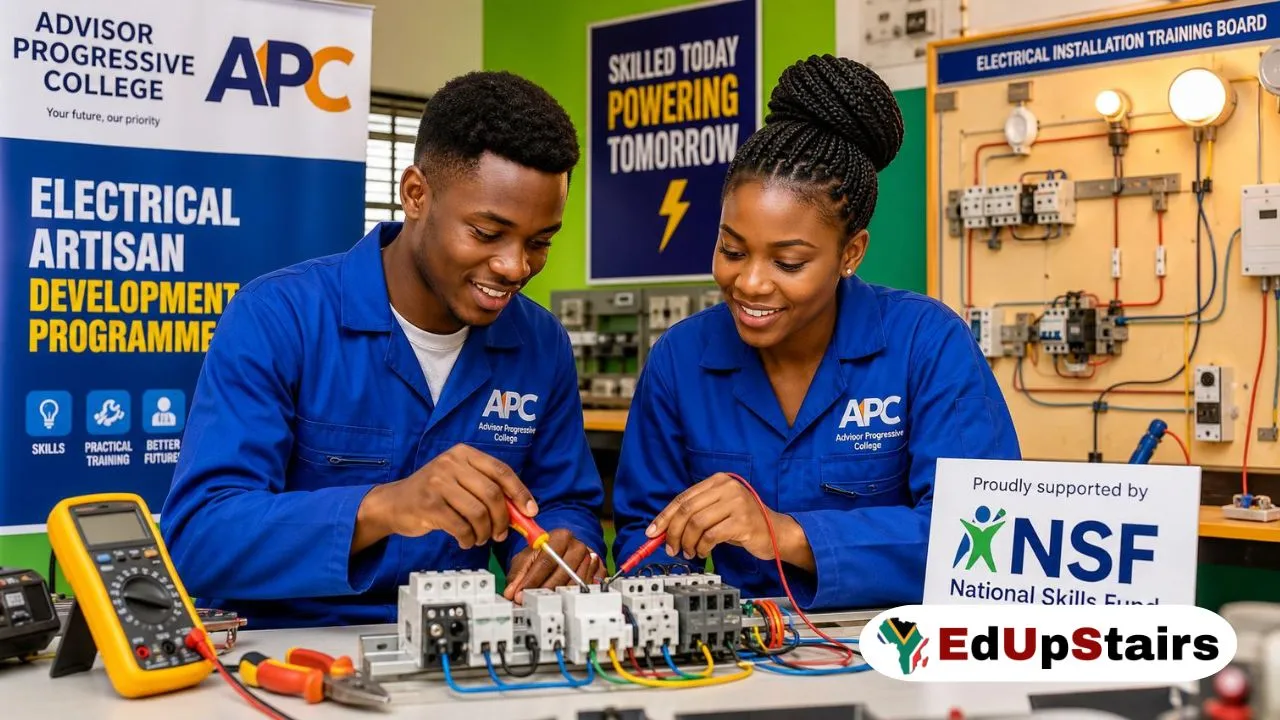

If you are an unemployed young South African looking for a practical career that can lead to long-term employment, the Advisor Progressive College (APC) Artisan Development Programme 2026 could be the opportunity you have been waiting for.
The programme invites unemployed youth to apply for an Electrical Apprenticeship, where successful learners will receive structured occupational training, workplace experience and a monthly stipend while working towards becoming qualified artisans.
Unlike many short courses, an apprenticeship combines classroom learning with practical workplace training over an extended period, giving participants valuable experience that employers actively seek.
This guide explains the official opportunity while also providing practical advice to help you submit a stronger application and understand what to expect from an artisan career.
Quick Overview
- Programme: Artisan Development Programme (Electrical Apprenticeship)
- Organisation: Advisor Progressive College (APC)
- Supported by: National Skills Fund (NSF)
- Trade: Electrical
- Duration: Three years
- Monthly Stipend: R4,500
- Age Requirement: 18–35 years
- Citizenship: South African citizens only
- Application Method: Email application
- Application Email: apprenticeship@apc.edu.za
- Closing Date: 15 September 2026
Minimum Qualification:
- Grade 12 (Matric) passed
- Mathematics and Science subjects are recommended but not compulsory according to the advert
About Advisor Progressive College
Advisor Progressive College (APC) is a South African Further Education and Training institution that offers skills development programmes aimed at preparing learners for employment in technical and vocational careers.
The advertised apprenticeship forms part of an Artisan Development Programme, designed to develop unemployed youth into qualified artisans through structured occupational learning and workplace exposure.
The programme is supported by the National Skills Fund (NSF), an organisation that funds skills development initiatives intended to improve employment opportunities and address scarce skills within South Africa.
Electrical artisans remain among the country’s most needed technical professionals, making this programme particularly valuable for young people who enjoy practical work and problem-solving.
What is an Electrical Apprenticeship?
Many people confuse apprenticeships with learnerships, but they are not exactly the same.
An apprenticeship is a structured pathway that combines:
- Practical workplace experience
- Occupational theory
- Technical skills training
- Continuous assessment
- Preparation for the national Trade Test
Instead of only studying in a classroom, apprentices spend a significant amount of time learning directly in real working environments.
According to the official advert, learners who successfully complete the occupational knowledge, practical and workplace learning will undergo a final summative assessment (Trade Test) as required by the Skills Development Act to qualify as artisans.
Passing the Trade Test is one of the most important milestones because it allows individuals to become recognised qualified artisans.
Why Electrical Artisans Are in Demand
Electrical skills are needed across almost every sector of the economy.
Qualified electricians work in industries including:
- Construction
- Mining
- Manufacturing
- Renewable energy
- Municipal infrastructure
- Telecommunications
- Property maintenance
- Industrial plants
- Commercial buildings
- Residential electrical installations
As South Africa continues investing in infrastructure, renewable energy and industrial development, qualified electricians remain among the country’s critical technical occupations.
An apprenticeship provides one of the strongest foundations for entering this profession.
Official Requirements
The following information comes directly from the official advertisement.
Applicants must:
- Be a South African citizen.
- Be unemployed.
- Be between 18 and 35 years old.
- Have passed or completed Grade 12.
- Mathematics and Science subjects are recommended but are not a compulsory requirement.
The advert also states that preference will be given to:
- Previously disadvantaged individuals
- People living with disabilities
- Female applicants
- Youth
The official advert does not specify:
- Minimum Matric percentage
- Whether work experience is required
- Whether applicants from all provinces are eligible
- Whether accommodation is provided
- Whether transport is provided
Applicants should therefore avoid making assumptions about these aspects unless confirmed directly by APC.
Monthly Stipend
According to the official advert:
- Learners will receive a monthly stipend of R4,500 throughout the apprenticeship.
A stipend is intended to assist learners with expenses such as:
- Transport
- Meals
- Daily living costs
It should not automatically be viewed as a salary or permanent employment income.
Documents Required
According to the official advertisement, applicants should attach certified copies of:
- N2 or NC(V) Level 3 obtained with relevant trade theory
- Matric certificate or statement of results or high school results
- South African identity document
- One-page Curriculum Vitae (CV)
How to Apply
The official advert instructs applicants to email their applications.
Email: apprenticeship@apc.edu.za
Also Check: What to Write in an Email When Sending Your CV
Before sending your application:
- Check that every document is certified if required.
- Use clear scanned copies.
- Name your files professionally.
- Include your contact details.
- Ensure your CV is only one page as requested.
Submit your application before: 15 September 2026
Edupstairs Application Guidance
The following advice is provided by Edupstairs and is not part of the official advertisement.
Many apprenticeship applications are rejected for avoidable mistakes.
Improve your chances by:
Prepare a professional CV
Even if you have never worked before, include:
- Personal details
- Education
- Technical subjects
- Practical projects
- Volunteer work
- School leadership
- Computer skills
Avoid unnecessary information that does not strengthen your application.
Create a Job Specific ATS CV and a Cover Letter Here
Also check: Interview Questions and Answers for Apprenticeship / Artisan Jobs in South Africa: A Complete Guide
How to Write a Winning Motivational Letter for an Apprenticeship / Artisan Job in South Africa
How to Write a Winning CV for Apprenticeship / Artisan Job Applications in South Africa
Use a professional email address
Addresses like:
- coolguy123@
- princessqueen@
create an unprofessional impression.
Instead, use your real name wherever possible.
Scan documents properly
Avoid:
- Cropped pages
- Dark photographs
- Blurry scans
- Missing pages
A clear PDF always looks more professional.
Double-check your attachments
One of the biggest mistakes applicants make is forgetting to attach documents before pressing Send.
Always verify your attachments.
Apprenticeship / Artisan Supporting Documents Checklist in South Africa
Submit early
Do not wait until the closing date.
Submitting early reduces the risk of:
- Internet problems
- Power outages
- Email delivery failures
What Happens After an Apprenticeship?
A successful apprenticeship can open several career pathways.
Qualified electricians may later work as:
- Installation electricians
- Maintenance electricians
- Industrial electricians
- Electrical technicians
- Plant maintenance specialists
- Renewable energy installers
- Electrical supervisors
Some eventually become self-employed contractors after gaining experience and meeting registration requirements.
The apprenticeship therefore represents more than temporary training—it can become the beginning of a lifelong technical career.
Common Reasons Applications Are Unsuccessful
Although the advert does not list selection reasons, applicants commonly lose opportunities because they:
- Apply after the closing date.
- Forget required documents.
- Submit unreadable scans.
- Ignore application instructions.
- Send incomplete CVs.
- Use incorrect email addresses.
- Fail to meet minimum eligibility requirements.
Carefully following instructions often makes a significant difference.
Tools you may find useful:
- SETA Platform
- RDP / BNG Housing Eligibility Checker
- SASSA Grant Eligibility Checker
- SAPS / Metro / Traffic / DCS Eligibility Checker
- Youth Employment Eligibility Checker
- SA Bursary & NSFAS Eligibility Checker
- UIF Benefits Eligibility Checker and Payment Estimator
View Other Employment Opportunities here
Need Help?
Edupstairs Advice
Electrical apprenticeships are among the most valuable vocational opportunities available to unemployed youth because they combine structured learning, practical experience and recognised occupational qualifications.
If you qualify, spend time preparing a high-quality application instead of rushing to submit it. A neat CV, organised supporting documents and careful attention to the application instructions can make your application stand out.
Even if you are not selected this time, continue applying for artisan programmes through colleges, SETAs, municipalities, state-owned entities and private employers. Persistence is often one of the biggest factors in eventually securing an apprenticeship.
Frequently Asked Questions
-
Is this a learnership or an apprenticeship?
According to the advert, this is an Electrical Apprenticeship under the Artisan Development Programme.
-
How much is the monthly stipend?
Successful learners will receive R4,500 per month.
-
How long is the apprenticeship?
The official advert states that the programme runs for three years.
-
Is Grade 12 required?
Yes. Applicants must have completed or passed Grade 12.
-
Are Mathematics and Science compulsory?
No. The advert states these subjects are recommended but not compulsory.
-
Is work experience required?
The official advert does not mention any work experience requirement.
-
Will participants write a Trade Test?
Yes. According to the advert, learners who complete the required occupational learning will undergo the final summative assessment (Trade Test).
-
Can people with disabilities apply?
Yes. The advert specifically indicates that preference will be given to people living with disabilities.
-
Can women apply?
Yes. Female applicants are specifically encouraged through the stated preference criteria.
-
What happens if I do not hear back?
The advert states that if applicants do not receive feedback within 30 days after the closing date, they should regard their application as unsuccessful.
You can also:
- View latest Internships
- View latest Learnerships
- View Latest Bursaries
- View latest Government jobs
- View latest Company Vacancies
- View latest Municipality vacancies
- Visit the Edupstairs blog for daily updates
Application Outcome Tracker (anonymous)
No names collected. This helps future applicants understand real-world timelines.
Have you applied for this opportunity?
Disclaimer
This article has been independently prepared by Edupstairs to explain a publicly advertised apprenticeship opportunity.
Applicants should always rely on the official advertisement and communications from Advisor Progressive College for the most accurate and up-to-date application information. Edupstairs cannot guarantee selection, programme availability or changes made after publication.
Editorial Integrity
At Edupstairs, we clearly distinguish between official information and our own application guidance.
- Official requirements, stipend, eligibility criteria, required documents, application method and closing date in this article are based on the official APC advertisement.
- Practical advice, career guidance, common mistakes and application tips are independent editorial content produced by Edupstairs to help applicants make stronger, more informed decisions.
- Where the advertisement did not specify information—such as provincial eligibility, accommodation, transport or minimum academic percentages—we have stated that this information was not specified rather than making assumptions.
This approach supports transparency, accuracy and trustworthy career guidance.
EDUPSTAIRS IS A REGISTERED NON-PROFIT ORGANISATION NPO No: 232 – 182, PUBLIC BENEFIT ORGANISATION (PBO): 930066984. EDUPSTAIRS DOES NOT, IN ANY WAY OR FORM, SOLICIT MONEY OR CV’S FROM PEOPLE FOR JOBS. PLEASE BE AWARE OF PHONY JOB POSTINGS AND RECRUITMENT FRAUD. USE THE EDUPSTAIRS SCAM DETECTOR TOOL TO SPOT A SCAM BEFORE YOU APPLY