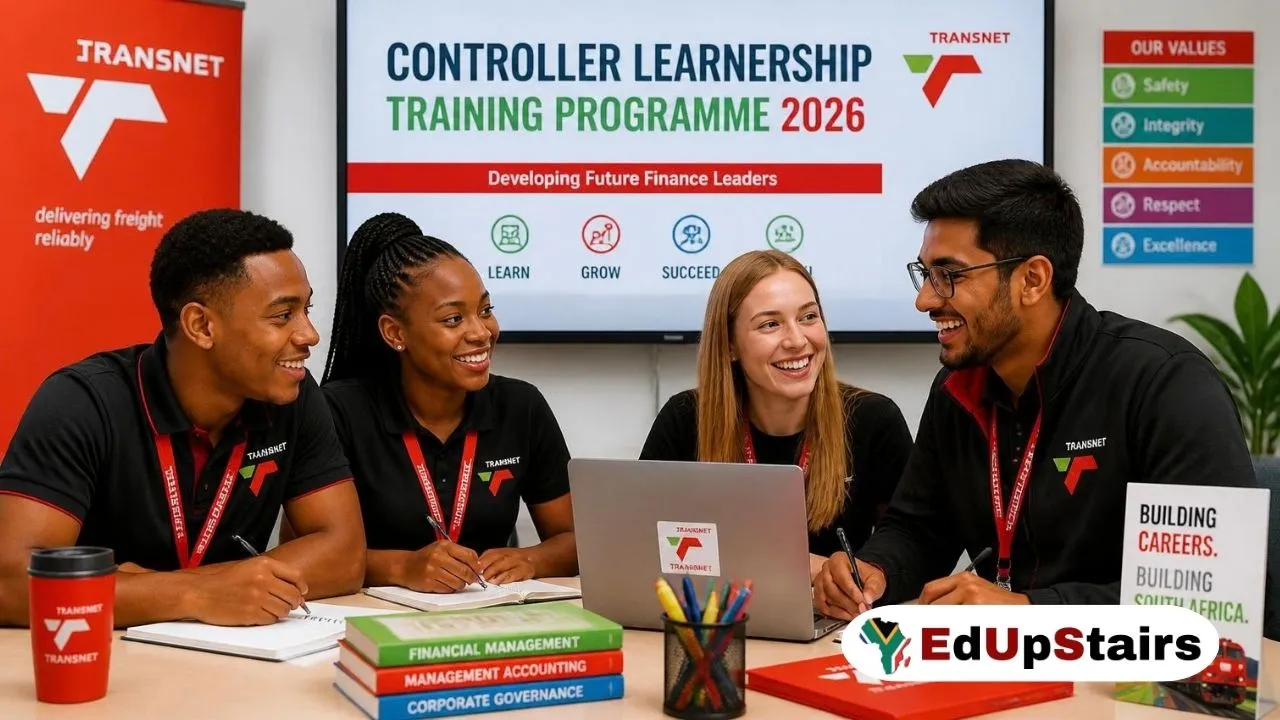

Transnet is inviting suitably qualified candidates to apply for the Trainee Controller Learnership Training Programme 2026, an opportunity designed to train successful applicants in the safe and efficient movement of petroleum products through South Africa’s pipeline network.
The programme is particularly relevant to applicants who have Grade 12 with Mathematics and Physical Science or an N3 Technical Engineering qualification in specified engineering fields.
Unlike many entry-level programmes that require a diploma or degree, Transnet specifically provides two educational entry routes for this opportunity: Grade 12 or N3 Technical Engineering.
Applicants must, however, meet the complete requirements, including holding a valid Code 08–10 driver’s licence and passing the required competency assessment.
Applications close on 6 October 2026.
Quick Overview: Transnet Controller Learnership 2026
| Programme Detail | Information |
| Organisation | Transnet |
| Programme | Trainee Controller – Learnership |
| Operating Division | Transnet Corporate Centre |
| Employee Group | Trainee |
| Department | Youth Development |
| Location | Various Locations |
| Reporting To | Senior Specialist: Youth Development |
| Grade | LRN |
| Reference | req5963 |
| Minimum Education | Grade 12 with Mathematics & Physical Science OR specified N3 Technical Engineering |
| Driver’s Licence | Valid Code 08–10 |
| Application Method | Online |
| Closing Date | 6 October 2026 |
What Is the Transnet Trainee Controller Learnership?
This programme trains candidates to perform the work associated with controlling the movement of petroleum products through a pipeline network.
According to the Transnet advertisement, a controller is responsible for the safe and efficient movement of petroleum products through the pipeline network using specialised equipment and working according to scheduled programmes and instructions.
The work requires attention to the volume and quality of products being transported as well as the safety of personnel and company assets.
Controllers also operate within an environment where internal and external customer requirements must be considered.
This means the opportunity is considerably more technical than the word “controller” might initially suggest.
Successful trainees can expect exposure to areas involving:
- pipeline operations;
- petroleum-product movement;
- operational control systems;
- risk and pollution control;
- product metering;
- maintenance;
- pipeline shutdowns;
- product quality testing;
- technical information systems; and
- specialised pipeline equipment.
Applicants who are considering technical careers can use the Edupstairs Career & Qualification Explorer to investigate engineering, instrumentation, electrical, mechanical and other related career and qualification pathways.
The Explorer currently brings together 1,511 OFO careers and 22,667 SAQA qualification records, allowing applicants to research occupations, NQF levels and qualifications from one platform.
Who Can Apply for the Transnet Controller Learnership?
There are two principal educational routes into the programme.
Route 1: Grade 12
Applicants may apply with: Standard 10 / Grade 12 with:
- Mathematics; and
- Physical Science.
This is important.
The advertisement specifically identifies Mathematics and Physical Science.
Applicants should therefore check their National Senior Certificate carefully rather than assuming that any Grade 12 certificate automatically meets the requirements.
Route 2: N3 Technical Engineering
Transnet also accepts an N3 Technical Engineering qualification in the following fields:
- Chemical Engineering;
- Mechanical Engineering;
- Electrical Engineering; or
- Metering Control & Instrumentation.
This makes the programme particularly relevant to TVET and technical-education applicants.
If you are considering studying towards an N1–N3, NC(V), occupational or other technical qualification in future, use the Edupstairs TVET College Explorer to investigate programmes at South Africa’s 50 public TVET Colleges, including their campuses, programmes, entry requirements and application resources.
Other Requirements You Should Not Ignore
Meeting the academic requirements does not necessarily mean an applicant will automatically qualify.
The Transnet advertisement also specifies that applicants must have:
- passed a competency assessment for technical ability;
- passed numeric reasoning assessment;
- passed verbal reasoning assessment;
- passed abstract reasoning assessment;
- a good command of the English language; and
- a valid Code 08–10 driver’s licence.
Applicants should therefore consider the whole eligibility profile, rather than focusing only on Grade 12 or N3.
What Will Trainee Controllers Learn?
The training covers several highly specialised operational areas.
-
Risk and Pollution Control
Trainees will learn how to communicate information regarding the risk status of a depot to relevant role players.
This includes learning to:
- report and document information;
- extract information from relevant systems;
- apply company and legislative regulations;
- deal with permits, protective clothing, restrictions and instructions;
- monitor separator tanks;
- detect leaks and spillages; and
- drain water from bund areas.
This component demonstrates why safety awareness and attention to detail are important attributes for the programme.
Pipeline operations involve infrastructure and petroleum products, so trainees need to learn how operational risk is identified, communicated and managed.
-
Handling Transmixtures and Intermixtures
Trainees will also receive training relating to the handling of mixtures and intermixtures.
This includes using company operational systems and software to control pipeline equipment.
Trainees will learn to:
- extract information;
- capture information;
- verify information for accuracy;
- prioritise information according to company procedures;
- plan the handling of transmixtures/intermixtures;
- perform blending where applicable; and
- assist with tanker loading of intermixtures.
The role therefore combines physical infrastructure with computerised operational systems.
-
Performing Minor Maintenance
Controllers are not simply expected to watch pipeline movements.
The training also includes aspects of minor maintenance.
Trainees will learn how to plan and perform certain scheduled and unscheduled minor maintenance activities, including testing, lubrication and repairs within the applicable scope.
They will also learn how to extract and capture maintenance-related information.
Applicants with Mechanical, Electrical or Instrumentation backgrounds may recognise the importance of maintenance within industrial operations.
-
Launching and Receiving Pigs and Spheres
Another particularly specialised part of the training concerns the launching and receiving of pigs and spheres.
Trainees will learn to communicate information relating to these operations and use applicable systems and software.
Training includes procedures associated with:
- isolation;
- draining;
- opening; and
- launching pigs and spheres according to company policies and procedures.
These are examples of the specialised technical processes that distinguish pipeline operations from more general administrative controller positions.
-
Product Metering
Another training area is product metering.
Trainees will learn how to use Transnet operating systems and control metering equipment.
Activities include:
- communicating operational information;
- extracting information;
- capturing information; and
- checking product-metering equipment.
Accurate measurement is particularly important where large quantities of petroleum products are being moved through an industrial network.
-
Pipeline Shutdowns
Trainees will also learn procedures associated with shutting down product movement.
This includes learning how to:
- identify or deal with substandard conditions;
- implement appropriate corrective actions;
- monitor pipeline shutdowns; and
- extract and capture relevant operational information.
The programme therefore requires applicants who can remain composed when dealing with operational problems.
-
Product Quality Testing
Product movement is not only about transporting a particular volume from one location to another.
Quality also matters.
Trainees will therefore learn how to use company product-quality testing equipment and associated software.
Training includes monitoring the initial performance of pipeline equipment and product movement and capturing the relevant information.
Competencies Transnet Is Looking For
The advertisement lists the following competencies:
Analytical ability
Controllers need to interpret operational information and make sense of technical conditions.
Perseverance
Technical operations do not always go according to plan. Candidates need the ability to continue working systematically through challenges.
Sound interpersonal skills
Although some work may occur independently, controllers still need to communicate effectively with other role players.
Attention to detail
This is particularly important when working with product quality, metering, safety procedures and operational information.
Conflict handling
Applicants should be able to manage difficult situations professionally.
Ability to remain composed
Transnet specifically requires candidates who can handle stressful situations.
Ability to work independently and in isolation
This is worth considering before applying. Candidates should be comfortable working independently when required.
High frustration tolerance
Pipeline and industrial operations can involve technical problems and demanding operating conditions.
Which SETA Pathways Are Relevant?
Applicants should also understand that a learnership exists within South Africa’s wider skills-development ecosystem.
The Edupstairs SETA Platform provides a central place to explore all 21 South African SETAs and more than 1,000 programme records across learnerships, apprenticeships, WIL, qualifications and other skills-development pathways.
This is useful even if you are applying directly to Transnet.
For example, someone interested in pipeline operations could use the platform to investigate pathways connected with:
Transport and logistics → Engineering → Electrical → Mechanical → Instrumentation → Occupational Health and Safety → Work Integrated Learning → Learnerships → Apprenticeships
Do not assume that every programme appearing on the SETA Platform qualifies you for this particular Transnet vacancy. The platform is a career and skills-development research resource; the Transnet requirements remain the requirements that determine eligibility for req5963.
What If You Want to Study Further?
This learnership does not require a university degree.
However, someone interested in building a longer-term career in engineering, technology, logistics, energy or industrial operations may eventually decide to pursue higher education.
The Edupstairs University Explorer allows prospective students to investigate South African universities, programmes, APS requirements, application information and other study resources. The Explorer currently covers 26 universities.
A learner’s longer-term pathway could therefore develop in several different directions.
For example:
Grade 12 Mathematics + Physical Science → Transnet Learnership → Pipeline Operations Experience → Further Technical Training → Career Development
Or:
Grade 12 → TVET Engineering Studies → N3 → Learnership/Workplace Training → Further Occupational Development
Or:
Grade 12 → University Engineering/Technical Qualification → Graduate/Professional Development
There is no single pathway that applies to everybody.
Use the Career & Qualification Explorer to investigate occupations and qualifications before deciding what further education would best support your career objectives.
Latest Learnership and Training Opportunities on Edupstairs
Applicants should not depend on a single application.
While waiting for the outcome of the Transnet application, investigate other opportunities for which you genuinely meet the requirements.
Northam Booysendal Learnership Programmes 2026
The recently published Northam Booysendal Learnership Programmes 2026 include Mining, Metallurgy and Auto Electrician pathways.
The Mining and Metallurgy programmes accept Grade 12/NQF Level 4 candidates with Mathematics and Physical Science, while the Auto Electrician route has more specialised technical requirements.
This makes Northam particularly relevant to some of the same technically inclined applicants considering the Transnet Controller programme.
Valterra Platinum Engineering Learnership Programme 2026 – X16
Another major current technical intake is the Valterra Platinum Engineering Learnership Programme 2026.
There are 16 positions across Fitter, Boilermaker, Rigger, Electrician, Instrument Mechanician and Millwright trades.
The programme provides structured off-the-job and workplace training leading towards a nationally recognised artisan qualification.
Mpumalanga National Youth Service X350
Applicants interested in practical technical exposure can also investigate the Mpumalanga National Youth Service Building Maintenance Programme 2026.
The current intake provides 350 opportunities across Mpumalanga and accepts specified Grade 12, N3 and NCV engineering routes. The same recruitment campaign also includes separate Trade Test opportunities in Plumbing, Electrical, Welding, Bricklaying and Plastering, and Carpentry.
These opportunities have different eligibility requirements. Read each advertisement independently before applying.
Transnet Opportunities: Build a Broader Application Strategy
Applicants interested specifically in Transnet should also understand that the organisation recruits young people through different development routes.
A recent example is the Transnet Work Integrated Technical Learnership (WITL) intake for qualified Carpentry and Plumbing artisans.
That programme targets applicants at a very different point in the technical-development pathway.
The distinction illustrates why applicants should not use “learnership”, “apprenticeship”, “WIL” and “internship” as though they always mean the same thing.
Your current qualification matters.
For example:
Grade 12 → Learnership
N2/N3/NCV → Technical Learnership/Apprenticeship
Trade Training + Workplace Experience → Trade Test
Qualified Artisan → Technical WIL/Workplace Experience
Diploma/Degree → Graduate Internship/Graduate Programme
The exact route varies by occupation and programme.
How to Apply for the Transnet Controller Learnership 2026
Applications must be submitted online through Transnet’s recruitment system.
Apply for the Transnet Trainee Controller Learnership Training Programme 2026
Reference: req5963
Closing date: 6 October 2026
Transnet states that it is the applicant’s responsibility to ensure that Human Resources has received the application before the closing date.
Do not wait until the final hours before attempting to submit.
Before completing the application, prepare your information and documents and ensure that the qualifications you enter correspond with the information appearing on your certificates.
Do not claim to have Mathematics, Physical Science, N3 subjects, a driver’s licence or technical qualifications that you do not possess.
Official Requirements vs Edupstairs Guidance
It is important to separate these two categories.
Official Transnet Requirements
The following come from the Transnet vacancy information:
- Grade 12 with Mathematics and Physical Science OR specified N3 Technical Engineering;
- competency assessment covering technical ability and numeric, verbal and abstract reasoning;
- good command of English;
- valid Code 08–10 driver’s licence;
- required competencies;
- various locations;
- reference req5963; and
- closing date of 6 October 2026.
Edupstairs Guidance
The following are additional Edupstairs resources and recommendations:
- Career & Qualification Explorer;
- TVET College Explorer;
- University Explorer;
- SETA Platform;
- related learnerships;
- career-pathway explanations; and
- suggestions about preparing applications.
These resources are intended to help applicants understand their options. They are not additional Transnet application requirements.
Tools you may find useful:
- Money Finder
- SETA Platform
- RDP / BNG Housing Eligibility Checker
- SASSA Grant Eligibility Checker
- SAPS / Metro / Traffic / DCS Eligibility Checker
- Youth Employment Eligibility Checker
- SA Bursary & NSFAS Eligibility Checker
- UIF Benefits Eligibility Checker and Payment Estimator
View Other Employment Opportunities here
Need Help?
Edupstairs Advice
Do not apply simply because the opportunity says “learnership.”
First check your certificate.
If you are applying through the Grade 12 route, verify that you have the required Mathematics and Physical Science.
If you are applying through the N3 route, check that your technical field corresponds with one of those specified by Transnet.
Then check your driver’s licence.
Only after establishing that you satisfy these requirements should you concentrate on completing the online application accurately.
Applicants should also prepare for the possibility of technical, numerical, verbal and abstract-reasoning assessments. Do not interpret this as meaning that you need to memorise pipeline terminology before applying. Rather, understand that Transnet has explicitly identified these reasoning and technical abilities as part of its assessment process.
Most importantly, build a broader application strategy.
One application should not become your entire employment plan.
Use the SETA Platform to investigate additional skills programmes, the Career & Qualification Explorer to understand where your qualifications could lead, and the TVET College Explorer if further technical education could strengthen your career pathway.
Frequently Asked Questions
-
What is the Transnet Controller Learnership 2026?
It is a trainee programme designed to train candidates in functions associated with the safe and efficient movement of petroleum products through Transnet’s pipeline network.
-
Can I apply with Grade 12?
Yes, provided you have the required Mathematics and Physical Science.
-
Can I apply with N3?
Yes. Transnet accepts N3 Technical Engineering in Chemical, Mechanical, Electrical or Metering Control & Instrumentation.
-
Do I need a degree or diploma?
The advertised minimum qualification does not require a university degree or diploma. Grade 12 and specified N3 routes are provided.
-
Do I need a driver’s licence?
Yes. The advertisement specifies a valid Code 08–10 driver’s licence.
-
Is there an assessment?
Yes. The advertisement requires applicants to pass a competency assessment covering technical ability as well as numeric, verbal and abstract reasoning.
-
Where is the learnership located?
The advertised location is Various Locations.
Applicants should therefore not assume that the programme is limited to their home province or nearest Transnet facility.
-
What will I be trained to do?
Training covers areas including pipeline operations, risk and pollution control, handling transmixtures/intermixtures, minor maintenance, pigs and spheres, product metering, shutdowns and product-quality testing.
-
Is previous work experience required?
The qualification and experience section supplied for this vacancy does not specify previous employment experience. Applicants must, however, satisfy the stated academic, assessment, language and driver’s-licence requirements.
-
Is this an office-based controller position?
The advertised duties indicate a highly technical pipeline-operations role involving petroleum-product movement, specialised equipment, operational systems, metering, maintenance, risk control and quality testing.
-
What is the reference number?
The vacancy reference is req5963.
-
When do applications close?
Applications close on 6 October 2026.
-
Where do I apply?
Applications are submitted through the official Transnet recruitment portal.
Apply for Transnet Trainee Controller Learnership – req5963
You can also:
- View latest Internships
- View latest Learnerships
- View Latest Bursaries
- View latest Government jobs
- View latest Company Vacancies
- View latest Municipality vacancies
- Visit the Edupstairs blog for daily updates
Application Outcome Tracker (anonymous)
No names collected. This helps future applicants understand real-world timelines.
Have you applied for this opportunity?
Disclaimer
Edupstairs is not Transnet and does not recruit, shortlist, assess or appoint applicants for this programme.
The core vacancy information in this Opportunity Explainer is based on the Transnet Trainee Controller – Learnership advertisement, reference req5963, supplied for this article.
Applicants should always verify the vacancy, requirements, closing date and application instructions on the official Transnet recruitment portal before submitting an application.
Never pay anyone who claims they can secure a Transnet learnership, job, interview, assessment result or appointment for you.
Editorial Integrity
The programme title, operating division, location, reference number, qualification requirements, driver’s-licence requirement, competencies, position purpose, training outputs, Employment Equity statement and closing date in this article are based on the supplied Transnet vacancy information.
Career explanations, study pathways, internal links, related opportunities and application guidance are additional Edupstairs editorial guidance designed to help applicants understand how the opportunity connects with South Africa’s broader education, training and employment system.
Where Edupstairs resources are linked, their inclusion should not be interpreted as an additional requirement imposed by Transnet.
EDUPSTAIRS IS A REGISTERED NON-PROFIT ORGANISATION NPO No: 232 – 182, PUBLIC BENEFIT ORGANISATION (PBO): 930066984. EDUPSTAIRS DOES NOT, IN ANY WAY OR FORM, SOLICIT MONEY OR CV’S FROM PEOPLE FOR JOBS. PLEASE BE AWARE OF PHONY JOB POSTINGS AND RECRUITMENT FRAUD. USE THE EDUPSTAIRS SCAM DETECTOR TOOL TO SPOT A SCAM BEFORE YOU APPLY