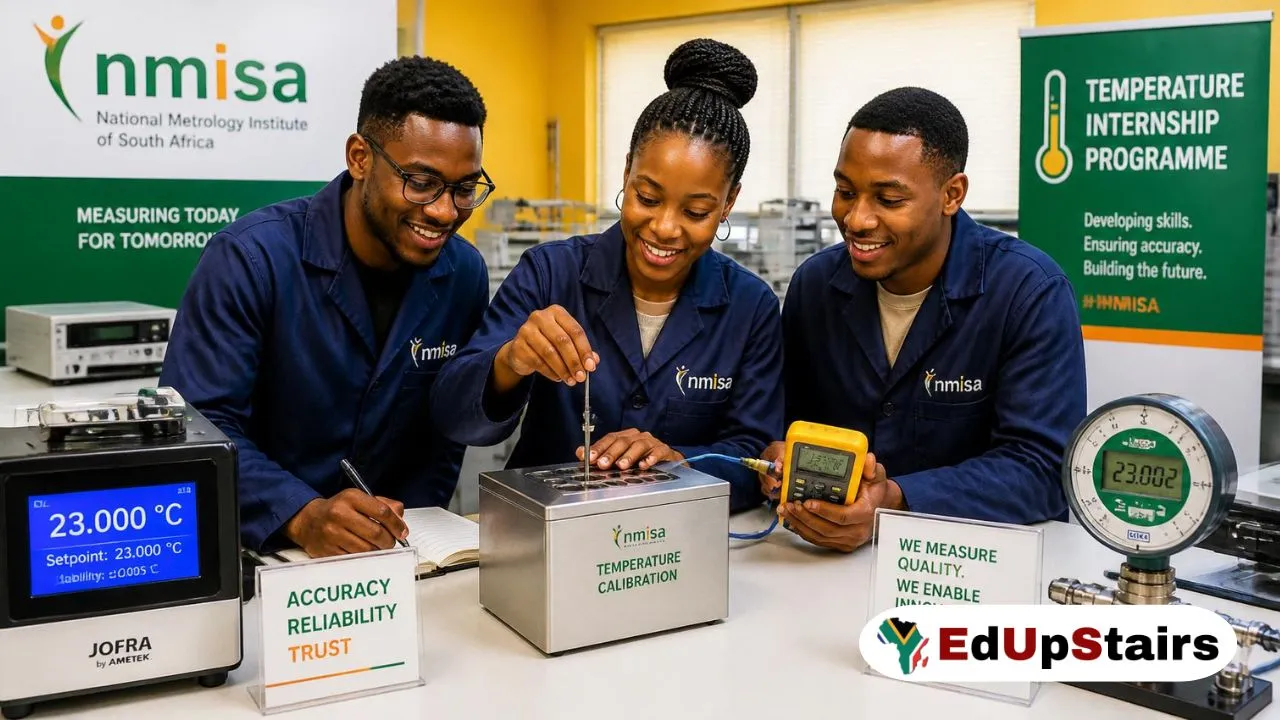

For graduates who have completed a BSc Honours degree in Physics or a related technical field but have not yet gained relevant workplace experience, the National Metrology Institute of South Africa (NMISA) Temperature Internship 2026 offers a specialised route into scientific measurement, calibration and laboratory work.
This is a 24-month internship in Temperature Metrology, with a monthly stipend ranging from R6 758 to R8 878, differentiated according to the applicant’s level of qualification. Importantly, NMISA states that no prior relevant work or internship experience is required. In fact, the official advert says candidates who already have relevant work experience will not be considered.
The opportunity is therefore particularly relevant to recent postgraduate science graduates who need their first structured opportunity to translate academic knowledge into practical laboratory experience.
Applications close on 25 August 2026, and applicants need to pay very close attention to NMISA’s document and email requirements. The organisation explicitly warns that non-compliant applications will not be considered.
Quick Overview
- Organisation: National Metrology Institute of South Africa (NMISA)
- Opportunity: Internship: Temperature
- Duration: 24 months
- Field: Temperature Metrology
- Location: NMISA, Brummeria, Pretoria, South Africa
- Minimum qualification: BSc Honours degree in Physics or a related technical field
- Experience: No prior internship or relevant work experience required
- Stipend: R6 758 – R8 878 per month
- Stipend level: Differentiated according to qualification level
- Closing date: 25 August 2026
- Application method: Email
- Application email: careers3@nmisa.org
- Required email subject: Internship_Temperature
- Required documents: CV, certified ID, qualification certificate(s) and academic transcript
- People with disabilities: Encouraged to apply
About the National Metrology Institute of South Africa
NMISA is a South African public entity operating in a highly specialised part of the country’s science and industrial infrastructure.
NMISA is a Type 3A Public Entity established in accordance with the Measurement Unit and Measurement Standards Act, No. 18 of 2006.
Its mandate includes providing for the use of the International System of Units, commonly known as SI units, in South Africa, maintaining National Measurement Standards and ensuring the comparability of those standards.
That may sound highly technical, but measurement standards affect far more of everyday economic life than many graduates realise.
Industries need to know that measurements are accurate and comparable. A temperature reading used in a laboratory, manufacturing process or technical system, for example, needs to mean the same thing when compared against recognised measurement standards.
This is where metrology comes in.
Metrology is the science of measurement. It supports accuracy, reliability and traceability in measurements used across science, industry and trade.
For a Physics graduate, an internship in this environment can provide exposure to a specialised scientific career that may not be as widely discussed as traditional graduate routes in research, teaching, engineering or data analysis.
What Is the NMISA Temperature Internship Actually About?
The purpose of the programme is not simply to place a graduate in an office for 24 months.
NMISA says the internship is intended to provide a graduate with practical training within Temperature Metrology.
The successful candidate will help support the dissemination of traceability from national temperature standards to industry. The work therefore contributes to measurement accuracy and, more broadly, supports South African trade and industry.
This distinction matters.
Applicants should understand that this is a technical scientific internship. Candidates should expect an environment involving laboratory procedures, measurements, data, documentation, quality systems and careful attention to accuracy.
Official Requirements
The requirements below come directly from the official NMISA internship advertisement.
Applicants must have:
- A BSc Honours degree in Physics or a related technical field
- Knowledge of programming and laboratory automation
- Knowledge of scientific data analysis and simulations
- A strong understanding of data analysis, uncertainty and physics-based corrections
- Computer literacy, including MS Office
NMISA also lists several areas of knowledge that would be an added advantage, rather than stating that they are mandatory:
- Knowledge of temperature measurement systems
- Familiarity with ISO/IEC 17025
- Understanding of the Guide to the Expression of Uncertainty in Measurement (GUM)
- Scientific publication record and/or international collaboration
These requirements and advantages are specifically identified in the official advertisement.
What does “related technical field” mean?
The advert does not provide a complete list of degrees that NMISA will regard as a “related technical field.”
Applicants should therefore not assume that every science or engineering qualification automatically qualifies.
If your qualification is not specifically titled BSc Honours in Physics but has substantial Physics, measurement, instrumentation or closely related technical content, you can apply if you reasonably believe it fits the advertised requirement. However, the final decision on qualification relevance belongs to NMISA.
Edupstairs does not recommend changing the description of your qualification to make it appear to be a Physics degree. Use the official qualification title shown on your certificate and academic record.
An Important Experience Requirement
This internship has an unusual eligibility condition that applicants should not overlook.
NMISA states:
- No prior internship experience is required.
- No relevant work experience is required.
- If you already have work experience, you will not be considered for this position.
This appears designed to create an entry point for graduates who have not yet had the opportunity to gain relevant workplace exposure.
If you have only completed academic projects, laboratory practicals, university research or similar academic activities, do not automatically interpret those as employment. Describe them accurately as academic experience rather than attempting to present them as formal employment.
What Will the Temperature Intern Do?
According to NMISA, the successful candidate will assist with:
- Calibration of temperature sensors
- Preparing calibration certificates
- Preparing uncertainty budgets
- Maintaining accurate job records and documentation
- Supporting compliance with NMISA’s Total Quality Management System and ISO/IEC 17025
- Laboratory planning, including budgeting and resource inputs
These responsibilities provide useful clues about what NMISA may value when reviewing applications.
Accuracy is clearly important. So are documentation, analytical ability, laboratory discipline and the ability to work within formal quality systems.
For applicants, this means your CV should not simply say that you have a Physics degree.
Where truthful, demonstrate relevant academic exposure such as:
- Laboratory practicals
- Experimental Physics
- Data analysis
- Scientific computing
- Programming
- Statistical analysis
- Instrumentation
- Measurement uncertainty
- Research projects
- Laboratory automation
- Simulation or modelling
These are suggestions for presenting relevant experience and are Edupstairs application guidance, not additional official NMISA requirements.
Person Specification
NMISA says the ideal candidate should demonstrate:
- Strong attention to detail and accuracy
- Analytical thinking and problem-solving skills
- Initiative and willingness to learn
- Integrity, reliability and accountability
- Ability to work independently and within a team
- Creativity and innovative thinking
Instead of copying these phrases directly into your CV, think about where you have actually demonstrated them.
For example, completing an Honours research project may demonstrate independent work, analytical thinking and problem-solving. Working on a group laboratory project could provide evidence of teamwork.
Evidence is generally more persuasive than a long list of unsupported adjectives.
Why This Internship Could Be Valuable for a Physics Graduate
One of the challenges facing science graduates is converting theoretical university training into demonstrable workplace capability.
A graduate may understand thermodynamics, experimental methods, programming, statistics or uncertainty calculations academically but still lack experience applying those concepts within an accredited or quality-controlled working laboratory.
The NMISA internship can help bridge that gap.
The advertised responsibilities suggest exposure to both the scientific and operational sides of metrology: calibration, uncertainty, documentation, quality management and laboratory planning.
That combination can help a graduate understand how scientific measurement functions outside the university environment.
It is important, however, not to claim that completing the internship guarantees permanent employment with NMISA or employment elsewhere. The official advert makes no such guarantee.
Stipend
The advertised stipend range is: R6 758 – R8 878 per month
NMISA states that the stipend is differentiated according to the level of qualification.
The advert does not specify exactly which qualification level corresponds to each amount within the range.
Applicants should therefore not assume that they will automatically receive R8 878 per month.
How to Apply
This is one of the most important parts of the application.
NMISA has provided unusually specific submission instructions and warns that non-compliant applications will not be considered.
Applications must be emailed to: careers3@nmisa.org
Also Check: What to Write in an Email When Sending Your CV
The exact email subject line must be: Internship_Temperature
Applicants must submit only one application per person for this position.
You must attach FOUR separate PDF files
Do not combine the documents into one PDF.
NMISA requires:
- Your CV
- Certified copy of your ID
- Qualification certificate(s)
- Full academic transcript
The required naming structure is:
Surname Name – Label
NMISA gives examples such as:
- Mokoena Thandi – CV.pdf
- Mokoena Thandi – ID.pdf
- Mokoena Thandi – Qualifications.pdf
- Mokoena Thandi – Transcript.pdf
Follow the naming convention exactly rather than inventing your own format.
Important PDF Rules
NMISA says all four documents must be submitted as PDFs.
The organisation specifically states that it will not accept:
- Word documents
- Photographs
- JPEG/image files
- Google Drive links
- OneDrive links
- Dropbox links
Your CV must be a proper PDF created from a document, such as by using “Save as PDF” in Microsoft Word. It must not be a scanned document or photograph.
Your full name, cellphone number and email address must appear at the top of the CV.
Your academic transcript must also be a clean and readable PDF rather than a photograph.
The certified ID and qualification certificate may be scanned, provided that they are clear and legible PDFs.
Edupstairs Application Guidance
The following recommendations are from Edupstairs and should not be confused with additional NMISA requirements.
Tailor your CV to the technical nature of the internship
A generic CV may fail to communicate why your academic background is relevant.
Consider including a concise section covering relevant technical competencies, but only include skills you genuinely possess.
Possible examples include:
- Python, MATLAB, R or another programming language you actually know
- Scientific data analysis
- Laboratory instrumentation
- Experimental design
- Statistical analysis
- Measurement uncertainty
- Scientific simulations
- Research methods
- Data visualisation
- Laboratory automation
Do not add software simply because it sounds impressive.
Make your Honours research visible
For a recent graduate without work experience, an Honours research project can be one of the strongest parts of the CV.
Consider stating:
- Research/project title
- Short description
- Experimental or analytical methods used
- Programming/software used
- Type of data analysed
- Laboratory or measurement techniques involved
Keep this concise and relevant.
Check your academic transcript
Do not wait until the final hour to find your transcript.
NMISA explicitly says applications without an academic transcript will not be considered.
Open the PDF before sending it and verify that every page is readable.
Common Application Mistakes to Avoid
A technically qualified candidate could still lose the opportunity because of an administrative mistake.
Before sending your application, check for:
- Incorrect email subject
- Sending documents in Word format
- Attaching photographs instead of PDFs
- Combining all documents into one PDF
- Forgetting the transcript
- Incorrect filenames
- Sending cloud-storage links instead of attachments
- Submitting a scanned CV
- Missing cellphone number or email address on the CV
- Sending multiple applications for the same position
- Sending unclear or unreadable scans
NMISA explicitly states that only applications containing all four documents, correctly named and in the required PDF format, will be considered.
Application Checklist Before You Press Send
Check that you have:
- The correct recipient: careers3@nmisa.org
- The exact subject: Internship_Temperature
- Surname Name – CV.pdf
- Surname Name – ID.pdf
- Surname Name – Qualifications.pdf
- Surname Name – Transcript.pdf
- Four separate attachments
- PDF format for every attachment
- A clear academic transcript
- A certified and legible ID copy
- Correct contact details at the top of your CV
Then open every attachment one final time.
A 60-second document check could prevent an otherwise strong application from being rejected for non-compliance.
Tools you may find useful:
- SETA Platform
- RDP / BNG Housing Eligibility Checker
- SASSA Grant Eligibility Checker
- SAPS / Metro / Traffic / DCS Eligibility Checker
- Youth Employment Eligibility Checker
- SA Bursary & NSFAS Eligibility Checker
- UIF Benefits Eligibility Checker and Payment Estimator
View Other Employment Opportunities here
Need Help?
Edupstairs Advice
This opportunity is unusually specialised, so focus on relevance rather than volume when preparing your CV.
If your Honours studies involved programming, laboratory work, scientific data analysis, simulations, uncertainty calculations, experimental Physics or instrumentation, make those competencies easy for a recruiter to identify.
At the same time, do not underestimate the administrative requirements.
NMISA has clearly stated how the application must be submitted. A candidate may satisfy the academic requirements but still be excluded for attaching the wrong file type, combining documents, forgetting a transcript or using the wrong email subject.
Treat the submission instructions as part of the application assessment.
And apply before 25 August 2026 rather than waiting for the final hours.
Frequently Asked Questions
-
When does the NMISA Temperature Internship close?
Applications close on 25 August 2026.
-
How long is the internship?
It runs for 24 months.
-
How much is the stipend?
The advertised range is R6 758 to R8 878 per month, differentiated according to qualification level. The advert does not explain the exact amount payable for each qualification level.
-
Do I need work experience?
No. NMISA specifically states that prior relevant work or internship experience is not required and indicates that applicants with work experience will not be considered.
-
What qualification is required?
The official minimum requirement is a BSc Honours degree in Physics or a related technical field.
-
Can I apply with only a bachelor’s degree?
The advert specifically requires a BSc Honours degree in Physics or a related technical field. It does not state that an ordinary bachelor’s degree alone will be accepted.
-
Where is the internship based?
The official advert identifies NMISA’s address as Meiring Naudé Road, Brummeria, Pretoria, South Africa.
-
How do I submit my application?
Email your application to careers3@nmisa.org using the exact subject Internship_Temperature.
-
Can I combine all my documents into one PDF?
No. NMISA requires four separate PDF documents.
-
Is an academic transcript compulsory?
Yes. NMISA explicitly states that applications without a transcript will not be considered.
-
Can I send Google Drive or OneDrive links?
No. The official instructions state that Google Drive, OneDrive and Dropbox links will not be accepted.
-
Are people with disabilities encouraged to apply?
Yes. NMISA specifically encourages people with disabilities to apply.
-
Will everyone receive feedback?
No. NMISA states that correspondence will be limited to shortlisted candidates.
-
Does the internship guarantee a permanent NMISA job?
No such guarantee is stated in the official advert. Applicants should view this as a 24-month practical training opportunity rather than assume permanent employment will follow.
You can also:
- View latest Internships
- View latest Learnerships
- View Latest Bursaries
- View latest Government jobs
- View latest Company Vacancies
- View latest Municipality vacancies
- Visit the Edupstairs blog for daily updates
Application Outcome Tracker (anonymous)
No names collected. This helps future applicants understand real-world timelines.
Have you applied for this opportunity?
Disclaimer
Edupstairs is an independent educational and opportunities information platform and is not NMISA.
The information in this Opportunity Explainer is based on the official NMISA Temperature Internship advertisement supplied for this article. Applicants should always read the official advertisement carefully and follow the employer’s instructions.
Requirements, selection decisions, verification processes, stipend determinations and appointments remain the responsibility of NMISA.
Never pay anyone who claims they can secure an internship position for you.
Editorial Integrity
Edupstairs independently explains employment, internship, learnership and education opportunities using information supplied by official employers and institutions.
For this article, factual details such as the qualification requirements, stipend range, duration, responsibilities, closing date, document requirements and application instructions were taken from the official NMISA internship advertisement.
Sections identified as Edupstairs Application Guidance provide independent practical advice intended to help applicants understand and prepare for the opportunity. They are not additional requirements imposed by NMISA.
Where the official advert does not provide information, Edupstairs does not invent it. For example, the advertisement does not provide a complete definition of which qualifications will be accepted as a “related technical field,” nor does it promise permanent employment after the internship.
EDUPSTAIRS IS A REGISTERED NON-PROFIT ORGANISATION NPO No: 232 – 182, PUBLIC BENEFIT ORGANISATION (PBO): 930066984. EDUPSTAIRS DOES NOT, IN ANY WAY OR FORM, SOLICIT MONEY OR CV’S FROM PEOPLE FOR JOBS. PLEASE BE AWARE OF PHONY JOB POSTINGS AND RECRUITMENT FRAUD. USE THE EDUPSTAIRS SCAM DETECTOR TOOL TO SPOT A SCAM BEFORE YOU APPLY