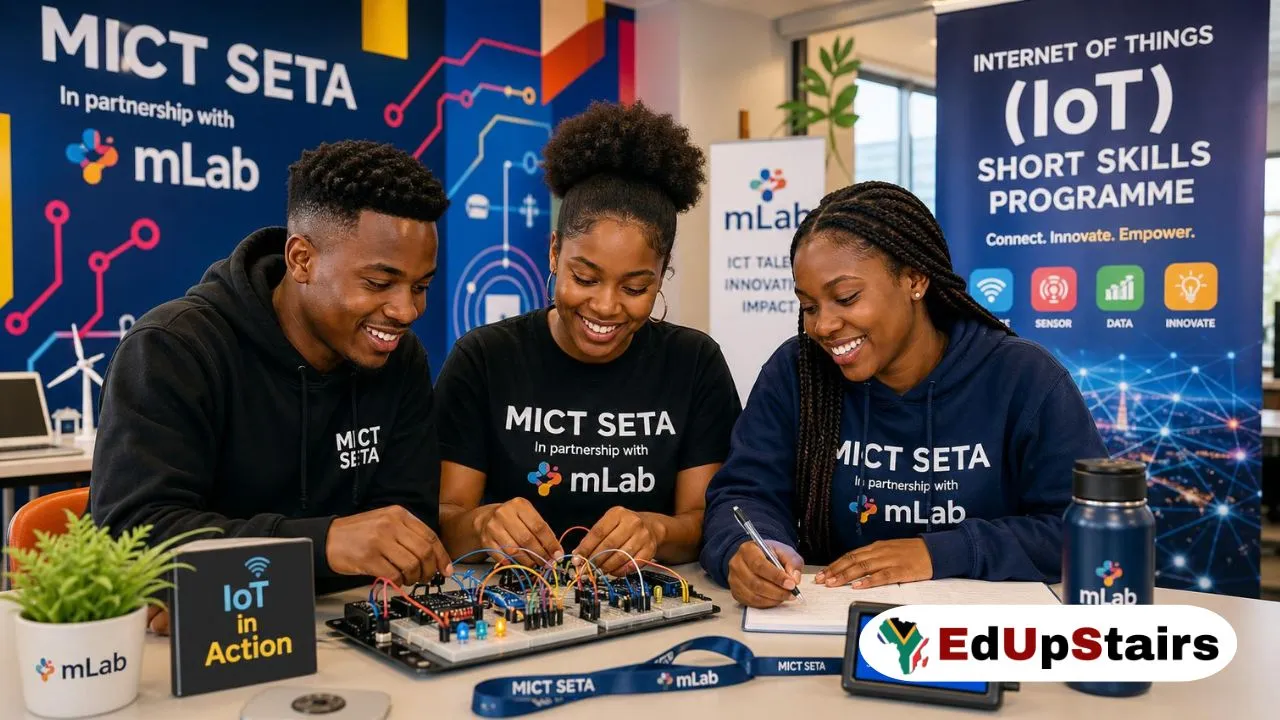

The demand for skilled technology professionals continues to grow as businesses, governments and industries embrace digital transformation. One of the fastest-growing areas in technology is the Internet of Things (IoT), where everyday devices are connected to the internet to collect, share and analyse data.
If you are a recent graduate looking to strengthen your technical skills and improve your employability, the MICT SETA & mLab Introduction to Internet of Things (IoT) Short Skills Programme 2026 could be the opportunity you’ve been waiting for.
This three-month programme is designed to equip unemployed South African graduates with practical IoT development skills while preparing them for careers in one of the world’s fastest-growing technology sectors.
At Edupstairs, we believe opportunities like these can change lives. That is why we not only explain official opportunities but also help young people discover similar programmes through the Edupstairs SETA Platform, where applicants can explore SETA-funded learnerships, internships, bursaries, apprenticeships, Work Integrated Learning (WIL) opportunities and short skills programmes from across South Africa.
Quick Overview
- Programme Name: Introduction to Internet of Things (IoT) Short Skills Programme 2026
- Offered By: mLab
- Endorsed By: MICT SETA
- Programme Duration: 3 Months
- Location: Kimberley, Northern Cape
- Monthly Stipend: Stipend available (subject to funder eligibility criteria)
- Minimum Qualification: NQF Level 5 qualification or higher
- Application Closing Date: 15 August 2026
- Employment Status Required: Unemployed
About mLab
mLab is one of South Africa’s leading technology innovation hubs focused on developing digital talent, supporting entrepreneurs and helping young innovators build practical technology solutions.
Its vision is simple but powerful:
Develop digital talent, encourage innovation and empower the next generation of African technology leaders.
Rather than only teaching theory, mLab focuses on practical, industry-relevant skills that prepare graduates for real jobs and entrepreneurship.
Through partnerships with organisations like MICT SETA, mLab continues to bridge the gap between education and employment by offering programmes aligned with industry demand.
What is the Internet of Things (IoT)?
Many people hear the phrase Internet of Things but are unsure what it actually means.
Simply put, IoT refers to physical devices that are connected to the internet and communicate with one another.
Examples include:
- Smart home devices
- Security cameras
- Smart electricity meters
- Agricultural monitoring systems
- Wearable fitness trackers
- Vehicle tracking systems
- Industrial sensors
- Smart traffic management systems
- Healthcare monitoring devices
These devices collect information and send it to software systems where the data can be analysed and used to make decisions automatically.
As more industries adopt smart technologies, the demand for IoT developers continues to increase.
Why IoT Skills are Important in South Africa
South Africa is investing heavily in digital transformation.
Industries including:
- Mining
- Agriculture
- Healthcare
- Manufacturing
- Retail
- Logistics
- Telecommunications
- Smart Cities
are increasingly adopting connected technologies.
This creates opportunities for graduates who understand:
- Embedded systems
- Programming
- Sensors
- Automation
- Networking
- Cloud computing
- Data communication
An IoT developer combines software development with hardware integration to create intelligent systems that solve real-world problems.
What Will You Learn?
While the official advertisement does not publish the detailed curriculum, introductory IoT programmes typically expose learners to concepts such as:
- Internet of Things fundamentals
- Programming for connected devices
- Sensors and actuators
- Microcontrollers
- Networking basics
- Cloud connectivity
- Data collection
- Device communication
- Smart automation
- IoT project development
The purpose of this programme is to build additional technical competencies that make graduates more attractive to employers.
Official Programme Information
According to the official programme information:
- Programme: Introduction to Internet of Things (IoT)
- Location: Kimberley, Northern Cape
- Duration: 3 Months
- Stipend: Available, subject to funder eligibility criteria.
Official Eligibility Requirements
Applicants must:
- Be a South African citizen.
- Be unemployed.
- Hold an NQF Level 5 qualification or higher.
- Be available full-time for the duration of the programme.
- Not currently be enrolled in another SETA-funded programme.
Applicants who do not meet these requirements may not be considered.
Create a Job Specific ATS CV and a Cover Letter Here
Why MICT SETA Supports Programmes Like This
The Media, Information and Communication Technologies Sector Education and Training Authority (MICT SETA) exists to develop skills within South Africa’s ICT sector.
Technology changes rapidly.
As new careers emerge, employers require graduates with practical, industry-ready experience rather than only academic qualifications.
This partnership between MICT SETA and mLab helps address that skills gap by providing graduates with practical exposure in an emerging field.
Who Should Apply?
This programme is ideal for graduates who have qualifications in areas such as:
- Information Technology
- Computer Science
- Software Development
- Information Systems
- Networking
- Electrical Engineering
- Electronics
- Mechatronics
- Computer Engineering
It may also benefit graduates who have coding experience and want to specialise in connected technologies.
Career Opportunities After Completing IoT Training
Although this is a short skills programme, it can strengthen your CV for careers including:
- IoT Developer
- Junior Software Developer
- Embedded Systems Developer
- IoT Support Technician
- Automation Technician
- Smart Systems Developer
- Firmware Developer
- Industrial IoT Technician
- IoT Testing Technician
- Technology Consultant
Many employers value practical certifications alongside formal qualifications.
Why Practical Skills are Important
Many graduates struggle to find employment because employers often ask for practical experience.
Short skills programmes like this help bridge that gap by allowing participants to:
- Work on practical projects.
- Develop technical portfolios.
- Gain exposure to industry-standard tools.
- Improve problem-solving skills.
- Build confidence before entering the workplace.
Even a three-month programme can significantly improve employability when combined with an existing qualification.
How the Edupstairs SETA Platform Can Help You
Finding the right SETA opportunity can be confusing because different SETAs advertise programmes independently.
The Edupstairs SETA Platform was created to make this process easier.
Instead of searching multiple websites every day, users can explore opportunities by:
- SETA
- Qualification level
- Learnerships
- Graduate Programmes
- Internships
- Apprenticeships
- Work Integrated Learning (WIL)
- Skills Programmes
- Short Courses
- Bursaries
The platform also helps users understand which SETA funds programmes related to their qualification and career interests, making it easier to identify opportunities beyond a single application.
If you are not selected for this IoT programme, continue checking the Edupstairs SETA Platform regularly, as new opportunities are published throughout the year.
How to Apply
Application Closing Date: 15 August 2026
Late applications may not be considered.
Tools you may find useful:
- SETA Platform
- RDP / BNG Housing Eligibility Checker
- SASSA Grant Eligibility Checker
- SAPS / Metro / Traffic / DCS Eligibility Checker
- Youth Employment Eligibility Checker
- SA Bursary & NSFAS Eligibility Checker
- UIF Benefits Eligibility Checker and Payment Estimator
View Other Employment Opportunities here
Need Help?
Edupstairs Application Advice
If you meet the eligibility requirements, don’t wait until the closing date.
Before applying:
- Update your CV.
- Ensure your qualification details are accurate.
- Prepare certified copies of your required documents if requested.
- Check that your contact information is current.
- Read all application instructions carefully.
- Submit your application well before the deadline.
Many applicants miss opportunities simply because they apply late or upload incomplete documents.
Frequently Asked Questions (FAQs)
-
Is this a learnership?
No. The official advertisement describes it as a three-month short skills programme endorsed by MICT SETA.
-
Will participants receive a stipend?
Yes. A monthly stipend is available, subject to the funder’s eligibility criteria.
-
Who can apply?
South African citizens who are unemployed, hold an NQF Level 5 qualification or higher, and meet all the official eligibility requirements.
-
Where will the programme take place?
The programme will be offered in Kimberley, Northern Cape.
-
Can I apply if I am currently studying?
The official requirements state that applicants should not be enrolled in another SETA-funded programme.
-
How long does the programme run?
The programme runs for three months.
-
Does completing the programme guarantee employment?
No. The official advertisement does not guarantee employment. However, the programme is intended to improve participants’ employability through practical digital skills.
-
What careers can this programme support?
It can strengthen your preparation for careers in IoT development, software development, embedded systems, automation and related ICT fields.
You can also:
- View latest Internships
- View latest Learnerships
- View Latest Bursaries
- View latest Government jobs
- View latest Company Vacancies
- View latest Municipality vacancies
- Visit the Edupstairs blog for daily updates
Application Outcome Tracker (anonymous)
No names collected. This helps future applicants understand real-world timelines.
Have you applied for this opportunity?
Disclaimer
Information in this article is based on the official programme announcement available at the time of publication. Programme details, eligibility requirements, funding availability and application processes may change without notice. Applicants should verify all information through the official mLab application channels before submitting their applications.
Editorial Integrity
This article has been independently prepared by Edupstairs using publicly available official programme information supplied by mLab. Our role is to explain opportunities in a simple, practical and educational way while adding career guidance that helps applicants better understand the opportunity. We do not represent mLab or MICT SETA, and applicants should always refer to the official application process for the most up-to-date information.
EDUPSTAIRS IS A REGISTERED NON-PROFIT ORGANISATION NPO No: 232 – 182, PUBLIC BENEFIT ORGANISATION (PBO): 930066984. EDUPSTAIRS DOES NOT, IN ANY WAY OR FORM, SOLICIT MONEY OR CV’S FROM PEOPLE FOR JOBS. PLEASE BE AWARE OF PHONY JOB POSTINGS AND RECRUITMENT FRAUD. USE THE EDUPSTAIRS SCAM DETECTOR TOOL TO SPOT A SCAM BEFORE YOU APPLY