
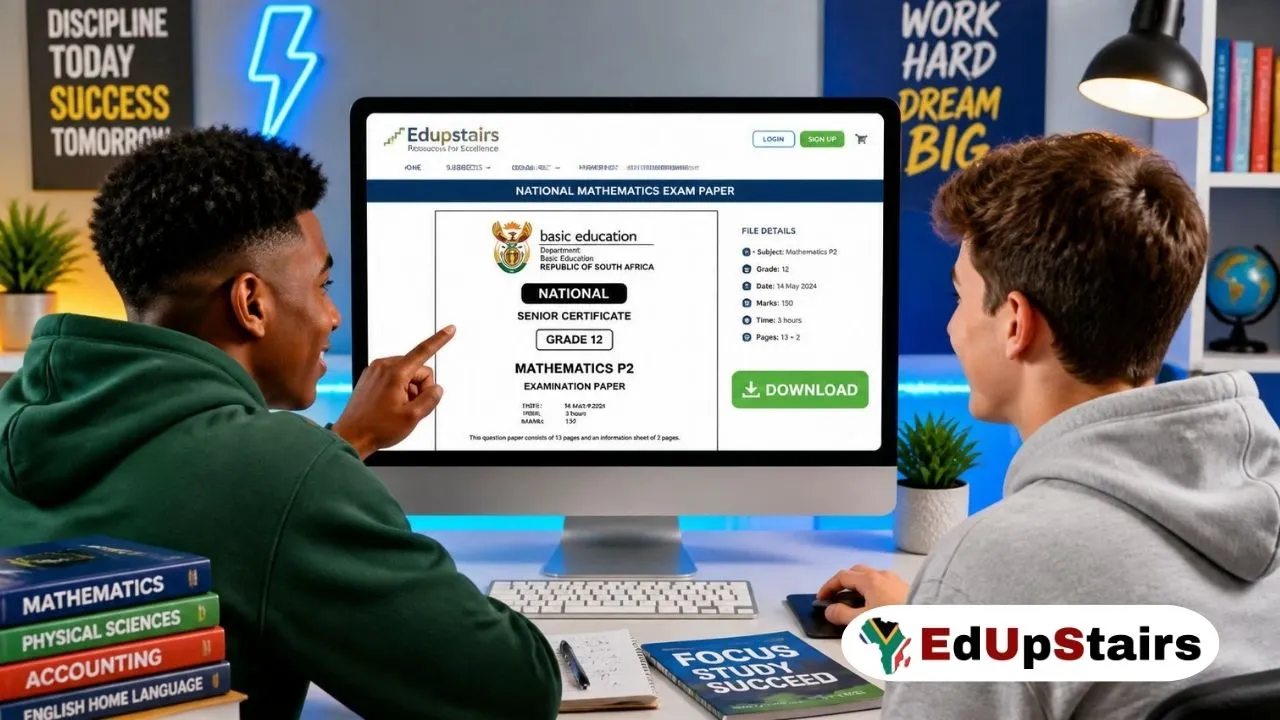

The Class of 2026 is officially writing its final matric examinations. But here is a question every Grade 12 learner should ask: Are you preparing for the questions you might face, or are you simply hoping you have studied enough?
Imagine walking into your Mathematics examination, opening the question paper and discovering that a familiar type of problem is worth several marks.
You recognise the topic. Your teacher explained it. You even remember seeing a similar question in a previous examination.
But there is one problem.
You never actually practised solving it yourself.
Now the clock is ticking, and you are trying to remember something you could have practised days earlier.
This is exactly why working through past examination papers and memoranda is one of the most valuable revision activities for South African matric learners.
The 2026 National Senior Certificate (NSC) examinations began on 13 October 2026, and hundreds of thousands of South African learners are participating in this important academic milestone.
According to the Department of Basic Education’s examination preparation guidance, learners should work through as many past examination papers as possible when preparing for their final examinations.
The good news is that you do not have to spend money buying collections of examination papers.
Edupstairs has developed a free South African School Past Exam Papers and Memoranda Explorer, bringing together examination resources from the Department of Basic Education and provincial education departments.
Before you write your next examination, give yourself the opportunity to discover what you still need to revise.
ACCESS FREE MATRIC PAST EXAM PAPERS AND MEMORANDA HERE
Quick Overview: Matric Past Exam Papers and Memoranda 2026
| Information | Details |
| Examination year | 2026 |
| Examination | National Senior Certificate (NSC) |
| Target learners | Grade 12 matric learners |
| Additional grades supported | Grades 3–11, depending on available resources |
| Resources | Previous examination papers, memoranda, marking guidelines and exemplars |
| Subjects | Mathematics, Physical Sciences, Accounting, English, Life Sciences and other available subjects |
| Cost | Free access |
| Platform | Edupstairs School Past Exam Papers Explorer |
| Main examination period | October–November 2026 |
| Official examination authority | Department of Basic Education |
| Access | Online through Edupstairs |
Important: The platform provides available past examination resources. The October/November 2026 examination papers are not presented as advance copies of examinations that learners have not yet written.
Why the 2026 Matric Examination Season Is Different From Ordinary School Tests
For many Grade 12 learners, the final examinations represent the culmination of years of schooling.
Your results can influence your access to university degrees, diplomas, higher certificates, bursaries and certain occupational training programmes.
Consider two learners who both want to study engineering in 2027.
Both attend school regularly. Both have textbooks. Both understand that Mathematics and Physical Sciences are important.
The first learner spends most of the remaining revision time rereading notes.
The second learner also studies the textbook but regularly attempts previous examination questions, checks the memoranda and works on areas where marks were lost.
There is no guarantee that the second learner will achieve better results. Nevertheless, the second learner has created opportunities to practise exam-style problem-solving, identify misconceptions and improve time management before entering the examination room.
That is the advantage of active revision.
Reading a worked solution can make a question look easy. Solving that question independently is how you discover whether you really understand it.
If you have not yet incorporated past papers into your examination preparations, you can start today.
Download Free Grade 12 Past Exam Papers and Memoranda on Edupstairs
The Edupstairs Past Exam Papers Explorer is designed to help South African learners locate official school examination resources without searching through numerous unrelated websites.
The platform includes available resources such as:
- National Senior Certificate examination question papers.
- Official examination memoranda.
- Marking guidelines.
- Previous examination resources from the Department of Basic Education.
- Provincial examination resources.
- Exemplar examination papers.
- Diagnostic and other school assessment materials.
Learners can explore available resources by grade and search for particular subjects.
The Explorer supports Grades 3 through 12, making it useful beyond matric.
For the Class of 2026, however, Grade 12 past examination papers should be a priority.
How to Find Your Past Examination Papers
Step 1: Open the Past Papers Explorer
Visit the Edupstairs School Past Exam Papers and Memoranda page.
Step 2: Select Grade 12
Use the grade selection options to narrow the available resources to matric-level examinations.
Step 3: Search for Your Subject
Search for Mathematics, Physical Sciences, Accounting, English or another subject you are preparing to write.
Step 4: Choose a Relevant Examination Paper
Where available, select a previous examination year and the correct paper, language or examination session.
Check that the resource corresponds to your subject and the current curriculum.
Step 5: Open the Question Paper
Attempt the questions independently before consulting the answers.
Step 6: Use the Memorandum
After attempting the questions, open the relevant memorandum or marking guideline where one is available.
Step 7: Revise Your Weak Areas
Identify the topics where you struggled and return to your textbook, classroom notes or study guide before attempting another paper.
START PRACTISING WITH FREE GRADE 12 PAST PAPERS AND MEMOS
Which Subjects Should Matric Learners Prioritise?
Your examination timetable and personal academic weaknesses should determine which subjects receive the most attention.
Mathematics: Practise Before You Enter the Examination Room
Mathematics requires more than recognising formulas.
Learners must understand how and when to use mathematical methods.
For Paper 1, focus on the relevant algebraic and analytical topics in your current syllabus, including functions, sequences, financial mathematics, calculus and probability.
For Paper 2, practise the applicable geometry, trigonometry and statistics topics.
When using Mathematics past examination papers, record questions you could not complete independently.
Then revisit those questions after studying the relevant concepts.
Physical Sciences: Understanding the Method Matters
Physical Sciences often requires learners to combine conceptual understanding, mathematical calculations, scientific principles and accurate terminology.
Practise calculations carefully, show your working and pay attention to units.
Use the memoranda to understand how marks are allocated.
Do not memorise a numerical answer from a previous examination. Understand the principles that produced that answer.
Accounting: Develop Accuracy Under Examination Conditions
Accounting learners should practise the financial calculations, accounting procedures, financial statements and interpretation questions required by the syllabus.
A learner may understand the accounting principle but still lose marks through calculation errors, incorrect formats or incomplete responses.
Previous examination papers can help reveal these recurring personal weaknesses.
Life Sciences: Understand the Scientific Concepts
Life Sciences learners should practise definitions, diagrams, scientific explanations, data interpretation and longer questions.
After marking your work, compare your responses with the memorandum to understand the level of scientific detail expected.
English and Other Languages: Practise Reading and Writing
Language examination preparation should include comprehension, language structures, literature and writing tasks, depending on the paper being written.
Pay attention to the wording of questions and the instructions.
For essay and transactional writing, practise planning and completing responses within the allocated time.
The objective across all these subjects is the same: use past papers to identify what you can do independently and what still needs improvement.
Important Matric Examination Dates for October and November 2026
According to the official 2026 Department of Basic Education NSC examination timetable, important scheduled papers include:
| Subject | Examination date |
| Accounting Paper 1 | 22 October 2026 |
| Mathematics Paper 1 | 23 October 2026 |
| Mathematical Literacy Paper 1 | 23 October 2026 |
| Mathematics Paper 2 | 26 October 2026 |
| Mathematical Literacy Paper 2 | 26 October 2026 |
| Accounting Paper 2 | 28 October 2026 |
| Physical Sciences Paper 1 | 30 October 2026 |
| Physical Sciences Paper 2 | 2 November 2026 |
| Life Sciences Paper 1 | 13 November 2026 |
| Life Sciences Paper 2 | 16 November 2026 |
These are selected DBE NSC examination dates, not the complete timetable.
Learners must consult the official timetable and confirm their examination arrangements with their school or examination centre. Candidates registered with other assessment bodies should follow their applicable examination timetables.
Edupstairs Advice: Identify your next examination first. Select the corresponding past paper and use the time remaining to revise the topics you find difficult.
The Past Paper Revision Method Every Matric Learner Should Try
Downloading examination papers is only the beginning.
The real benefit comes from how you use them.
Here is a practical five-stage approach.
Stage 1: Attempt the Paper Without Looking at the Answers
Select a previous examination paper appropriate to your subject.
Find a quiet place and work through it without consulting the memorandum.
Where practical, use the same time limit as the actual examination.
If you have only a short study period, select a meaningful section and attempt it independently.
Stage 2: Mark Your Answers
Once you finish, compare your responses with the official memorandum.
Pay attention to the expected method, important terminology and any marks awarded for intermediate steps.
Stage 3: Create a Mistake Register
Use a notebook to record:
| Question or topic | Problem identified | Next action |
| Algebra | Incorrect manipulation | Revise the relevant rule |
| Trigonometry | Wrong identity used | Practise similar examples |
| Accounting | Incorrect calculation | Repeat the calculation method |
| Life Sciences | Incomplete explanation | Revise concepts and terminology |
| English | Misunderstood question | Practise comprehension questions |
Your mistake register should become a personal revision guide.
It tells you what needs attention rather than forcing you to revise everything equally.
Stage 4: Revisit Your Weakest Topics
Use textbooks, teacher explanations, classroom notes and study guides to correct misunderstandings.
The Department of Basic Education also provides Mind the Gap study guides, which can complement examination practice.
Stage 5: Attempt Another Paper
After revising, attempt another suitable previous examination paper.
Compare your progress and identify any remaining difficulties.
Repeat the process where time permits.
One important warning: Past papers are not predictions of the 2026 examinations. The topics, questions and formats may vary, and learners remain responsible for studying the full prescribed curriculum.
Only Have One or Two Days Before Your Next Exam? Use Your Remaining Time Wisely
A learner with limited revision time can still benefit from structured preparation.
Instead of trying to read an entire textbook again, consider the following approach:
First revision session: Attempt a past paper or a selected set of questions without checking the answers.
Second revision session: Mark the answers and identify the topics causing the greatest difficulty.
Third revision session: Revise the concepts behind those mistakes, using your notes and teacher-recommended resources.
Final revision session: Practise selected questions again and review essential formulas, definitions, procedures or writing structures.
Leave enough time for rest, meals, sleep and preparation for the examination day.
The DBE’s own examination preparation guidance emphasises manageable study sessions, adequate sleep and arriving at the examination centre prepared.
Do not confuse studying for more hours with studying more effectively.
Not Only for Matric: Grade 10 and Grade 11 Learners Should Start Preparing Early
Although Grade 12 learners are currently writing their final examinations, other grades can benefit from previous examination resources.
A Grade 11 learner who begins practising exam-style questions now may enter Grade 12 with a better understanding of the skills that require attention.
Grade 10 learners can also develop effective examination preparation habits before matric.
The Edupstairs Past Exam Papers Explorer includes filters for Grades 3–12 and provides access to available examination, assessment and exemplar resources.
Learners should select appropriate resources for their grade, subject and curriculum rather than attempting Grade 12 papers as a replacement for their current coursework.
Explore More Than 25,000 Schools Through the Edupstairs Schools Directory
Edupstairs has also developed a South African Schools Explorer and Directory based on the Department of Basic Education’s national schools masterlist.
The directory allows learners, parents, guardians, educators and education stakeholders to research more than 25,000 schools across South Africa.
Users can search using information such as:
- School name.
- Province and education district.
- School phase.
- EMIS number.
- School quintile.
- Fee-paying or no-fee school classification.
The Schools Explorer covers institutions across all nine provinces.
Why This Directory Matters to Parents and Learners
Imagine a family relocating to another province and needing information about schools in its new area.
Instead of relying exclusively on informal recommendations, the family can use the Edupstairs Schools Directory to identify schools and review the available official masterlist details.
Parents can also use the directory to investigate schools by district and school phase.
Teachers, education researchers and community organisations may find it useful when researching the distribution of schools.
Important: A school’s appearance in the directory does not establish current admission availability, contact details, academic performance or quality. Verify admissions and other current information directly with the school and education department.
EXPLORE SOUTH AFRICAN SCHOOLS BY PROVINCE AND DISTRICT
Your Matric Results Can Influence Your 2027 Opportunities – Have You Planned Your Next Step?
Here is something many learners only begin thinking about after their final examinations.
Passing matric is an important achievement.
But what happens after your results are released?
Will you apply for university? Attend a TVET college? Pursue a learnership? Apply for a bursary? Explore an apprenticeship?
There is no single pathway that is right for every learner.
What matters is knowing which qualifications and entry requirements are associated with the career you want.
Edupstairs has developed several free tools to help you investigate these decisions.
-
Explore South African Universities and 2027 Courses
The Edupstairs University Explorer helps prospective students research South African universities, programmes, admission requirements, APS information and available application resources.
This can help you investigate whether your subject choices and academic performance align with a particular qualification.
Some degree programmes require specific Mathematics, Physical Sciences or language achievement levels.
Do not assume that obtaining a Bachelor’s pass automatically qualifies you for every university degree.
University admission remains subject to the institution’s specific requirements, capacity and selection arrangements.
-
Explore All 50 Public TVET Colleges
University is not the only post-matric option.
South Africa also has a network of 50 public Technical and Vocational Education and Training colleges.
Through the Edupstairs TVET College Explorer, learners can investigate colleges, campuses, vocational programmes and relevant application information.
Technical training may provide pathways into fields such as engineering-related occupations, business administration, information technology and other vocational disciplines.
Edupstairs also offers a separate TVET Past Examination Papers and Memoranda Library for learners interested in NC(V) and NATED/Report 191 examination resources.
-
Explore Careers Before Choosing Your Qualification
Imagine spending years studying towards a qualification only to discover that you misunderstood the occupation it was supposed to prepare you for.
That is why career research matters.
The Edupstairs Career and Qualification Explorer allows users to research South African occupations, SAQA qualifications, NQF levels and available qualification pathways.
You can investigate careers associated with fields such as engineering, health sciences, education, finance, information technology and the skilled trades.
Understanding a career before choosing a qualification can help you make a more informed decision.
-
Not Sure Which Career Suits You? Try Career Discovery
Some matric learners already know what they want to become.
Others are still exploring.
If you are uncertain about your interests, try the free Edupstairs Career Discovery Assessment.
The assessment asks about activities you might enjoy and suggests occupations that align with your occupational interests.
It does not guarantee admission, assess employment eligibility or determine what you are capable of achieving.
Its purpose is to provide a starting point for further career exploration.
-
Understand South Africa’s Skills Landscape
A qualification decision should be informed by more than the popularity of a career.
The Edupstairs National Skills Intelligence Explorer brings together South African occupational classifications and available SETA research observations.
Users can explore documented priority occupations, skills-related research, emerging occupational themes and qualification pathways.
However, historical research and occupational priority classifications are not guarantees of future employment or live job opportunities.
Use the information as one part of your career research.
-
Explore All 21 SETAs and Their Training Programmes
Not every learner will move directly into university after matric.
Some may pursue occupational certificates, learnerships, apprenticeships or other skills-development programmes.
The Edupstairs SETA Platform provides access to information about all 21 South African Sector Education and Training Authorities.
You can investigate learnerships, apprenticeships, skills programmes, occupational qualifications, workplace learning and bursary-related pathways.
This is especially useful for matriculants researching vocational alternatives or longer-term routes into employment.
Latest 2027 Bursaries Published on Edupstairs – Don’t Miss Important Application Dates
While you are preparing for your matric examinations, remember that some funding programmes for the 2027 academic year already have application deadlines approaching.
You do not have to abandon your examination preparation to investigate bursaries.
Instead, set aside a manageable amount of time to identify legitimate funding opportunities and prepare necessary documents.
Below are recently published bursaries that prospective students should investigate.
ATNS Air Traffic Services Bursary Programme 2027 – 120 Opportunities
Air Traffic and Navigation Services has advertised 120 ATS bursary opportunities for 2027/28.
The programme involves specialised aviation training at the ATNS Aviation Training Academy in Gauteng.
The advertised minimum academic requirements include a completed matric qualification with Pure Mathematics and English at Level 4, together with other eligibility conditions.
This is particularly relevant to learners interested in aviation, although current Grade 12 learners who have not yet obtained their matric results should verify their eligibility before applying.
Advertised listing closing date: 5 October 2027. Applicants should confirm the deadlines and availability for individual training intakes with ATNS.
Northam Zondereinde Bursaries 2027
The Northam Zondereinde Bursary Programme for 2027 includes several study disciplines and is relevant to qualifying learners and tertiary students.
Closing date: 22 October 2026.
Applicants should investigate the academic requirements, supported fields and required admission documentation immediately.
Glencore Coal SA Bursary Programme 2027
The Glencore Coal South Africa Bursary Programme for 2027 supports qualifying students pursuing Mining Engineering.
The advertised funding package includes several study-related expenses, subject to the programme’s conditions.
Closing date: 30 October 2026.
Limpopo Department of Public Works Bursary 2027
The Limpopo Department of Public Works, Roads and Infrastructure Bursary Programme supports eligible Limpopo students in identified priority study fields.
These include engineering, construction and related infrastructure disciplines.
Stated closing date: 31 October 2026, based on the department’s published annual deadline. Check for updated official notices.
Victor Thebe Sifora Provincial Bursary Programme 2027
The North West Victor Thebe Sifora Provincial Bursary Programme for 2027 targets qualifying youth permanently residing in North West.
The advertised priority study fields cover several sectors, including health, engineering, education, agriculture, information technology and public administration.
Closing date: 13 November 2026.
Silulumanzi Bursary Fund 2027
The Silulumanzi Bursary Fund for 2027 is relevant to eligible students interested in engineering, science, environmental and technical disciplines associated with the water industry.
It has specific academic, admission and geographical conditions.
Closing date: 30 November 2026.
SIOC-CDT Bursary Programme 2027
The SIOC Community Development Trust Bursary Programme for 2027 targets qualifying applicants from identified beneficiary communities.
The programme includes academic, financial and institutional admission requirements.
Closing date: 30 November 2026 at 12:00.
For additional funding opportunities, visit the Edupstairs Latest Bursaries Section.
Important: Bursary programmes have different eligibility criteria. Publication on Edupstairs does not guarantee that applications remain open or that any individual will qualify. Always verify the latest instructions with the bursary provider.
Matric Learners: Check Your Bursary and NSFAS Funding Options for 2027
Your examination results and your study-funding arrangements are connected, but they are not the same thing.
A learner may qualify academically for a programme while still needing financial assistance.
If you intend to study in 2027, investigate funding as early as possible.
The Edupstairs Bursary and NSFAS Eligibility Checker can help you explore potential funding pathways based on your circumstances.
You should also read the NSFAS Applications for 2027 University and TVET Funding Guide for information about the funding application process.
These Edupstairs resources provide independent guidance. They do not replace official funding applications or decisions.
If a bursary requires a student CV, use the Edupstairs Student CV Guide for Bursary Applications and the Bursary Supporting Documents Checklist.
Your 2026 Exams and 2027 Future
Use these free education and career resources as you prepare for your examinations and next academic steps.
Examination preparation: Grade 12 Past Exam Papers and Memoranda | TVET Past Exam Papers and Memos
School information: South African Schools Directory and Explorer
University and college research: University Explorer | TVET College Explorer
Career planning: Career and Qualification Explorer | Career Discovery Assessment
Skills and training: National Skills Intelligence Explorer | SETA Platform
Study funding: Latest Bursaries | Bursary and NSFAS Eligibility Checker | NSFAS 2027 Funding Guide
Tools you may find useful:
- Money Finder
- SETA Platform
- RDP / BNG Housing Eligibility Checker
- SASSA Grant Eligibility Checker
- SAPS / Metro / Traffic / DCS Eligibility Checker
- Youth Employment Eligibility Checker
- SA Bursary & NSFAS Eligibility Checker
- UIF Benefits Eligibility Checker and Payment Estimator
View Other Employment Opportunities here
Need Help?
Edupstairs Advice: Your Next Examination Deserves More Than Hope
To the Class of 2026:
You have already spent years working towards your matric certificate.
You have attended lessons, completed assignments, written tests and prepared for examinations.
Now you have reached the point where your preparation must translate into answers on an examination paper.
You cannot control the exact questions the examiner will set.
You cannot control how difficult you might find a particular paper.
But there are things you can still influence.
You can choose to practise.
You can identify your weaknesses.
You can ask for help.
You can revise the topics you do not understand.
And you can enter your next examination knowing that you made productive use of your preparation time.
Imagine finishing your last matric paper in November and knowing that you gave yourself every reasonable opportunity to prepare.
That confidence is worth working towards.
Your next step starts here:
DOWNLOAD FREE MATRIC PAST EXAM PAPERS AND MEMORANDA FOR 2026 EXAM PREPARATION
Share this resource with classmates who may also benefit from free examination materials.
Access to reliable revision resources should not depend on whether a learner can afford expensive study packs.
Frequently Asked Questions About Matric Past Papers 2026
-
Where can I download free Grade 12 past exam papers and memoranda?
You can use the Edupstairs School Past Exam Papers Explorer to search for available Grade 12 examination papers, memoranda and other official assessment resources.
-
Can I download Mathematics and Physical Sciences past papers?
Yes. You can search the Explorer for available Mathematics and Physical Sciences examination resources and select the appropriate paper and year.
-
Are the papers and memoranda free?
The Edupstairs Explorer provides free access to its indexed resources. Standard internet or data charges may still apply.
-
Will questions from previous years appear in the 2026 matric examinations?
There is no guarantee. Past examination papers help learners practise concepts, examination techniques and problem-solving skills. They do not reveal the questions that will appear in an unreleased examination.
-
Should I only study previous examination papers?
No. Use past papers together with current curriculum materials, textbooks, study guides, classroom notes and teacher guidance.
-
Can Grade 10 and Grade 11 learners use the platform?
Yes. The platform offers grade filters covering Grades 3–12, with resource availability varying by grade and subject.
-
Where can I find the official 2026 matric examination timetable?
Visit the Department of Basic Education’s NSC Examinations page and open the 2026 November NSC examination timetable.
-
Can I find my school on Edupstairs?
You can search the Edupstairs South African Schools Directory by school name and available masterlist information, including province, district and EMIS number.
-
Can my matric results help me qualify for a bursary?
Academic results are an important eligibility consideration for many bursaries. However, funding programmes may also consider financial need, residence, intended study field, institutional admission and other conditions.
-
What if I do not achieve the matric results I wanted?
Investigate the applicable result-improvement or rewriting options through the Department of Basic Education. You can also research alternative study and training pathways through the Edupstairs career, university, TVET and SETA resources.
A disappointing result does not mean every education or career pathway is permanently closed.
You can also:
- View latest Internships
- View latest Learnerships
- View Latest Bursaries
- View latest Government jobs
- View latest Company Vacancies
- View latest Municipality vacancies
- Visit the Edupstairs blog for daily updates
Disclaimer
Edupstairs is an independent South African education and career information platform.
The Past Exam Papers Explorer indexes available examination and assessment materials from official education sources. Edupstairs does not set National Senior Certificate examinations, administer the examinations, issue matric certificates or guarantee examination results.
The existence of a particular historical examination paper or memorandum does not establish that the same questions will appear in the 2026 examinations.
Learners must use their official examination timetable, current curriculum and school-issued instructions as the authoritative sources for examination preparation and attendance.
Bursary information and deadlines are provided for educational guidance and may change. Applicants must consult the relevant official bursary provider before applying.
Editorial Integrity
This Edupstairs education guide was researched for the 2026 matric examination season using the Department of Basic Education’s published NSC examination timetable, examination preparation guidance and historical examination resources.
Information about the Edupstairs School Past Exam Papers Explorer, Schools Directory, universities, TVET colleges, Career and Qualification Explorer, Career Discovery Assessment, National Skills Intelligence Explorer and SETA Platform was checked against the corresponding Edupstairs resources.
The bursary opportunities linked above are independently published Edupstairs articles. Their requirements, application procedures and deadlines remain subject to the respective bursary providers’ official documentation.
Edupstairs does not claim to possess confidential or unreleased 2026 NSC examination papers. All learning advice is intended to support legitimate preparation, academic integrity and informed post-school planning.
EDUPSTAIRS IS A REGISTERED NON-PROFIT ORGANISATION NPO No: 232 – 182, PUBLIC BENEFIT ORGANISATION (PBO): 930066984. EDUPSTAIRS DOES NOT, IN ANY WAY OR FORM, SOLICIT MONEY OR CV’S FROM PEOPLE FOR JOBS. PLEASE BE AWARE OF PHONY JOB POSTINGS AND RECRUITMENT FRAUD. USE THE EDUPSTAIRS SCAM DETECTOR TOOL TO SPOT A SCAM BEFORE YOU APPLY

