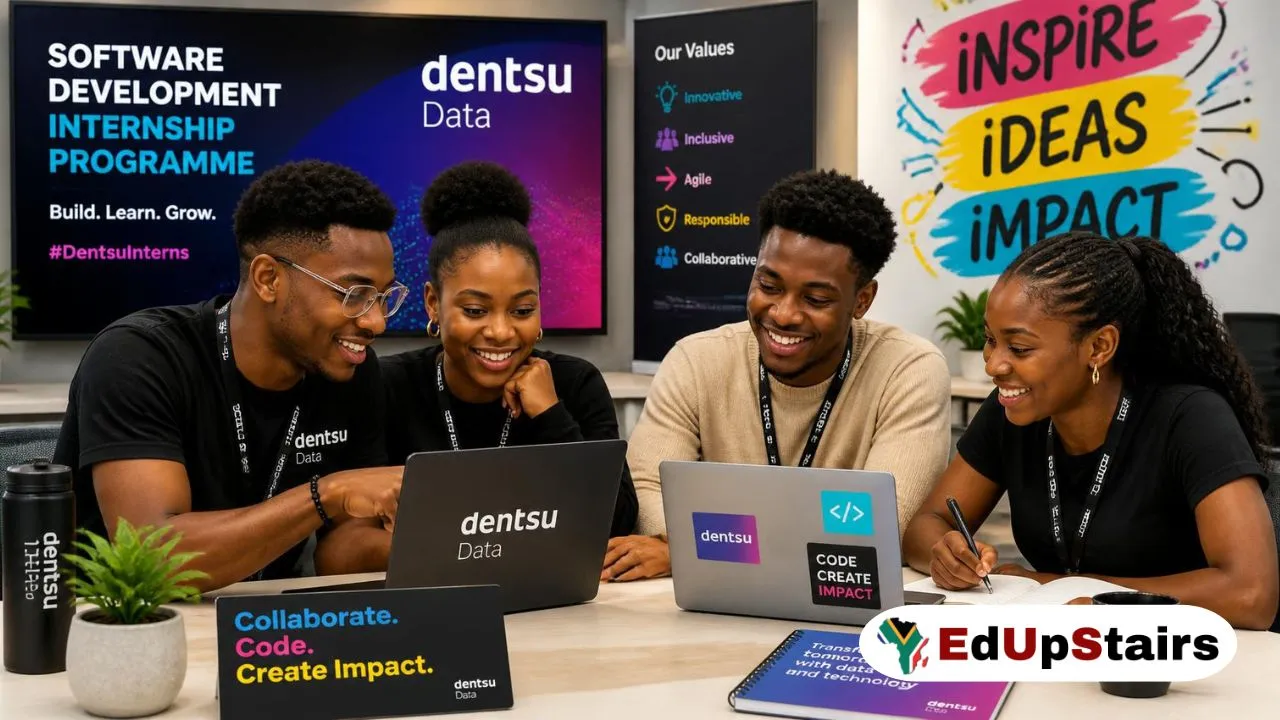

Are you a final-year computing student who wants real product experience building cloud, data and AI-enabled software? This 6-month on-site software engineering internship at dentsu Data in Cape Town offers practical exposure to Python, TypeScript/JavaScript, APIs and Microsoft Azure — plus collaboration with engineers, data scientists and product teams. Below you’ll find a concise summary of the role and practical, applicant-focused guidance to help you decide whether to apply and how to prepare a strong submission.
Quick overview — verified facts
- Job title: Intern Software Development
- Company: dentsu (dentsu Data)
- Location: On-site — 183 Sir Lowry Road, Woodstock, Cape Town, Western Cape, South Africa
- Contract: 6-month internship (fixed-term)
- Employment type: Full time, Intern / Student
- Closing date: 7 August 2026
- Posted: 30 July 2026
- Minimum requirement: Undergraduate final year / degree in Computer Science or Information Systems (or similar)
- Technical skills listed: basic proficiency in Python, TypeScript or JavaScript; familiarity with Git, APIs and databases; basic knowledge of software testing/debugging; familiarity with cloud computing concepts (preferably Microsoft Azure)
- Work will include: building product features, APIs and backend services; testing and debugging; participating in code reviews and collaborative engineering practices; exposure to AI/data solutions
- Apply via Dentsu Data Careers Portal
- Response note in advert: “Should you do not hear from us within two weeks, you may consider your application unsuccessful.”
What this opportunity really offers
This internship is positioned as a learning-forward, product-focused placement inside a commercial agency environment. Expect to work on real product features and collaborate with cross-functional teams that include engineers, data scientists, AI specialists and product managers. Key practical gains are:
- Applied coding experience in Python and/or TypeScript/JavaScript — writing maintainable, tested code that ships to a product.
- Backend/API development and integration with databases, plus exposure to cloud-native development on Microsoft Azure.
- Familiarity with industry workflows: Git-based version control, code reviews, testing and debugging in a team setting.
- Visibility into how data and AI components are included in client-facing products.
- Short-term professionalisation: managing tasks, adapting to workplace expectations, receiving technical mentoring and feedback.
Who should consider applying
- Final-year undergraduate students in Computer Science, Information Systems or related technical degrees who can commit to a 6-month, full-time, on-site internship in Cape Town.
- Developers with basic hands-on experience in Python or TypeScript/JavaScript from coursework, personal projects, or previous internships who want to broaden into cloud and data-driven product work.
- Candidates who enjoy working in collaborative, multidisciplinary teams and want exposure to AI/data specialists and product management.
- Early-career applicants aiming to transition from academic projects to production-quality code and industry workflows.
Is it worth applying?
Yes — if you meet the minimum academic requirement and have basic coding experience. This is a classic bridge role: it focuses less on advanced algorithms and more on shipping maintainable code, learning cloud concepts and participating in team engineering practices. For students who want to convert academic knowledge into production-ready skills and who can be on-site in Cape Town, this internship is a strong short-term investment in practical experience.
How competitive could it be?
Although exact applicant volumes aren’t provided, software engineering internships at well-known agencies typically attract many applicants: final-year students from local universities, bootcamp graduates and early-career developers all apply. The most important differentiators will be:
- Demonstrable hands-on experience — even small projects or university module work that show you’ve written, tested and deployed code.
- Clarity about the technologies you know (Python vs TypeScript) and concrete examples that prove it.
- Evidence of teamwork and communication: contribution to group projects, open-source work, or internships where you collaborated with others.
- Professionalism in your application: clean CV, concise cover note, correct links to code or portfolios and punctuality with the closing date.
What a strong application should show
Recruiters will look for signals that you can move quickly from learning to contributing. A strong application will combine:
- Technical evidence: one or two short projects showing backend/API work or full-stack involvement, with links to repositories or live demos.
- Clear statement of your role on projects: what you built, technologies used, what you learned and what you tested.
- Familiarity with core tools: Git history, branches and meaningful commit messages; mention of Azure if you used it or a similar cloud platform.
- Soft skills: examples of teamwork, communication and how you handled feedback or tight deadlines.
- Interest in data/AI: mention of relevant coursework, personal projects or online learning in data science, machine learning or AI APIs if available.
Also Check: Internship Readiness Checklist: Everything South African Students and Graduates Need Before Applying
What Employers Look for in Internship Candidates in South Africa
CV and cover letter advice tailored to this internship
- Length and layout: keep your CV to 1–2 pages. Use clear headings: Education, Technical Skills, Projects, Work Experience, Relevant Coursework.
- Technical Skills section: list languages and tools with a short proficiency label (e.g., Python — intermediate; TypeScript — basic). Include Git and Azure if you have experience, even at an introductory level.
- Projects: for each project include a one-sentence summary (problem solved), a bullet list of your contributions, technologies used, link to code or demo, and one measurable outcome where possible.
- Cover note: 3 short paragraphs. 1) A hook: who you are and your final-year status; 2) two quick examples showing technical competence and teamwork; 3) one sentence explaining why dentsu and what you want to learn over 6 months.
- Proofread: avoid spelling or grammar errors and ensure all links work. Use South African spelling conventions.
Create a Job Specific ATS CV and a Cover Letter Here
What the selection process may involve (general preparation)
Note: The following is general preparation advice typical for internships like this and not confirmed by the employer.
- Application screen: HR or the hiring manager checks eligibility (final-year status), technical skills and clarity of CV/cover note.
- Technical assessment or take-home task: a small coding challenge or bug-fix related to APIs, backend code or basic algorithms. Focus on clarity, tests and maintainability rather than clever one-liners.
- Technical interview: discussion of your projects, a walkthrough of code you’ve written, and problem-solving questions around debugging and design decisions.
- Behavioural interview: examples of teamwork, handling feedback and time management; expect questions about how you work in a team and how you prioritize tasks.
- Reference or academic checks: may be requested for final clearance.
Tip: be ready to explain trade-offs in your code (why you wrote it that way), how you tested it, and how you would monitor or improve it in a production setting.
Career paths this experience may support
Completing this internship can strengthen your profile for several early-career routes:
- Junior backend or full-stack developer roles in agencies or tech companies.
- Cloud engineering or DevOps entry roles, especially if you deepen Azure exposure.
- Data engineering or ML engineering entry roles, when combined with additional data-focused projects.
- Product- or engineering-focused graduate programmes that value practical product delivery experience.
Remember, the internship is a stepping stone — use it to accumulate concrete examples of shipped work, which matter more than credentials alone.
Common application mistakes to avoid
- Submitting a generic CV or cover letter — tailor to the technologies and teamwork emphasis in the role.
- Linking to private or non-functioning code repositories; ensure public access and working demos where possible.
- Overstating experience — be honest about proficiency levels and explain gaps as learning opportunities.
- Ignoring testing and code quality in project samples. The advert emphasises maintainable, well-tested code.
- Missing the closing date or failing to follow the application URL precisely.
Similar opportunities to consider
If you’re aiming for hands-on product engineering and cloud exposure, look for:
- Software engineering internships at digital agencies or product startups — similar fast-paced, product-driven learning.
- Data engineering, ML engineering or data science internships for a stronger focus on data pipelines and modelling.
- Cloud-focused graduate programmes or vendor bootcamps (Azure-focused) if you want formal cloud certification paired with hands-on work.
How to apply
Apply through the employer’s official vacancy page.
Note the closing date is 7 August 2026. The advert also states: “Should you do not hear from us within two weeks, you may consider your application unsuccessful.” Ensure your CV, cover note and project links are ready before you submit.
Tools you may find useful:
- RDP / BNG Housing Eligibility Checker
- SASSA Grant Eligibility Checker
- SAPS / Metro / Traffic / DCS Eligibility Checker
- Youth Employment Eligibility Checker
- SA Bursary & NSFAS Eligibility Checker
- UIF Benefits Eligibility Checker and Payment Estimator
View Other Employment Opportunities here
Need Help?
Edupstairs advice
Before you apply, prepare a one-page project brief for one of your strongest projects that explains the problem, your design choices, tests you wrote and what you’d improve with more time. Attach this as a PDF or include a link in your cover note — it’s a compact way to demonstrate the “maintainable, well-tested code” the internship emphasises. If you’re short on Azure experience, take one short guided lab (Microsoft Learn has free modules) so you can at least speak knowledgeably about cloud concepts in an interview.
Frequently asked questions
-
Do I need to be in Cape Town already?
The role is on-site at 183 Sir Lowry Road in Woodstock, Cape Town, so you must be able to work on-site for the 6-month contract.
-
Is this suitable for final-year students?
Yes — the advert specifies undergraduate final-year or degree status in Computer Science/Information Systems (or similar).
-
What technologies should I highlight?
Highlight Python and/or TypeScript/JavaScript, Git, APIs, databases and any Azure or cloud exposure. Also emphasise testing and clear code.
-
Will I work with AI or data teams?
The role includes exposure to data and AI-powered solutions and collaboration with data scientists and AI specialists.
-
How long is the contract and what happens after 6 months?
The advertised contract is 6 months. The advert does not promise future employment; use the period to build tangible project outcomes for your next applications.
You can also:
- View latest Internships
- View latest Learnerships
- View Latest Bursaries
- View latest Government jobs
- View latest Company Vacancies
- View latest Municipality vacancies
- Visit the Edupstairs blog for daily updates
Application Outcome Tracker (anonymous)
No names collected. This helps future applicants understand real-world timelines.
Have you applied for this opportunity?
Disclaimer
Please confirm final details, application steps and timelines on the employer’s official vacancy page before applying.
EDUPSTAIRS IS A REGISTERED NON-PROFIT ORGANISATION NPO No: 232 – 182, PUBLIC BENEFIT ORGANISATION (PBO): 930066984. EDUPSTAIRS DOES NOT, IN ANY WAY OR FORM, SOLICIT MONEY OR CV’S FROM PEOPLE FOR JOBS. PLEASE BE AWARE OF PHONY JOB POSTINGS AND RECRUITMENT FRAUD. USE THE EDUPSTAIRS SCAM DETECTOR TOOL TO SPOT A SCAM BEFORE YOU APPLY