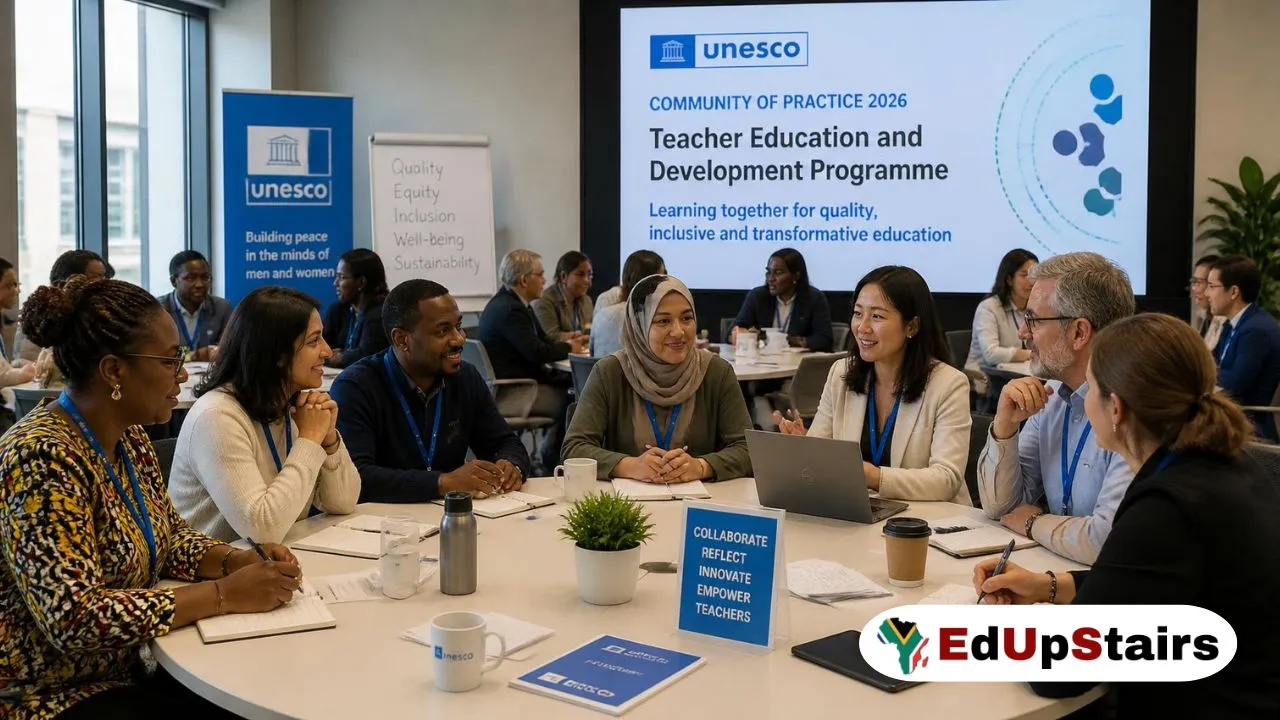

Teachers, teacher educators, education researchers, school leaders and education policymakers across Sub-Saharan Africa have an opportunity to participate in an international professional learning programme focused on strengthening teacher education and development.
The GPE KIX Africa 19 Hub team at the UNESCO International Institute for Capacity Building in Africa (IICBA) has announced the restart of its Community of Practice (CoP) in Teacher Education and Development Strengthening in Sub-Saharan Africa, with Module 2 beginning on 19 August 2026.
The programme is delivered virtually and is designed as a peer-learning space where education professionals from different African countries can exchange knowledge, examine evidence-based approaches and strengthen their capacity to improve teacher development programmes.
Registration for Module 2 closes on 14 August 2026, making this a time-sensitive opportunity for eligible education professionals who want to participate.
Quick Overview
- Programme: Community of Practice (CoP) – Teacher Education and Development Strengthening in Sub-Saharan Africa
- Module: Module 2
- Format: Virtual peer-learning programme
- Registration deadline: 14 August 2026
- Participants notified: 16 August 2026
- Programme begins: 19 August 2026
- Session frequency: Every second Wednesday
- Session time: 3:00 PM–5:00 PM East Africa Time (UTC+3)
- Independent learning: Approximately 3 hours of self-paced learning per month
- Final scheduled session: 16 December 2026
- Certification: Available to participants who meet the stated participation and assignment requirements
- Geographical focus: Sub-Saharan Africa
What Is the Community of Practice?
According to the official programme information, the Community of Practice is a virtual peer-learning space for education policy actors, teacher representatives and selected school leaders.
Its purpose is to enable participants to exchange evidence-based policies and good practices relating to:
- Teacher professional development
- In-service education
- Teacher education policy
- Education reform
- Professional learning
- Capacity development
The programme is particularly important because improving education systems is not simply a matter of recruiting more teachers. Education authorities also need mechanisms that help existing teachers develop their knowledge, teaching practice and professional capabilities throughout their careers.
The CoP provides a space where people involved in those systems can learn from experiences across Sub-Saharan Africa rather than working entirely within their own institutions or countries.
Why This Programme is Important
Teacher development affects much more than an individual educator’s career.
Well-designed professional development can influence classroom practice, curriculum implementation, school leadership and ultimately the quality of learning experienced by pupils.
At policy level, governments and education institutions must also decide how teacher professional development should be structured, delivered, monitored and improved.
The Community of Practice therefore brings together participants who can contribute from different parts of the education system.
Instead of operating as a conventional once-off webinar, the programme combines interactive virtual workshops with applied and independent learning.
The official announcement states that participants will work on strengthening their capacity to improve teacher development programmes within their respective countries and institutions.
Who May Join?
The official programme announcement identifies several categories of participants.
These include:
- Ministries of Education, particularly Teacher Development Departments
- Teacher Councils and Teacher Commissions
- Teacher Educators
- Education Researchers
- Teacher Colleges
- School Leaders implementing Continuous Professional Development (CPD) reforms
Applicants should pay close attention to these categories.
This is not advertised as a general teaching vacancy, internship, bursary or learnership. It is a professional Community of Practice intended for people involved in teacher education, teacher development, education research, policy and related institutional work.
Official Requirements
Edupstairs has separated the requirements explicitly stated in the programme announcement from general application guidance.
Based on the official announcement, the programme is intended for the categories of education stakeholders listed above.
The advert does not specify:
- A minimum age
- A maximum age
- A specific university qualification
- A minimum number of years of teaching experience
- An application fee
- A stipend
- An employment guarantee
- A specific nationality requirement beyond the programme’s Sub-Saharan African focus
Applicants should therefore avoid assuming requirements that have not been published.
Similarly, there is no indication in the supplied announcement that participation constitutes employment with UNESCO or any of the programme partners.
Who Organises the Programme?
The Community of Practice brings together several major organisations working in education, research, teacher development and policy across Africa.
The organisers and partners listed in the announcement include:
- UNESCO International Institute for Capacity Building in Africa (IICBA)
- Global Partnership for Education Knowledge and Innovation Exchange (GPE KIX) Africa 19 Hub
- International Development Research Centre (IDRC)
- European Union Regional Teachers Initiative for Africa (EU-RTIA)
- Africa Federation of Teaching Regulatory Authorities (AFTRA)
- African Union
The involvement of organisations operating at regional and international levels also helps explain why the programme is structured around cross-country learning.
Participants are not simply studying an isolated training module. The Community of Practice is designed to encourage professional exchange among people working on similar education challenges in different contexts.
Full Programme Schedule
According to the official programme notice, sessions take place every second Wednesday.
The scheduled dates are:
- 19 August 2026
- 2 September 2026
- 16 September 2026
- 30 September 2026
- 14 October 2026
- 28 October 2026
- 11 November 2026
- 25 November 2026
- 9 December 2026
- 16 December 2026
The virtual sessions are scheduled from: 3:00 PM to 5:00 PM East Africa Time (UTC+3).
South African participants should carefully check the corresponding local time before each session and make sure they can attend consistently.
Independent Learning Component
The programme does not consist only of scheduled online sessions.
Participants should also prepare for approximately three hours of self-paced learning per month.
This is important for anyone considering registering.
Before applying, think realistically about whether you can commit to both the virtual sessions and independent learning requirements between sessions.
Professional development programmes are most useful when participants have sufficient time to engage with the material rather than simply registering and then struggling to attend.
Will Participants Receive a Certificate?
Yes, but certification is conditional.
According to the official announcement, participants who:
- Attend at least 8 of the 10 sessions, and
- Complete the final assignment
will receive a certificate.
This means registration alone does not guarantee certification.
Anyone primarily interested in obtaining the certificate should therefore examine the programme dates before registering.
Missing several sessions could affect your ability to satisfy the attendance requirement.
Registration Deadline
Registration must be completed by: 14 August 2026
The programme organisers indicate that participants will be notified on: 16 August 2026
Module 2 then begins on: 19 August 2026
The turnaround between registration, notification and the start of the programme is therefore relatively short.
Potential participants should avoid waiting until the programme has already started before attempting to register.
How to Register
Interested eligible participants can register using the official Google Forms registration form provided in the programme announcement.
Official registration form:
https://forms.gle/uMAysjKrDr2wyWRp9
A QR code leading to the registration process is also included in the official programme poster.
Registration closes on 14 August 2026.
Applicants should complete the registration form carefully and make sure the contact information they provide is accurate, particularly because the announcement states that participants will be notified on 16 August 2026.
Edupstairs Application Guidance
The following guidance is provided independently by Edupstairs and should not be confused with official eligibility requirements.
-
Register before the deadline
The deadline is close to the programme’s starting date. Do not assume that late registration will be accepted.
-
Use an email address you regularly check
If registration asks for an email address, use one you can access reliably.
Participants are scheduled to be notified on 16 August, so monitor your inbox around this date.
Also check your spam or junk folder.
-
Describe your professional role accurately
If the application asks about your occupation or organisation, describe your current role truthfully.
For example, do not describe yourself as an education researcher merely because you are interested in education research.
-
Check your availability before registering
There are ten scheduled sessions running from August through December.
Compare these dates with your work, teaching, examination or institutional commitments.
-
Prepare for online participation
Because the CoP is virtual, participants should consider their access to:
- A reliable internet connection
- A smartphone, tablet or computer
- A suitable environment for participating in online sessions
- Email and other digital communication platforms required by organisers
These are practical considerations from Edupstairs and are not additional official requirements unless stated by the organisers during registration.
-
Plan for the independent learning
The advertised commitment includes approximately three hours of self-paced learning each month.
Block out time for this work rather than relying only on the scheduled sessions.
Common Mistakes to Avoid
A strong application begins with understanding exactly what opportunity you are applying for.
Avoid these common mistakes:
- Assuming the programme is a job opportunity
- Assuming that a certificate is automatically awarded after registration
- Registering without checking the session dates
- Providing an email address you rarely use
- Entering inaccurate professional information
- Waiting until after 14 August to register
- Assuming there is a stipend when none is stated in the announcement
- Assuming participation guarantees employment or promotion
The Community of Practice should primarily be viewed as a professional development and peer-learning opportunity.
How Teachers and Education Professionals Could Benefit
For people working in education, one of the potentially valuable aspects of a Community of Practice is exposure to perspectives outside their immediate workplace.
A teacher educator working in one country, for example, may encounter approaches to continuing professional development being tested elsewhere.
An education researcher may gain a better understanding of the practical challenges facing policymakers.
A school leader may encounter new ways of thinking about CPD implementation.
And policymakers can hear perspectives from professionals working closer to classrooms and teacher-training environments.
That exchange of experience is central to the idea of a Community of Practice.
Why Evidence-Based Teacher Development Is Important
Teacher development programmes can consume considerable institutional resources, but simply providing training does not automatically mean that professional development will be effective.
Education authorities need to consider questions such as:
- What professional development do teachers actually need?
- How should programmes respond to different school environments?
- How should teacher development be evaluated?
- How can evidence from research influence policy?
- How can successful programmes be scaled?
- How can teachers remain active participants in professional development rather than passive recipients?
A regional Community of Practice creates an environment in which these questions can be explored collectively.
Opportunity for South African Education Professionals
Although this is a Sub-Saharan African initiative rather than a South Africa-only programme, it may be particularly relevant to South African professionals involved in teacher development and Continuous Professional Development.
Potential participants may include people working within teacher education, education research, teacher regulatory structures, teacher colleges and school leadership.
However, applicants should use the official eligibility information and registration process to determine whether their specific professional role fits the programme.
Tools you may find useful:
- SETA Platform
- RDP / BNG Housing Eligibility Checker
- SASSA Grant Eligibility Checker
- SAPS / Metro / Traffic / DCS Eligibility Checker
- Youth Employment Eligibility Checker
- SA Bursary & NSFAS Eligibility Checker
- UIF Benefits Eligibility Checker and Payment Estimator
View Other Employment Opportunities here
Need Help?
Edupstairs Advice
If your work involves teacher development, education research, CPD implementation, teacher education or education policy, this programme deserves consideration.
Do not register simply because a certificate is available.
The greater potential value lies in gaining access to structured professional learning and engaging with education professionals working on similar challenges elsewhere in Sub-Saharan Africa.
If you participate, approach the programme with questions from your own professional environment.
Consider what challenges your institution faces in teacher development, what practices appear to be working, what evidence is missing and what you could learn from other education systems.
That approach can make participation substantially more meaningful.
Frequently Asked Questions
-
What is the UNESCO Community of Practice?
It is a virtual peer-learning Community of Practice focused on Teacher Education and Development Strengthening in Sub-Saharan Africa.
-
When does Module 2 begin?
Module 2 begins on 19 August 2026.
-
When is the registration deadline?
Registration closes on 14 August 2026.
-
Is the programme online?
Yes. The announcement describes it as a virtual peer-learning programme.
-
Who can participate?
The advertised participant groups include Ministries of Education teacher-development departments, Teacher Councils and Commissions, teacher educators, education researchers, teacher colleges and school leaders implementing CPD reforms.
-
How many sessions are scheduled?
There are 10 sessions, beginning on 19 August and ending on 16 December 2026.
-
How often are sessions held?
Sessions are generally scheduled every second Wednesday, according to the programme announcement.
-
What time are the sessions?
Sessions are scheduled for 3:00 PM–5:00 PM East Africa Time (UTC+3).
-
Is there independent study?
Yes. Participants should expect approximately three hours of self-paced learning per month.
-
Will participants receive a certificate?
Participants who attend at least 8 of the 10 sessions and complete the final assignment will receive a certificate, according to the announcement.
-
Is there a stipend?
The supplied programme announcement does not state that participants will receive a stipend.
Applicants should therefore not assume that financial support will be provided.
-
Is this a teaching job?
No. The announcement describes a professional Community of Practice and peer-learning programme, not a teaching vacancy.
-
When will successful participants be notified?
The announcement states that participants will be notified on 16 August 2026.
-
Does registration guarantee participation?
The announcement provides a participant-notification date after registration. Applicants should therefore wait for official communication from the organisers rather than assuming that submitting the registration form automatically confirms participation.
Important Dates to Remember
- 14 August 2026: Registration deadline
- 16 August 2026: Participants notified
- 19 August 2026: Module 2 begins
- 16 December 2026: Final scheduled session
Applicants are encouraged to save these dates immediately if they intend to participate.
You May Also Like…
Educator Recruitment Databases
National Unemployed Qualified Educators Recruitment Database
Mpumalanga DoE Unemployed Educators Recruitment Database Register
Free State DoE Unemployed Educators Recruitment Database Register
KwaZulu-Natal DoE Unemployed Educators Recruitment Database Register
Gauteng DoE (GDE) Unemployed Educators Recruitment Database Register
Northern Cape DoE Unemployed Educators Recruitment Database Register
Western Cape DoE Unemployed Educators Recruitment Database Register
Limpopo DoE Unemployed Educators Recruitment Database Register
Teacher Resources
Download Worksheets for Grade 7 – 9 (All Subjects)
Download Past Exam Question Papers (From Grade 3 – Grade 12)
Teaching Posts
View the Latest Teaching Posts (Published Daily)
CV’s and Motivational Letters
Ask Edupstairs for Teacher Interview Questions & Answers for your Specific Learning Areas / Subjects
Disclaimer
Edupstairs is sharing this opportunity for informational and educational purposes.
Edupstairs is not UNESCO, GPE KIX Africa 19 Hub, IDRC, EU-RTIA, AFTRA or the African Union, and does not control the selection, registration, programme delivery or certification process.
Applicants should rely on official programme communication for final confirmation of participation, schedules, requirements and any changes to the programme.
Never pay an individual claiming that they can guarantee selection unless an official programme source explicitly requires a legitimate fee. No application or participation fee was specified in the supplied announcement.
You can also:
- View latest Internships
- View latest Learnerships
- View Latest Bursaries
- View latest Government jobs
- View latest Company Vacancies
- View latest Municipality vacancies
- Visit the Edupstairs blog for daily updates
Editorial Integrity
Edupstairs independently explains education, training, employment and professional development opportunities to help readers understand official announcements.
The factual programme dates, participant categories, schedule, organisers, learning commitment and certification conditions in this article were taken from the official Community of Practice announcement supplied to Edupstairs.
Application tips, explanations and practical guidance labelled as Edupstairs Application Guidance or Edupstairs Advice are independent editorial guidance and should not be interpreted as additional requirements imposed by the programme organisers.
Where the official announcement did not specify information — including a stipend, age requirement or specific academic qualification — this article does not invent those details.
EDUPSTAIRS IS A REGISTERED NON-PROFIT ORGANISATION NPO No: 232 – 182, PUBLIC BENEFIT ORGANISATION (PBO): 930066984. EDUPSTAIRS DOES NOT, IN ANY WAY OR FORM, SOLICIT MONEY OR CV’S FROM PEOPLE FOR JOBS. PLEASE BE AWARE OF PHONY JOB POSTINGS AND RECRUITMENT FRAUD. USE THE EDUPSTAIRS SCAM DETECTOR TOOL TO SPOT A SCAM BEFORE YOU APPLY