
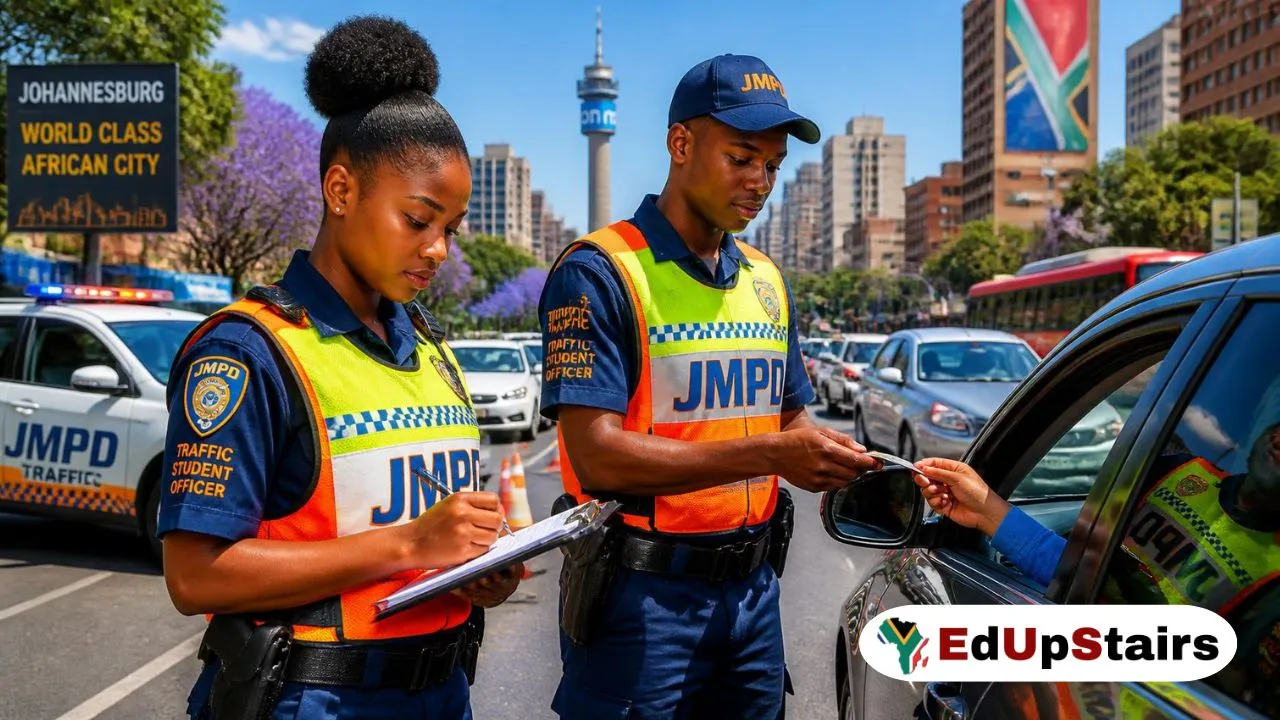

If becoming a Traffic Officer is one of your career goals for 2027, do not wait for a vacancy or trainee programme to be advertised before you start preparing.
Traffic Officer opportunities can attract many applicants, and meeting the minimum requirements is only one part of being ready. You can use the months ahead to understand the profession, improve your knowledge of road safety, organise important documents, work towards the correct driving licence if necessary, and develop skills relevant to traffic law enforcement.
This article explains the official requirements for becoming a Traffic Officer in South Africa and introduces an online traffic laws and safety course that you can use for additional skills development and career preparation.
Important: Edupstairs is not announcing that Traffic Officer training opportunities for 2027 are currently open. This is a career-preparation guide for people who want to start getting ready before future opportunities are advertised.
Quick Overview
- Career: Traffic Officer
- Preparation period: Start preparing for possible 2027 opportunities now
- Minimum education according to the RTMC: Grade 12/Matric or equivalent
- Driving licence: Code B manual driving licence
- Criminal record: Applicants must have no criminal record
- Physical requirements: A medical certificate confirming ability to undertake strenuous exercise is required
- Age: RTMC currently states applicants must not be older than 35
- Formal Traffic Officer training: You cannot simply enrol privately to become a Traffic Officer; you first need to be appointed as a trainee by an appropriate authority
- Additional preparation: Online study can help you develop background knowledge before opportunities arise
- Important distinction: An online course does not replace official Traffic Officer occupational training or appointment requirements
The Road Traffic Management Corporation (RTMC) states that a person must first be employed or appointed as a trainee by a provincial transport department, municipality or relevant government agency before undertaking official Traffic Officer training.
Why You Should Start Preparing Now
One of the biggest mistakes job seekers make is beginning their preparation only after seeing an advert.
By then, the closing date may be only days away.
You may suddenly discover that you need a particular driving licence, that your documents are outdated, that you know very little about the occupation or that you have done nothing to develop knowledge relevant to the career.
A better strategy is:
Prepare first. Apply when the opportunity arrives.
If Traffic Officer recruitment opportunities are advertised for 2027, applicants who have already researched the career and prepared their documents and basic knowledge will be in a better position to submit a considered application.
There is another important reason to prepare early: Traffic Officer training in South Africa is regulated.
The RTMC is responsible for training norms and standards and monitors Traffic Training Colleges. Its official information makes clear that aspiring Traffic Officers do not simply choose a college and privately enrol for the official basic Traffic Officer course.
Understanding this now can also help you avoid scams.
Understanding the Traffic Officer Career
Traffic Officers play an important role in road safety and law enforcement.
Their work can involve enforcing traffic legislation, dealing with motorists, helping promote compliance with road rules and contributing to safer roads.
This is not simply a career about issuing fines.
Traffic personnel operate within a legal and regulatory environment and need to understand road traffic rules, enforcement procedures, road safety and interactions with members of the public.
The occupation can also be physically and mentally demanding.
RTMC career information notes that Traffic Officers may work weekends and public holidays, undertake shifts and perform duties in different weather conditions.
Anyone interested in this profession should therefore ask:
Am I interested only in getting the job, or am I genuinely prepared for the responsibilities that come with it?
That is why career preparation should involve more than waiting for an application link.
Official Career Requirements
The following section covers official requirements, not Edupstairs recommendations.
According to current information published by the RTMC, the minimum requirements to become a Traffic Officer include:
- Grade 12/Matric or an equivalent qualification
- A Code B driving licence for a manual-transmission vehicle
- No criminal record
- A medical certificate confirming that the applicant can undertake strenuous exercise
- Applicants must not be older than 35 years
In addition, a prospective Traffic Officer must first be employed or appointed as a trainee by a provincial authority, local authority/municipality or relevant government agency before undergoing official Traffic Officer training.
The RTMC also lists the Occupational Certificate: Traffic Officer at NQF Level 6, Qualification ID 97639, under the QCTO framework. The formal programme includes knowledge, practical skills and workplace-experience components.
Can You Enrol at a Traffic College Yourself?
This is an extremely important point.
The RTMC warns that a private individual cannot simply enrol directly at a Traffic Training College as a Traffic Officer trainee.
Applicants normally first need to be selected or employed by the relevant traffic authority. Selected candidates are then sent for the appropriate formal training.
The RTMC also warns prospective applicants against paying individuals who claim they can reserve a place at a Traffic Training College.
If somebody promises you guaranteed Traffic Officer training in exchange for money, investigate carefully before paying anything.
Edupstairs Preparation Guidance
The following recommendations are Edupstairs career-preparation guidance. They are not additional official Traffic Officer requirements.
If you want to target possible Traffic Officer opportunities during 2027, consider working on the following areas now:
- Make sure your Matric certificate and identification documents are accessible.
- Check that your driving licence meets the requirements stated in future adverts.
- Keep your CV updated.
- Learn more about road safety and traffic law enforcement.
- Improve your understanding of road signs, markings and road behaviour.
- Improve your communication skills.
- Develop physical fitness gradually and responsibly.
- Follow municipalities, provincial transport departments and the RTMC for legitimate recruitment notices.
- Learn how government and municipal applications work.
- Avoid organisations promising guaranteed placement.
- Read every future advertisement carefully because individual recruitment campaigns can contain additional selection criteria.
You can also use the free Edupstairs eligibility tool to assess your general readiness for careers in these services:
Edupstairs SAPS / Metro / Traffic / DCS Eligibility Checker
The checker is a preparation tool and should not be treated as an official recruitment decision. The recruiting authority ultimately determines whether an applicant qualifies.
Online Course You Can Start Now
One way to start developing relevant background knowledge is through an online course covering traffic laws and road safety.
The course researched for this guide is called Diploma in Traffic Laws and Safety.
It is designed to introduce learners to subjects such as traffic regulations, road signs and markings, safe driving principles, common violations, defensive driving, traffic enforcement concepts and road-safety awareness. The course currently indicates approximately 6–10 hours of learning.
There is, however, an important limitation for South African learners.
The course focuses substantially on the UK traffic environment.
You should therefore not assume that every law, penalty, enforcement procedure or rule taught in the course applies in South Africa.
Its value for a South African learner is primarily in developing broader traffic-safety knowledge and introducing concepts that can help you understand the field.
South African Traffic Officers must ultimately learn and operate according to South African legislation, official curricula and authorised training standards.
What You Will Learn
Based on our review of the course, learners are introduced to several broad areas of traffic and road-safety knowledge.
These include understanding why traffic laws exist and how they contribute to safer and more orderly roads.
You will also explore subjects such as:
- Recognising and interpreting traffic signs, road markings and signals
- Understanding intersection and right-of-way principles
- Speed management and speeding violations
- Safe lane-changing and merging
- Common traffic violations
- Road-user interaction involving pedestrians and cyclists
- Responding appropriately around emergency vehicles
- The dangers associated with impaired driving
- Distracted driving and its consequences
- Road safety around construction or work zones
- Driving appropriately during difficult weather conditions
- Defensive-driving principles
- Collision-avoidance concepts
- Basic concepts relating to traffic law enforcement
- Reporting procedures
- Community involvement in road-safety promotion
These outcomes have been paraphrased from the provider’s course information rather than reproduced word-for-word.
How This Knowledge Can Help You Prepare
Completing an introductory course will not turn you into a qualified Traffic Officer.
What it can do is help you become a more informed prospective applicant.
For example, learning about road signs, defensive driving, impaired driving, road-user behaviour and traffic enforcement can give you a broader understanding of the environment in which traffic professionals operate.
That distinction matters.
Think of this course as preparation, not qualification.
If you eventually secure an official Traffic Officer trainee position, you will still need to satisfy the recruiting authority’s requirements and complete the formal occupational training required for the profession.
Early learning can nevertheless demonstrate something valuable about your approach to career development: instead of waiting passively for recruitment to begin, you are actively trying to understand the profession you want to enter.
Start the Online Course
If Traffic Officer work is one of the careers you are considering for 2027, you can start developing your traffic-law and road-safety knowledge now.
Do not wait for the opportunity to open. Start preparing now.
Start the Traffic Laws and Safety Online Course
Please note: The link above takes you away from Edupstairs to an external online learning platform.
Affiliate disclosure: The supplied link contains affiliate tracking parameters. Edupstairs may receive a commission or other benefit when eligible actions are completed through the link. This does not change the importance of independently checking whether a course is suitable for your career goals.
What This Course Does and Does Not Do
This distinction is essential.
What the course can do
It can:
- Help you develop general knowledge about traffic laws and road safety
- Introduce traffic-management concepts
- Improve your understanding of road signs and safe road behaviour
- Introduce defensive-driving concepts
- Help you understand some basic traffic-enforcement principles
- Give you structured learning while you wait for future recruitment opportunities
What the course does NOT do
It does not:
- Make you a qualified South African Traffic Officer
- Guarantee a Traffic Officer job
- Guarantee selection for a traineeship
- Replace Matric
- Replace the required driving licence
- Replace official occupational Traffic Officer training
- Replace medical or other recruitment requirements
- Give you automatic entry into a Traffic Training College
- Mean that the RTMC, SAQA, QCTO, a municipality or provincial government endorses the course
Most importantly, this online course is not being presented as a SAQA-registered South African qualification and does not carry a South African NQF level.
The word “Diploma” in the course title should therefore not be confused with a South African NQF-registered diploma or the formal occupational qualification required for Traffic Officers.
Use it for additional knowledge and skills development, not as a replacement for recognised South African qualifications, licences or occupational training.
Other Ways to Prepare for Traffic Officer Opportunities
You do not need to limit your preparation to one course.
Start building a broader career-preparation strategy.
Research the RTMC and understand its role in South Africa’s road traffic environment. Learn about your provincial transport department and the traffic services operated by municipalities you may want to apply to.
You can also familiarise yourself with South African road rules and road-safety campaigns.
If you do not currently have the required driving licence, investigate what you would need to obtain it. Do not wait until an attractive vacancy has a short closing period before discovering that your licence does not meet the stated criteria.
Physical readiness can also matter because the RTMC’s minimum requirements include medical confirmation that an applicant can undertake strenuous exercise.
Finally, keep a digital application folder containing commonly requested documents such as your CV, ID and qualifications. Requirements can vary between recruitment campaigns, so never assume that documents requested by one employer will automatically be the same for another.
Common Mistakes to Avoid
Waiting for vacancies before preparing: By the time an advert appears, you may have limited time to address gaps.
Believing every “Traffic Officer course” advertisement: Formal Traffic Officer training is regulated. Verify training claims.
Paying someone to secure a Traffic College space: The RTMC specifically warns applicants against this practice.
Assuming an online certificate qualifies you as a Traffic Officer: It does not.
Confusing an international course with an NQF qualification: The online course discussed here does not replace the recognised South African occupational pathway.
Ignoring the driving-licence requirement: RTMC currently specifies a Code B manual driving licence.
Assuming 2027 recruitment is already open: This article is about preparation. It is not an announcement of a 2027 Traffic Officer intake.
Using UK traffic rules as South African law: The recommended course contains UK-oriented content. Always distinguish general road-safety principles from jurisdiction-specific law.
Tools you may find useful:
- SETA Platform
- RDP / BNG Housing Eligibility Checker
- SASSA Grant Eligibility Checker
- SAPS / Metro / Traffic / DCS Eligibility Checker
- Youth Employment Eligibility Checker
- SA Bursary & NSFAS Eligibility Checker
- UIF Benefits Eligibility Checker and Payment Estimator
View Other Employment Opportunities here
Need Help?
Edupstairs Advice
If becoming a Traffic Officer is genuinely one of your goals, make 2026 your preparation period for possible opportunities in 2027.
Do not spend the next several months simply searching for “Traffic Officer vacancies 2027.”
Use that time productively.
Check your eligibility. Work towards the required driving licence if you do not have it. Organise your documents. Learn about the occupation. Develop your knowledge of road safety. Improve your fitness responsibly. Follow legitimate recruitment channels.
And when an official opportunity eventually appears, read that advertisement from beginning to end before applying.
The opportunity may not be open today, but your preparation can start today.
Frequently Asked Questions
-
Are Traffic Officer applications for 2027 open?
This article does not claim that a national 2027 Traffic Officer recruitment programme is currently open. Recruitment opportunities must be confirmed through the relevant municipality, provincial authority, RTMC or other recruiting body.
-
What qualification do I need to apply to become a Traffic Officer?
The RTMC currently lists Matric/Grade 12 or equivalent among the minimum entry requirements.
-
Do I need a driving licence?
Yes. Current RTMC information specifies a Code B manual driving licence.
-
Can I go directly to a Traffic College and register?
Not for the official Traffic Officer trainee pathway described by the RTMC. You first need to be appointed/employed as a trainee by an appropriate authority.
-
Will completing the online course make me a Traffic Officer?
No. It is an additional skills-development course and does not replace official South African Traffic Officer training.
-
Does the online course have an NQF level?
It is not being presented here as a SAQA-registered South African qualification and does not carry a South African NQF level. Do not confuse its “Diploma” title with an NQF-registered South African diploma.
-
Will the course guarantee that my application is shortlisted?
No. No legitimate preparatory course can guarantee employment or selection.
-
Why should I take it if it does not qualify me?
Because career preparation is not only about collecting qualifications. Learning about traffic safety, road signs, defensive driving and enforcement concepts can help you understand the profession you are hoping to enter.
-
Is the course specifically about South African traffic law?
No. The provider states that the course is particularly focused on the UK traffic environment. South African learners should therefore use it for broader knowledge development and not treat jurisdiction-specific material as South African law.
-
Is there an age requirement for Traffic Officer applicants?
Current RTMC information states that applicants must not be older than 35 years. Always check the specific future advertisement because recruitment requirements should be verified at the time of application.
-
Do I need to be physically fit?
The RTMC currently requires a medical certificate confirming that an applicant can undertake strenuous exercise. This reflects the physical demands that can form part of the occupation and training.
-
Where can I check whether I may meet the basic requirements?
You can use the Edupstairs SAPS / Metro / Traffic / DCS Eligibility Checker as a preliminary career-preparation tool:
Remember that the checker does not replace an official assessment by a recruiting authority.
Disclaimer
This article is an independent Edupstairs career-preparation guide and is not an official Traffic Officer recruitment advertisement.
Edupstairs does not guarantee employment, selection, admission to training or appointment as a Traffic Officer.
Requirements can change, and individual recruiting authorities may establish additional criteria. Applicants should always verify requirements against the official advertisement and information published by the relevant municipality, provincial government, RTMC or authorised institution.
The online course discussed in this article is intended for additional learning and skills development. It does not replace official South African qualifications, occupational training, licences or recruitment requirements.
Editorial Integrity
Edupstairs independently researches and explains career opportunities to help South African job seekers make better-informed decisions.
For this article, official Traffic Officer career and training information was checked against information published by the Road Traffic Management Corporation, while the online course content was reviewed using information published on the course provider’s platform.
The course provider’s outcomes have been paraphrased rather than copied.
The inclusion of an online course should not be interpreted as an endorsement by the RTMC, SAQA, QCTO, any municipality, provincial government or other South African public institution unless such endorsement is explicitly confirmed by that institution.
EDUPSTAIRS IS A REGISTERED NON-PROFIT ORGANISATION NPO No: 232 – 182, PUBLIC BENEFIT ORGANISATION (PBO): 930066984. EDUPSTAIRS DOES NOT, IN ANY WAY OR FORM, SOLICIT MONEY OR CV’S FROM PEOPLE FOR JOBS. PLEASE BE AWARE OF PHONY JOB POSTINGS AND RECRUITMENT FRAUD. USE THE EDUPSTAIRS SCAM DETECTOR TOOL TO SPOT A SCAM BEFORE YOU APPLY


I want to start a new goal. Help my people to cross the road and other things