
The rapid growth of drone technology is transforming industries across South Africa, from agriculture and mining to construction, emergency response, and private security. One of the sectors experiencing significant innovation is the private security industry, where drones are increasingly used for surveillance, patrols, incident response, and crime prevention.
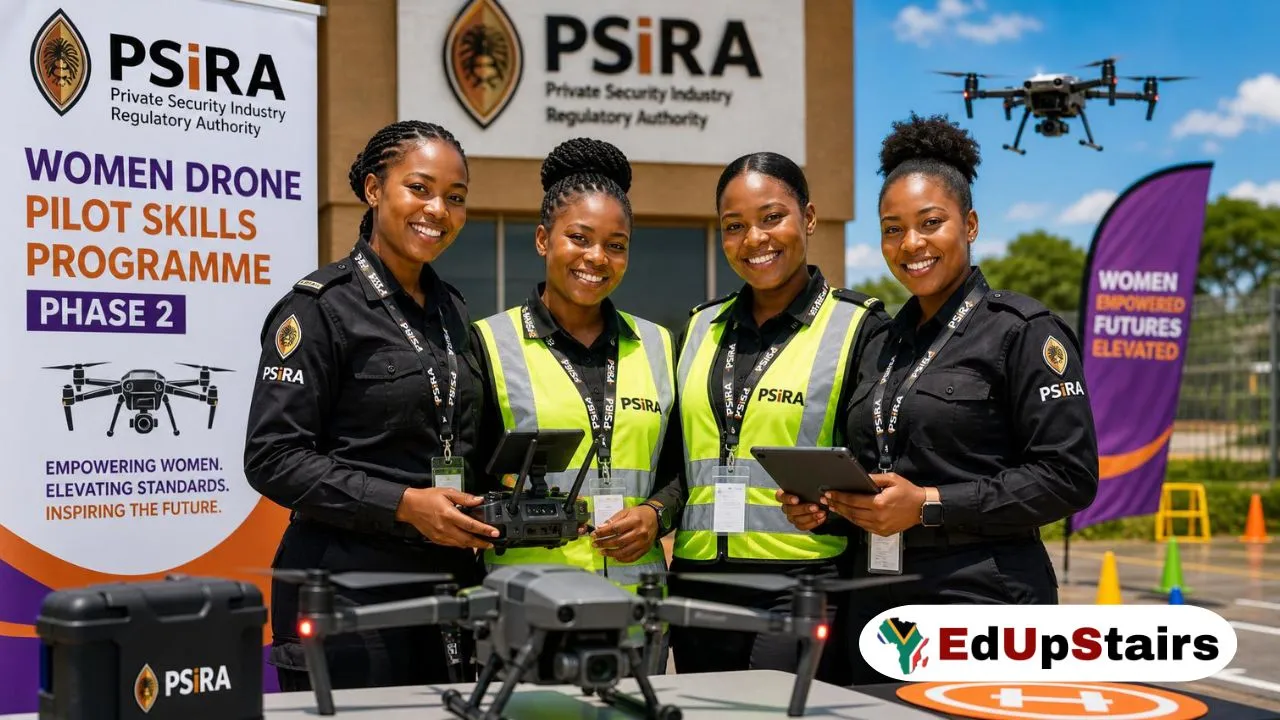
To help prepare more women for these emerging opportunities, the Private Security Industry Regulatory Authority (PSiRA) has opened applications for the second intake (Phase 2) of its Women Drone Pilot Skills Programme.
Following the successful launch of the programme in 2025, where 64 female beneficiaries completed the training, PSiRA is now inviting aspiring female security officers to participate in a 6–8 week Drone Pilot Skills Training Programme designed to equip participants with practical drone operation skills for the private security industry.
If you’re a woman working in security—or planning to build a career in security technology—this could be one of the most unique government-supported skills development opportunities available in 2026.
Quick Overview
- Programme: PSiRA Women Drone Pilot Skills Programme (Phase 2)
- Organisation: Private Security Industry Regulatory Authority (PSiRA)
- Programme Duration: 6–8 Weeks
- Application Closing Date: 14 August 2026
- Stipend: No stipend
- Accommodation & Transport: Provided during training
- Training Provider: RPAS Training (SACAA/1121/ATO)
- Application Email: droneprogramme@psira.co.za
Who Can Apply?
- South African citizens
- Female applicants
- Aged 18–40 years
- PSiRA registered and in good standing
- Passionate about technology
- Matric certificate with at least 50% for English
- Good health
About PSiRA
The Private Security Industry Regulatory Authority (PSiRA) is South Africa’s statutory body responsible for regulating the private security industry.
Its responsibilities include:
- Registering security officers
- Monitoring security companies
- Ensuring industry compliance
- Promoting professionalism
- Supporting skills development initiatives
In recent years, PSiRA has expanded beyond regulation by investing in training programmes that prepare security professionals for future technologies.
The Women Drone Pilot Skills Programme is one such initiative, aimed at increasing women’s participation in technology-driven security careers.
Why Drone Skills Are Becoming So Valuable
Many people still think drones are mainly used for photography.
In reality, today’s security drones are sophisticated tools capable of:
- Monitoring large properties
- Detecting suspicious movement
- Conducting perimeter patrols
- Supporting emergency response
- Assisting with search operations
- Capturing evidence
- Providing live aerial surveillance
Large security companies increasingly use drones to improve response times while reducing operational costs.
As technology adoption grows, professionals who understand drone operations may have stronger employment prospects than those relying solely on traditional guarding skills.
This makes specialised drone training a valuable addition to a security officer’s career profile.
What the Official Programme Offers
According to the official PSiRA advert:
- Second intake (Phase 2)
- 6–8 weeks of training
- Drone Pilot Skills Training
- Focus on aspiring female security officers
- Practical drone operation skills
- Designed to enhance careers within the private security industry
The advert does not specify:
- Whether participants receive a formal qualification
- The NQF level (if applicable)
- Daily training schedule
- Training venue
- Number of available places
Applicants should therefore avoid making assumptions and rely only on official communication from PSiRA after successful application.
Official Requirements
The following requirements are taken directly from the official PSiRA advertisement.
Applicants must:
- Be a South African citizen
- Be between 18 and 40 years old
- Be passionate about technology
- Hold a Matric certificate with at least 50% for English
- Be in good health
- Be female
- Be PSiRA registered and in good standing
These are the published eligibility criteria.
Edupstairs Application Guidance
The following guidance is not part of the official PSiRA advertisement, but is intended to help applicants submit stronger applications.
Before applying:
- Ensure your PSiRA registration is active.
- Verify that your contact details are current.
- Prepare certified copies of all required documents.
- Use a professional email address.
- Save all documents as clear PDF files where possible.
- Double-check spelling errors before submitting your application.
Remember that a professional application reflects positively on your attention to detail.
Documents Required
Applicants must email the following:
- Completed application form
- Updated CV
- Certified copy of South African ID
- Certified copy of Matric certificate
- PSiRA certificate
Important Information (Official)
According to PSiRA:
- No stipend is payable.
- No internet or data will be provided for the online theory component.
- Applicants must have access to reliable internet.
- Training dates will be communicated to successful applicants.
- Successful applicants will undergo an Aviation Class III Medical Examination.
- Accommodation and transport to the training facility will be provided.
Understanding the Aviation Medical Requirement
One point many applicants may overlook is the requirement for an Aviation Class III Medical Examination after successful selection.
The advert does not explain what this assessment includes.
Generally, aviation medical examinations are used to determine whether a candidate is medically fit for aviation-related activities. Since the official advert does not provide further details, applicants should wait for instructions from PSiRA regarding the examination process rather than arranging one independently.
Why This Programme Focuses on Women
Technology careers have historically seen lower female participation, particularly in technical fields linked to engineering, aviation, and security.
Programmes like this help address that imbalance by creating pathways for women to develop specialised technical skills.
Beyond learning how to operate drones, participants gain exposure to emerging technologies that are becoming increasingly important across multiple industries.
While the programme is designed for security officers, drone skills may also become valuable in sectors such as:
- Infrastructure inspection
- Agriculture
- Mining
- Disaster management
- Environmental conservation
- Municipal services
- Construction monitoring
Career Opportunities After Drone Training
Although the advert does not guarantee employment, drone skills can strengthen your profile when applying for roles such as:
- Drone Operator
- Security Surveillance Operator
- Remote Monitoring Officer
- Security Technology Specialist
- Control Room Operator
- Tactical Response Support
- Security Operations Coordinator
As more organisations adopt drone technology, professionals with both security experience and drone knowledge may be increasingly sought after.
Common Application Mistakes to Avoid
Many otherwise eligible applicants lose opportunities because of avoidable errors.
Avoid:
- Sending incomplete applications
- Missing certified documents
- Using outdated CVs
- Forgetting to attach the PSiRA certificate
- Applying after the closing date
- Sending blurry document scans
- Using incorrect email subject lines (if instructions are later provided)
Always keep copies of everything you submit.
How to Prepare Before Training
If selected, consider preparing by:
- Learning basic aviation terminology
- Improving computer literacy
- Familiarising yourself with GPS technology
- Reading about drone safety regulations
- Developing communication skills
- Practising teamwork and problem-solving
None of these are official requirements, but they may help you adapt more quickly to the learning environment.
How to Apply
Applications must be submitted via email.
Attach:
- Completed application form (Download here)
- CV
- Certified RSA ID copy
- Certified Matric certificate
- PSiRA certificate
Email: droneprogramme@psira.co.za
Also Check: What to Write in an Email When Sending Your CV
Closing Date: 14 August 2026
Late applications are unlikely to be considered.
Tools you may find useful:
- SETA Platform
- RDP / BNG Housing Eligibility Checker
- SASSA Grant Eligibility Checker
- SAPS / Metro / Traffic / DCS Eligibility Checker
- Youth Employment Eligibility Checker
- SA Bursary & NSFAS Eligibility Checker
- UIF Benefits Eligibility Checker and Payment Estimator
View Other Employment Opportunities here
Need Help?
Edupstairs Advice
This programme is more than a short training course—it is an opportunity to position yourself for the future of private security. Technology is rapidly changing how security services are delivered, and employers increasingly value candidates who combine operational experience with technical skills.
If you meet every requirement, don’t delay your application. Submit a complete, well-organised application before the closing date, ensure your documents are certified and clearly scanned, and monitor your email regularly for updates from PSiRA. Even though the programme does not offer a stipend, the specialised training could strengthen your long-term career prospects in a growing area of the security industry.
Frequently Asked Questions (FAQs)
-
Is this programme only for women?
Yes. According to the official advert, applicants must be female.
-
Do I need to be PSiRA registered?
Yes. Applicants must be PSiRA registered and in good standing.
-
Is there a stipend?
No. The official advert clearly states that no stipend is payable.
-
How long is the programme?
Between 6 and 8 weeks.
-
Will accommodation be provided?
Yes. The advert states that accommodation and transport to the training facility will be provided.
-
Will internet or data be supplied?
No. Applicants must have their own internet connection for the online theory component.
-
Does completing the programme guarantee employment?
The official advert does not state that employment is guaranteed after completion.
-
What qualification will I receive?
The advert does not specify whether participants receive a formal qualification or certificate beyond programme completion.
-
Can I apply if I am older than 40?
No. The published age requirement is between 18 and 40 years.
-
What English mark is required?
Applicants must have achieved at least 50% for English in Matric.
You can also:
- View latest Internships
- View latest Learnerships
- View Latest Bursaries
- View latest Government jobs
- View latest Company Vacancies
- View latest Municipality vacancies
- Visit the Edupstairs blog for daily updates
Application Outcome Tracker (anonymous)
No names collected. This helps future applicants understand real-world timelines.
Have you applied for this opportunity?
Disclaimer
This article is an independent educational guide published by Edupstairs to help applicants understand the PSiRA Women Drone Pilot Skills Programme. Applicants should always rely on official PSiRA communications for the final application process, eligibility decisions, programme schedules, and any updates or changes.
Editorial Integrity
At Edupstairs, we explain opportunities using official information while adding independent educational guidance to help applicants make informed decisions. In this article, the eligibility criteria, required documents, application process, programme duration, and important notices are based on the official PSiRA advertisement. Any career advice, application tips, industry context, or preparation guidance is provided independently by Edupstairs and should not be interpreted as official statements from PSiRA. Where information was not specified in the official advert, we have stated this clearly rather than making assumptions.
EDUPSTAIRS IS A REGISTERED NON-PROFIT ORGANISATION NPO No: 232 – 182, PUBLIC BENEFIT ORGANISATION (PBO): 930066984. EDUPSTAIRS DOES NOT, IN ANY WAY OR FORM, SOLICIT MONEY OR CV’S FROM PEOPLE FOR JOBS. PLEASE BE AWARE OF PHONY JOB POSTINGS AND RECRUITMENT FRAUD. USE THE EDUPSTAIRS SCAM DETECTOR TOOL TO SPOT A SCAM BEFORE YOU APPLY