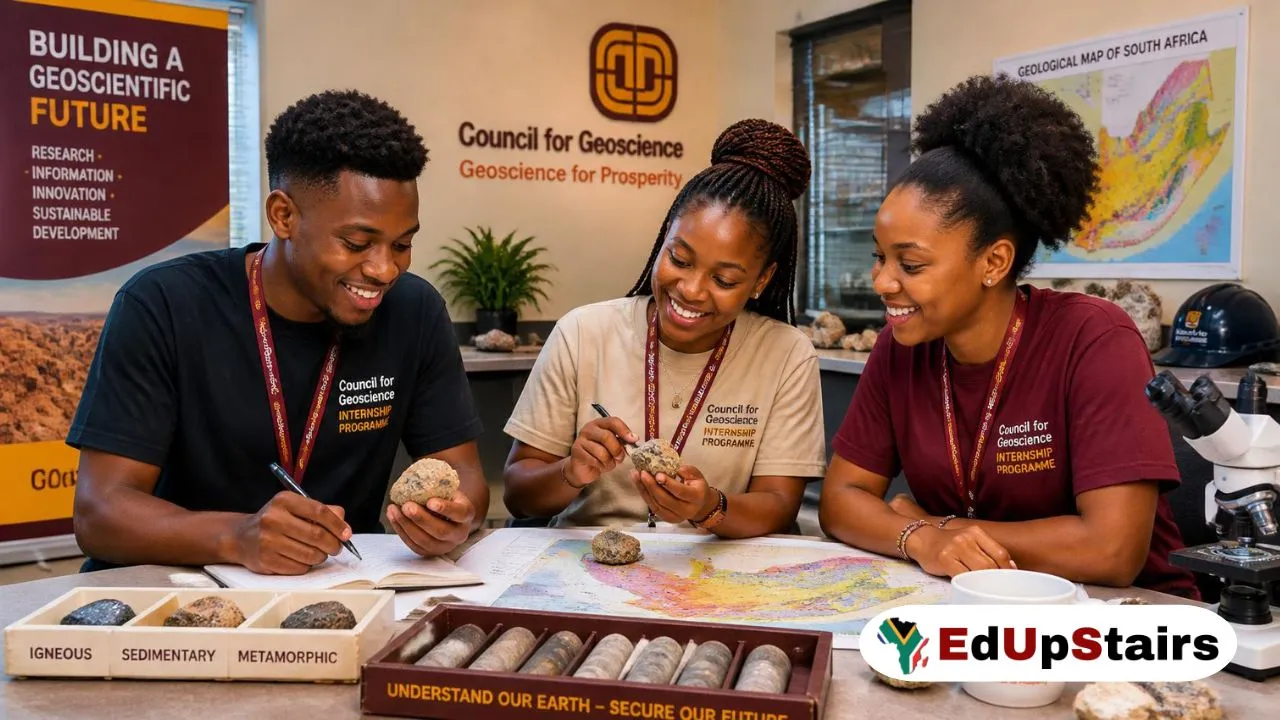

The Council for Geoscience (CGS) is inviting suitably qualified graduates to apply for its Geology Internship Programme 2026, with seven internship positions available at the organisation’s Head Office in Pretoria, Gauteng.
For graduates who have completed an BSc Honours in Geology or another relevant Earth Science qualification, this internship provides an opportunity to move beyond university-based learning and gain practical exposure to geoscientific research, exploration work, data collection, scientific reporting and field activities.
Successful interns will receive a monthly stipend of R13,000 while participating in the programme.
What makes this opportunity particularly valuable is the type of work interns may encounter. The position is not described simply as administrative support for a scientific team. The official vacancy indicates that interns will undertake limited research, contribute to geoscience data collection and interpretation, participate in exploration projects and assist with scientific reports under the guidance of more experienced scientific staff.
Below, Edupstairs explains the official requirements, what the work may involve and how graduates can prepare a stronger application.
Quick Overview
- Organisation: Council for Geoscience (CGS)
- Programme: Geology Internship Programme 2026
- Job Title: Intern – Geology
- Number of Posts: 7
- Location: Pretoria Head Office, Gauteng
- Monthly Stipend: R13,000
- Minimum School Qualification: Grade 12
- Tertiary Qualification: BSc Honours in Geology or another relevant Earth Science qualification
- Field: Geology / Earth Sciences / Geoscientific Research
- Experience: The advert does not specify previous formal work experience as a requirement
- Closing Date: 21 August 2026
- Vetting: Appointments are subject to positive vetting results
- Applications by Email: Not accepted
About the Council for Geoscience
The Council for Geoscience is a South African geoscience institution whose work involves the collection, development and application of geoscientific knowledge.
For a geology graduate, an organisation of this nature can provide exposure to the practical side of a discipline that may previously have been experienced mainly through lectures, laboratory work, academic research and university fieldwork.
Geoscience contributes to numerous areas of economic and societal importance, including understanding geological formations, mineral resources, groundwater, geohazards, infrastructure development, environmental considerations and the broader understanding of South Africa’s geology.
The internship should therefore be viewed as more than an opportunity to add a recognised organisation to your CV. It is an opportunity to begin understanding how professional geoscientific work is conducted within a structured scientific environment.
What Is the Purpose of the Geology Internship?
According to the official vacancy information, the overall purpose of the position is to:
Undertake limited research in a wide variety of engineering geology projects under the guidance of more senior scientific staff.
The wording “under the guidance” is important for graduates.
An internship is a developmental position. Applicants are not expected to enter the organisation knowing everything that an experienced geoscientist knows. Instead, the programme provides an environment in which graduates can apply their academic knowledge while receiving professional guidance.
At the same time, applicants should understand that this is a scientific role. A successful candidate will need to demonstrate curiosity, analytical ability, professionalism and an interest in geoscientific research.
Official Key Responsibilities
The following responsibilities come from the vacancy information supplied by the Council for Geoscience.
Conduct geoscientific research
Interns will conduct limited geoscience research under guidance.
This may include:
- Data collection
- Basic analysis
- Interpretation of information
For graduates, this is important because the ability to move from raw scientific information to meaningful interpretation is central to many geoscience careers.
Assist with solving geoscientific problems
Interns may be expected to resolve relatively simple problems across different geoscientific fields.
This work will be performed, at least partly, according to:
- Standard operating procedures
- Research methodologies
- Guidance from supervisors or senior scientific staff
Applicants should therefore be comfortable working within defined scientific processes rather than approaching every task informally.
Participate in exploration projects
The successful candidates will participate in exploration projects under supervision.
Graduates who are particularly interested in exploration geology should pay attention to this responsibility because the official advert specifically lists an interest in exploration geology under knowledge and experience.
Assist with scientific reports
Interns will help compile scientific reports under guidance.
Scientific reporting requires more than good grammar. Graduates may need to communicate:
- What work was conducted
- How information was collected
- What was observed
- How information was analysed
- What conclusions can reasonably be drawn from the available evidence
Strong written communication skills will therefore be useful.
Work with geoscience data
The programme may involve:
- Geoscience data collection
- Data capturing
- Map compilation
- Geoscience data collation
These responsibilities highlight the importance of accuracy.
Incorrectly captured scientific data can affect later analysis and interpretation, so applicants should be able to demonstrate attention to detail.
Deliver scientific or technical presentations
Interns may be required to give formal scientific or technical presentations based on papers or reports.
These presentations could be delivered internally to CGS staff or externally, with guidance, at conferences or symposia.
The advert indicates that this would typically occur approximately once a year.
For graduates who have completed an Honours degree, experience presenting an Honours research project, seminar or academic paper could therefore be useful preparation.
Contribute to research publications
Interns may publish research findings internally and externally depending on the nature and stage of a project.
Exposure to scientific publishing can be particularly useful for graduates who may later consider research-intensive careers or postgraduate studies.
Follow prescribed work standards
Interns will be required to work according to prescribed standards, including ISO requirements and international best practices.
This means professionalism, documentation and procedural compliance will form part of the working environment.
Participate in professional development
Interns may undertake relevant self-improvement and development activities through:
- Workshops
- Training courses
- Conferences
- Other learning opportunities
A willingness to continue learning is therefore important.
Maintain field equipment
Field equipment must also be maintained as part of the internship responsibilities.
Applicants should understand that geology can involve both office-based scientific work and practical field-related responsibilities.
Official Educational Requirements
Applicants must meet the educational requirements stated by the Council for Geoscience.
You need:
- Grade 12, and
- BSc Honours in Geology, or
- Another relevant Earth Science qualification
Applicants should not assume that every science qualification will automatically qualify as a “relevant Earth Science qualification.”
If your qualification has a different title but is closely related to geology or Earth Sciences, ensure that your application clearly identifies the qualification and relevant academic specialisations.
Do not claim equivalence that has not been officially established.
Knowledge and Experience
The Council for Geoscience specifically identifies the following:
- Keen interest in geoscientific research
- Interest in exploration geology
The vacancy information supplied does not specify a minimum number of years of previous employment experience.
That is important for graduates who may have strong academic knowledge but limited professional employment history.
However, having no formal work experience does not mean your CV should be empty.
Relevant university experience can still help demonstrate your suitability.
Key Personal Attributes
The Council for Geoscience is looking for candidates with:
- Analytical skills
- Effective oral communication skills
- Effective written communication skills
- Ability to relate to team members
- Ability to work effectively within a team
These attributes align closely with the actual responsibilities of the internship.
For example, analytical ability is relevant to scientific interpretation, communication skills are necessary for reports and presentations, and teamwork matters because research and exploration projects are rarely conducted entirely by one person.
Edupstairs Application Guidance
What to Highlight on Your CV
This section is Edupstairs guidance rather than additional official CGS requirements.
One of the biggest mistakes graduates make is submitting a generic CV that lists their qualification but provides very little evidence of what they actually studied or did.
Create a Job Specific ATS CV and a Cover Letter Here
If you have limited work experience, consider including relevant academic experience such as:
- Honours research project
- Research methodology
- Geological fieldwork
- Geological mapping
- Data collection
- Data interpretation
- Laboratory work
- Academic research
- Scientific report writing
- Research presentations
- Exploration-related coursework
- Relevant software exposure
- GIS or mapping exposure, where genuinely applicable
- Relevant geological or Earth Science projects
Only include skills and experience you genuinely possess.
For example, don’t list specialised geological software simply because you think CGS might use it. If you have actually worked with a particular application during university, explain your level of exposure accurately.
Make Your Honours Research Work for You
Your Honours research may be one of the strongest pieces of evidence you have.
Instead of writing only:
BSc Honours in Geology – University XYZ
consider providing a short subsection covering your research experience.
You could identify:
- Your research topic
- The geological problem investigated
- Research methods used
- Type of data collected
- Analysis performed
- Fieldwork undertaken
- Relevant laboratory techniques
- Software used
- Report or dissertation completed
- Presentation experience
This helps an employer see how your academic background connects with a research-focused internship.
Preparing for Potential Fieldwork
The vacancy specifically mentions exploration projects and maintaining field equipment.
Applicants should therefore understand that a career in geology may not be confined to a desk.
Depending on the project and responsibilities assigned by CGS, geological work can involve practical activities associated with data gathering, mapping, observations and field-based scientific work.
The advert provided does not specify travel frequency, field locations or the amount of time interns will spend in the field.
Applicants should therefore avoid making assumptions about those conditions and seek clarification during the recruitment process where necessary.
How to Apply
Applications must be submitted through the official Council for Geoscience portal here
Applicants should complete their applications before: Closing Date: 21 August 2026
Importantly, CGS states that applications sent to its recruitment email address or through its social media platforms will not be considered.
The email address recruitment@geoscience.org.za is provided for enquiries, not applications.
Therefore, do not email your CV to that address expecting it to count as an application.
Follow the official vacancy’s online application process.
Before You Submit Your Application
Edupstairs recommends checking the following before clicking submit:
- Your name and contact information are correct.
- Your CV is current.
- Your Grade 12 qualification is correctly reflected.
- Your BSc Honours or relevant Earth Science qualification is clearly stated.
- Your university and graduation details are accurate.
- Relevant Honours research is included.
- Geological fieldwork is highlighted where applicable.
- Relevant research, mapping and analytical skills are included.
- Your CV does not contain skills you cannot demonstrate.
- All information entered into the recruitment system matches your supporting documents.
- You have followed the official application instructions.
Do not wait until the final few hours before the deadline if you can avoid it.
Common Application Mistakes to Avoid
-
Sending the application to the enquiry email
CGS specifically warns that applications submitted to the recruitment email address will not be considered.
-
Using a generic CV
A CV designed for a general administration job will not necessarily communicate your suitability for a scientific internship.
Highlight your geology and Earth Science background.
-
Ignoring university research experience
Graduate applicants sometimes think only paid employment belongs on a CV.
For a research-focused internship, relevant academic research can be highly useful.
-
Listing technical skills without context
Don’t simply write “mapping” or “research.”
Where appropriate, briefly demonstrate how you used those skills.
-
Exaggerating experience
Never claim field, software, research or laboratory experience that you don’t possess.
Scientific organisations value accuracy, and your application should reflect that principle.
-
Applying after the deadline
The closing date is 21 August 2026. Applicants should submit on time.
Employment Equity and Diversity
The Council for Geoscience states that it is committed to Employment Equity and diversity.
In accordance with Employment Equity prescripts, preference will be given, but not limited, to candidates from under-represented designated groups.
The organisation particularly encourages females and people from previously disadvantaged groups and sectors to apply.
Applicants should interpret this exactly as stated by the employer and should not assume that it changes the academic requirements of the internship.
Vetting and Personal Information
All appointments are subject to positive vetting results.
CGS also states that applicants’ personal information will be processed in accordance with the Protection of Personal Information Act (POPIA), Act 4 of 2013.
Applicants should ensure that information supplied during recruitment is accurate and truthful.
What Happens After You Apply?
Correspondence will be limited to shortlisted candidates.
According to the vacancy notice, if you have not been contacted within eight weeks after the closing date, you should consider your application unsuccessful.
This means applicants should not assume that they will necessarily receive an individual rejection email.
Continue applying for other graduate programmes while waiting for the outcome.
Why This Internship Could Be Valuable for a Geology Graduate
Graduate unemployment can create a difficult cycle: employers want practical exposure, while graduates need an employer willing to give them the opportunity to obtain that exposure.
An internship such as this can help bridge the transition between university and professional scientific work.
The responsibilities listed by CGS could provide successful interns with exposure to areas including:
- Geoscientific research
- Exploration projects
- Geological data
- Data interpretation
- Mapping
- Scientific reporting
- Technical presentations
- Research publication
- Field equipment
- Professional standards
- Team-based scientific projects
These are transferable foundations that may be relevant across different areas of the geoscience sector.
The internship should not, however, be interpreted as a guarantee of permanent employment. No guarantee of permanent appointment after completion is stated in the information provided.
Tools you may find useful:
- SETA Platform
- RDP / BNG Housing Eligibility Checker
- SASSA Grant Eligibility Checker
- SAPS / Metro / Traffic / DCS Eligibility Checker
- Youth Employment Eligibility Checker
- SA Bursary & NSFAS Eligibility Checker
- UIF Benefits Eligibility Checker and Payment Estimator
View Other Employment Opportunities here
Need Help?
Edupstairs Advice
With seven posts available, geology graduates who meet the academic requirements should seriously consider this opportunity.
Focus your application on evidence rather than generic statements.
Instead of merely saying you are “passionate about geology,” show where that interest comes from.
Your Honours research, fieldwork, geological mapping, scientific reports, presentations, research methods and exploration-related academic experience can all help demonstrate your readiness to develop further within a professional geoscience environment.
Also pay close attention to the application method. The Council for Geoscience explicitly states that applications submitted through the recruitment enquiry email or social media platforms will not be considered.
Apply through the official recruitment process and submit before 21 August 2026.
Frequently Asked Questions
-
How many Council for Geoscience geology internships are available?
There are seven Geology Internship posts advertised.
-
Where are the internships based?
The positions are based at the Council for Geoscience Head Office in Pretoria, Gauteng.
-
How much is the stipend?
The advertised stipend is R13,000 per month.
-
What qualification do I need?
Applicants require Grade 12 and a BSc Honours in Geology or another relevant Earth Science qualification.
-
Can I apply with only a bachelor’s degree in geology?
The official educational requirement provided specifies BSc Honours in Geology or another relevant Earth Science qualification. Applicants should assess their qualifications against the stated requirement rather than assuming that a lower qualification will automatically be accepted.
-
Do I need previous work experience?
The vacancy information provided does not specify a required number of years of previous employment experience. It does, however, require a keen interest in geoscientific research and an interest in exploration geology.
-
What will geology interns do?
Responsibilities include limited geoscientific research, data collection and analysis, participation in exploration projects, scientific report preparation, data capturing, map compilation, presentations, research publication activities and maintaining field equipment.
-
Can I email my CV to CGS?
No. The Council for Geoscience specifically states that applications submitted to recruitment@geoscience.org.za will not be considered. That address is for enquiries.
-
What is the closing date?
Applications close on 21 August 2026.
-
What happens if I don’t hear back?
CGS states that correspondence will be limited to shortlisted candidates. If you have not been contacted within eight weeks after the closing date, you should consider your application unsuccessful.
-
Will successful candidates undergo vetting?
Yes. All appointments are subject to positive vetting results.
-
Does the internship guarantee permanent employment?
The information supplied for the vacancy does not state that interns will receive permanent employment after completing the programme. Applicants should therefore not interpret the internship as a guarantee of a permanent position.
You can also:
- View latest Internships
- View latest Learnerships
- View Latest Bursaries
- View latest Government jobs
- View latest Company Vacancies
- View latest Municipality vacancies
- Visit the Edupstairs blog for daily updates
Application Outcome Tracker (anonymous)
No names collected. This helps future applicants understand real-world timelines.
Have you applied for this opportunity?
Disclaimer
Edupstairs is an independent education, employment and opportunity information platform. We are not the Council for Geoscience and are not involved in selecting or appointing candidates.
Applicants should always verify vacancy information and submit applications through the employer’s official recruitment platform.
Never pay anyone who claims they can secure you an internship position. Applicants should also protect their personal information and submit documents only through legitimate recruitment channels.
Editorial Integrity
This Opportunity Explainer was independently prepared by Edupstairs using the official vacancy information supplied for the Council for Geoscience Geology Internship Programme 2026.
Official requirements, responsibilities, stipend information, location, Employment Equity information and the closing date have been separated from Edupstairs’ independent application guidance wherever necessary.
Where the official information does not specify a detail — such as the programme duration, guaranteed permanent employment or exact fieldwork schedule — Edupstairs does not invent or assume that information.
Applicants should rely on the Council for Geoscience’s official recruitment information for final application requirements and recruitment decisions.
EDUPSTAIRS IS A REGISTERED NON-PROFIT ORGANISATION NPO No: 232 – 182, PUBLIC BENEFIT ORGANISATION (PBO): 930066984. EDUPSTAIRS DOES NOT, IN ANY WAY OR FORM, SOLICIT MONEY OR CV’S FROM PEOPLE FOR JOBS. PLEASE BE AWARE OF PHONY JOB POSTINGS AND RECRUITMENT FRAUD. USE THE EDUPSTAIRS SCAM DETECTOR TOOL TO SPOT A SCAM BEFORE YOU APPLY