Amajuba District Municipality in KwaZulu-Natal is inviting community members to apply for its Community Practical Welding Training Programme 2026, an intensive skills-development initiative that will benefit 100 community members.
The programme is being implemented by Amajuba District Municipality in partnership with Abiot Projects Consultants, the Industrial Development Corporation (IDC) and MTO Matlala Steel Works.
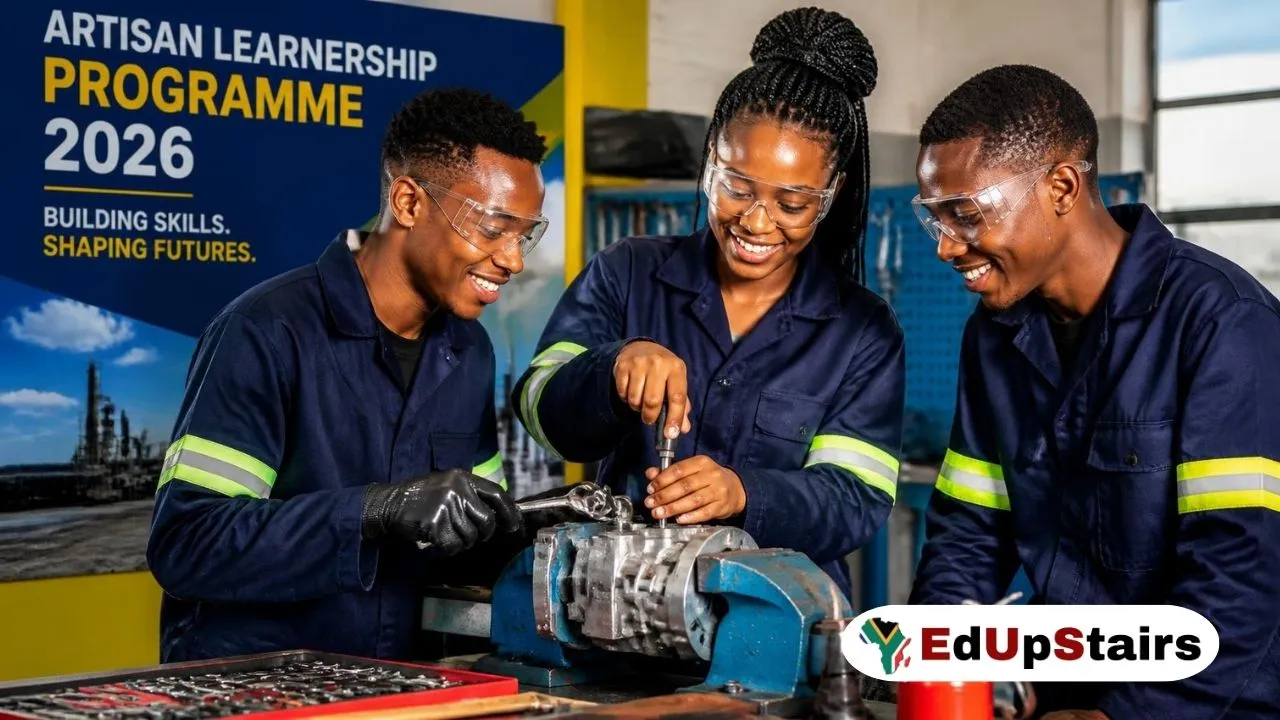
According to the official programme advertisement, participants will receive practical training in welding, metal fabrication, tool and equipment handling, occupational health and safety, workplace readiness and entrepreneurship.
The programme is particularly relevant to unemployed youth, women, emerging artisans, people interested in welding and metalwork, and community members interested in employment or entrepreneurship opportunities.
For people interested in turning this training into a longer-term artisan career, Edupstairs recommends using the Career & Qualification Explorer to research careers such as Welder, Boilermaker, Metal Fabricator and other engineering trades. The Explorer currently contains more than 22,000 SAQA qualification records and 1,500 OFO careers.
Quick Overview: Amajuba Community Practical Welding Training Programme 2026
| Detail | Information |
| Programme | Community Practical Welding Training Programme |
| Municipality | Amajuba District Municipality |
| Province | KwaZulu-Natal |
| Number of Beneficiaries | 100 community members |
| Training Period | 7 months |
| Mentoring, Monitoring & Evaluation | 5 months |
| Focus | Welding, metal fabrication, workplace readiness and entrepreneurship |
| Target Groups | Unemployed youth, women, emerging artisans and interested community members |
| Application Method | Physical submission |
| Submission Point | Amajuba District Municipality Reception |
| Application Marking | “WELDING PROJECT” |
| Closing Date | 23 September 2026 |
| Enquiries | Amajuba District landlines: (034 329 7200) |
What Is the Amajuba Community Practical Welding Training Programme?
The Community Practical Welding Training Programme is designed to equip community members with technical, workplace and entrepreneurial skills.
This is important because welding skills can provide pathways into both employment and self-employment. Welding and fabrication skills are used across engineering, manufacturing, construction, mining, maintenance and other industrial environments.
The programme advertisement states that 100 community members will benefit.
It is being offered through a partnership involving:
Amajuba District Municipality → Abiot Projects Consultants → Industrial Development Corporation (IDC) → MTO Matlala Steel Works
The initiative therefore goes beyond simply introducing participants to welding. Its stated focus includes technical training, workplace preparation and entrepreneurship.
Applicants interested in the broader South African skills-development landscape can also use the Edupstairs SETA Platform to explore artisan development, apprenticeships, learnerships and occupational qualifications across all 21 SETAs.
What Will Participants Learn?
According to the official Amajuba District Municipality advertisement, participants will receive practical training in:
- Basic Welding Skills
- Metal Fabrication
- Tool & Equipment Handling
- Occupational Health & Safety
- Workplace Readiness
- Practical Workshop Training
- Basic Entrepreneurship & Business Opportunities
This combination is significant.
Learning how to weld is only one part of becoming employable in an engineering environment. Participants also need to understand how to use tools correctly, work safely, operate in a workshop and conduct themselves appropriately in a workplace.
The entrepreneurship component could also be useful for participants who eventually want to investigate opportunities such as small-scale fabrication, repair services, gates, steel structures or other legitimate metalwork businesses.
Welding Can Become a Career Pathway
Applicants should distinguish between community practical training and becoming a fully qualified artisan.
The advertisement describes this opportunity as a practical welding training programme. It should therefore not automatically be interpreted as a registered welding apprenticeship, learnership, occupational qualification or trade qualification unless the programme organisers explicitly confirm this.
However, it could give participants useful exposure to a field they may later decide to pursue professionally.
Start by researching the occupation through the Edupstairs Career & Qualification Explorer.
“Welder” is one of the popular trade searches available in the Explorer, alongside careers such as Electrician and Plumber.
A possible longer-term pathway could look like this:
Community Welding Training → Further Technical Education → Apprenticeship/Occupational Training → Workplace Experience → Trade Requirements → Artisan Career
The exact pathway will depend on the occupation, qualification and applicable trade requirements.
Explore Welding and Engineering Programmes Through the SETA Platform
Welding and metal fabrication sit particularly close to South Africa’s metal and engineering skills ecosystem.
The Edupstairs SETA Platform – Engineering Programmes currently includes several relevant merSETA qualification records, including Engineering Fabrication and Welding Application and Practice pathways.
The broader SETA Platform allows users to investigate:
learnerships, apprenticeships, artisan development, skills programmes, occupational qualifications, WIL programmes, internships and bursaries.
Edupstairs’ research on South Africa’s 21 SETAs identifies merSETA as covering metal and engineering, automotive manufacturing, motor retail, tyre manufacturing, plastics and related sectors.
Applicants should not interpret this as confirmation that merSETA is funding this specific Amajuba programme. Rather, it is a useful resource for researching future welding, engineering and artisan-development pathways.
Who Can Apply?
The official advertisement says the programme is open to:
- unemployed youth;
- women;
- emerging artisans;
- community members interested in welding and metalwork; and
- individuals interested in employment and entrepreneurship opportunities.
The advertisement does not specify a particular age range, Matric requirement or minimum NQF level.
Applicants should therefore avoid adding requirements that do not appear in the official notice.
If further eligibility criteria appear on the application form, those requirements should also be followed.
Application Requirements
Applicants must submit the following:
Updated CV
Make sure your CV contains your current contact details and accurately reflects any relevant education, technical experience, workshop exposure or employment history.
Certified copy of ID
Ensure the copy is clear and properly certified where required.
Certified copies of qualifications
Submit copies of qualifications you genuinely hold.
Proof of relevant knowledge or experience
The advertisement requests proof of any relevant knowledge or experience in: steelwork, welding or metalwork.
Applicants should provide legitimate supporting information where they have relevant experience.
Do not claim welding, fabrication or workshop experience that you cannot substantiate.
Official Requirements vs Edupstairs Guidance
The official requirements are those contained in Amajuba District Municipality’s advertisement: applicants must submit an updated CV, certified ID, certified copies of qualifications and proof of relevant knowledge or experience in steelwork, welding or metalwork.
The programme is advertised for unemployed youth, women, emerging artisans, community members interested in welding and metalwork, and people interested in employment and entrepreneurship opportunities.
Edupstairs guidance: If you already have technical experience, make it easy to identify on your CV. Relevant information could include welding exposure, metal fabrication, workshop training, engineering studies, practical projects, tool handling, occupational health and safety training or previous steelwork experience.
These are preparation suggestions and should not be confused with additional official requirements.
How Long Is the Programme?
The programme advertisement separates the initiative into two components: 7 months – Training
followed by: 5 months – Mentoring, Monitoring & Evaluation
This means participants should understand that the initiative is not presented simply as a short workshop.
The follow-up mentoring and monitoring component could be particularly valuable because developing a practical skill is only one stage of becoming work-ready or establishing a viable small enterprise.
Interested in Studying Engineering at a TVET College?
Community members who are serious about building careers in welding, fabrication and engineering should also investigate formal technical study pathways.
Edupstairs’ TVET Colleges Explorer can be used to explore South Africa’s 50 public TVET Colleges, programmes, campuses, admission information, applications, NSFAS resources and other information.
For applicants from the Amajuba area, the Majuba TVET College 2027 Explorer is particularly useful.
The Majuba TVET College page includes programme and campus information and provides access to engineering and other vocational study routes.
Do not enrol in a programme simply because it contains the word “engineering”. First decide which occupation you want to pursue, investigate its qualification pathway and then identify an appropriate programme.
A useful approach is:
Career & Qualification Explorer → TVET College Explorer → SETA Platform → Apprenticeship/Workplace Opportunity
Community Training vs Apprenticeship: Know the Difference
This distinction is important.
The Amajuba opportunity is advertised as a Community Practical Welding Training Programme.
An apprenticeship is normally a more formal occupational pathway combining structured training and workplace experience towards artisan development and, where applicable, trade-testing requirements.
For example, the recently published Bidvest Tank Terminals Mechanical Fitter Apprenticeship Programme 2026 runs for 36 months and combines theoretical and practical experiential training towards the Mechanical Fitter trade and a trade test.
Applicants should therefore never assume that completing the Amajuba welding programme automatically makes someone a qualified artisan.
Instead, use the experience as a potential stepping stone and investigate what further education, apprenticeship or occupational requirements apply to your chosen career.
Entrepreneurship Opportunities After Welding Training
One of the most interesting elements of the programme is its inclusion of Basic Entrepreneurship & Business Opportunities.
Not every participant needs to view welding exclusively as a pathway to formal employment.
Practical welding and fabrication skills can potentially support entrepreneurship, provided the person develops sufficient competence and complies with applicable business and safety requirements.
The Edupstairs SETA Platform’s Incubation and Entrepreneurship programmes also provides examples of enterprise-development pathways. One listed programme specifically focuses on entrepreneurship support for artisans in areas including welding, electrical work, fitting and boilermaking.
This makes entrepreneurship worth investigating as part of a longer-term career plan rather than viewing the training only as preparation for finding an employer.
How to Apply for the Amajuba Community Practical Welding Training Programme 2026
Unlike many current opportunities that require online applications, this programme requires applicants to submit the completed application form together with the relevant attachments at the Amajuba District Municipality Reception.
Your application must be clearly marked: “WELDING PROJECT”
Before submitting, make sure you have included all applicable documents requested in the advertisement.
Closing Date
Applications close on: 23 September 2026
Applicants should avoid waiting until the final day, particularly because applications are submitted physically.
For enquiries, the advertisement provides the Amajuba District Municipality landline: 034 329 7200
The official municipality website shown on the advertisement is Amajuba District Municipality.
Latest Learnerships and Youth Training Opportunities on Edupstairs
Edupstairs is publishing several new workplace and skills-development opportunities this week. As of 11 September 2026, the Learnerships section shows the following among its newest programmes.
MAZIV Learnership Programme 2026
The MAZIV Learnership Programme 2026: 12-Month Opportunities for Unemployed Gauteng Matric Youth is one of the newest learnerships published on Edupstairs.
Metropolitan Human Capital Learnership Programme 2026
Unemployed Matric youth can also investigate the Metropolitan Human Capital Learnership Programme 2026. The 12-month programme is based in Hatfield and combines workplace experience with structured learning towards a Wealth Management NQF Level 4 qualification.
Ekurhuleni West TVET College & CHIETA Data Lab Project 2026
Young people interested in technology can read about the Ekurhuleni West TVET College & CHIETA Data Lab Project 2026, a six-month Data Science and AI skills opportunity.
Buffalo City Sekunjalo Culinary Programme 2026
The Buffalo City Sekunjalo Culinary Programme 2026 is a 12-month programme aimed at unemployed youth, aspiring chefs, farmers and food entrepreneurs.
Ntabankulu Local Municipality Learnership Programme 2026
Applicants can also investigate the Ntabankulu Local Municipality Learnership Programme 2026: X49 Opportunities for Unemployed Youth.
Because application windows change quickly, applicants should check each article and the official recruiting organisation before assuming that an opportunity is still accepting applications.
You can also bookmark the Edupstairs Learnerships page for newly published programmes.
Other Artisan Opportunities Worth Checking
If welding, fabrication or engineering is your preferred career direction, do not restrict your search to this programme.
The recently published Bidvest Tank Terminals Mechanical Fitter Apprenticeship Programme 2026 provides another example of a structured artisan-development route. Edupstairs’ coverage also explains how technical applicants can use the Career & Qualification Explorer, SETA Platform and TVET Colleges Explorer to build a longer-term artisan pathway.
The important distinction is that community skills training, learnerships, apprenticeships, TVET qualifications and employment are not interchangeable. Each serves a different purpose in the skills-development pathway.
Why This Opportunity Matters for Amajuba Communities
The strongest feature of this programme is its practical focus.
Participants are not only being introduced to basic welding. The programme covers fabrication, equipment handling, occupational safety, workplace readiness and entrepreneurship.
For an unemployed person who has had limited access to technical training, this could provide useful exposure to an industrial skill and help them determine whether they want to pursue welding or another artisan career further.
The 100 available beneficiary places also make this a significant community skills-development initiative.
However, participants should think beyond the immediate programme.
Ask: What career do I want this training to lead to?
If the answer is Welder, Boilermaker, Fabricator or another engineering trade, use the Career & Qualification Explorer to research that occupation, investigate formal study through the TVET Colleges Explorer and explore artisan pathways through the SETA Platform.
That turns one training opportunity into part of a longer career plan.
Tools you may find useful:
- SETA Platform
- RDP / BNG Housing Eligibility Checker
- SASSA Grant Eligibility Checker
- SAPS / Metro / Traffic / DCS Eligibility Checker
- Youth Employment Eligibility Checker
- SA Bursary & NSFAS Eligibility Checker
- UIF Benefits Eligibility Checker and Payment Estimator
View Other Employment Opportunities here
Need Help?
Edupstairs Advice
If you live within the Amajuba District and are genuinely interested in welding, fabrication or an artisan career, this programme deserves serious consideration.
The combination of seven months of practical training plus five months of mentoring, monitoring and evaluation is particularly interesting because participants are being exposed not only to welding but also to workplace readiness and entrepreneurship.
If selected, use the programme to build evidence of your technical development. Keep copies of certificates or records you legitimately receive, update your CV, document the practical competencies you develop and begin investigating your next step before the programme ends.
Your pathway could eventually move from:
Welding Training → TVET/Occupational Education → Apprenticeship → Trade Development → Artisan Employment or Entrepreneurship
Use Edupstairs’ Career & Qualification Explorer, SETA Platform and TVET Colleges Explorer to research those next steps rather than waiting until the programme is finished.
Frequently Asked Questions
- How many people will benefit from the Amajuba welding programme?
The official advertisement states that 100 community members will benefit. - Who can apply?
The programme is open to unemployed youth, women, emerging artisans, community members interested in welding and metalwork, and individuals interested in employment and entrepreneurship opportunities. - Do I need Matric?
The supplied advertisement does not state Matric as a specific minimum requirement. Applicants should check the application form for any additional conditions. - How long is the programme?
The advertisement states seven months of training followed by five months of mentoring, monitoring and evaluation. - What will participants learn?
Training covers basic welding, metal fabrication, tool and equipment handling, occupational health and safety, workplace readiness, practical workshop training and basic entrepreneurship/business opportunities. - What documents must I submit?
Applicants must submit an updated CV, certified copy of ID, certified copies of qualifications and proof of any relevant knowledge or experience in steelwork, welding or metalwork. - Where do I apply?
Completed applications and supporting documents must be submitted at Amajuba District Municipality Reception. - What must I write on the application?
Applications should be clearly marked “WELDING PROJECT”. - When do applications close?
The closing date stated on the advertisement is 23 September 2026. - Will completing this programme make me a qualified Welder?
Applicants should not assume so. The notice describes it as a Community Practical Welding Training Programme and does not state that successful completion automatically confers qualified-artisan status. - Where can I research welding qualifications and careers?
Use the Edupstairs Career & Qualification Explorer to investigate South African careers and SAQA qualification records. - Where can I find apprenticeships and other artisan programmes?
Use the Edupstairs SETA Platform to explore apprenticeship, artisan-development, learnership and occupational pathways across South Africa’s 21 SETAs.
You can also:
- View latest Internships
- View latest Learnerships
- View Latest Bursaries
- View latest Government jobs
- View latest Company Vacancies
- View latest Municipality vacancies
- Visit the Edupstairs blog for daily updates
Application Outcome Tracker (anonymous)
No names collected. This helps future applicants understand real-world timelines.
Have you applied for this opportunity?
Disclaimer
This article is provided for educational, career-guidance and opportunity-information purposes. The programme information, requirements, number of beneficiaries, duration, application method and closing date are based on the Amajuba District Municipality advertisement supplied for this article.
Applicants should verify the latest information with Amajuba District Municipality before submitting an application. Edupstairs does not guarantee admission to the programme, certification, funding, employment, artisan status or business opportunities after completion.
Editorial Integrity
Edupstairs distinguishes between information contained in the official programme advertisement and supplementary career guidance.
The programme requirements and application instructions reported above come from the supplied Amajuba District Municipality notice. Edupstairs resources concerning careers, qualifications, SETAs, TVET Colleges, apprenticeships and entrepreneurship have been added to help applicants understand how practical welding training could fit into a broader skills and career-development pathway.
EDUPSTAIRS IS A REGISTERED NON-PROFIT ORGANISATION NPO No: 232 – 182, PUBLIC BENEFIT ORGANISATION (PBO): 930066984. EDUPSTAIRS DOES NOT, IN ANY WAY OR FORM, SOLICIT MONEY OR CV’S FROM PEOPLE FOR JOBS. PLEASE BE AWARE OF PHONY JOB POSTINGS AND RECRUITMENT FRAUD. USE THE EDUPSTAIRS SCAM DETECTOR TOOL TO SPOT A SCAM BEFORE YOU APPLY